Showing posts with label NOAA. Show all posts

Saturday, May 23, 2026

NOAA Predicts Subpar Hurricane Season

 At WUWT, GOOD: NEWS: NOAA predicts a below-normal 2026 Atlantic hurricane season

Forecasters with NOAA’s National Weather Service are predicting a below-normal hurricane season for the Atlantic basin this year. NOAA’s outlook for the 2026 Atlantic hurricane season, which runs June 1 to November 30, predicts a 35% chance of a near-normal season, a 10% chance of an above-normal season, and a 55% chance of a below-normal season.

The agency is forecasting a total of 8-14 named storms (winds of 39 mph or higher). Of those, 3-6 are forecast to become hurricanes (winds of 74 mph or higher), including 1-3 major hurricanes (category 3, 4 or 5 with winds of 111 mph or higher). NOAA has a 70% confidence in these ranges. An average season has 14 named storms with seven hurricanes, including three major hurricanes.
The Atlantic season is expected to be below-normal due to competing factors. El Niño is expected to develop and intensify during the hurricane season, while ocean temperatures in the Atlantic are expected to be slightly warmer than normal and trade winds are likely weaker than average. El Niño conditions tend to support less tropical storms and hurricanes, while warmer ocean temperatures and low winds support a more active year.
But, Scorecard: How Well Does NOAA’s Hurricane Outlook Actually Perform? 26 Years of Forecasts vs. Reality. Even with the rather generous ranges they allow themselves to call correct predictions, they're only about 68% accurate.

Remember, it only takes one hurricane to ruin your whole day.

Sunday, May 17, 2026

How Good are Hurricane Season Forecasts?

 WUWT has the Scorecard: How Well Does NOAA’s Hurricane Outlook Actually Perform? 26 Years of Forecasts vs. Reality

Let's check the data:


NOAA’s May outlooks land within their stated range for named storms roughly 17 of 25 years; about 68%, just shy of their own 70% confidence target. The hurricane count accuracy is similar. That said, NOAA aims for a range (not a point forecast), so some “hits” are easier than others in wide-range years.

So, a little better than a coin toss...


Saturday, May 25, 2024

NOAA Predicts Hurricanes

 More than usual. WUWT,  NOAA predicts above-normal 2024 Atlantic hurricane season

NOAA National Weather Service forecasters at the Climate Prediction Center predict above-normal hurricane activity in the Atlantic basin this year. NOAA’s outlook for the 2024 Atlantic hurricane season, which spans from June 1 to November 30, predicts an 85% chance of an above-normal season, a 10% chance of a near-normal season and a 5% chance of a below-normal season.

NOAA is forecasting a range of 17 to 25 total named storms (winds of 39 mph or higher). Of those, 8 to 13 are forecast to become hurricanes (winds of 74 mph or higher), including 4 to 7 major hurricanes (category 3, 4 or 5; with winds of 111 mph or higher). Forecasters have a 70% confidence in these ranges.

The upcoming Atlantic hurricane season is expected to have above-normal activity due to a confluence of factors, including near-record warm ocean temperatures in the Atlantic Ocean, development of La Nina conditions in the Pacific, reduced Atlantic trade winds and less wind shear, all of which tend to favor tropical storm formation.

Not exactly good news. That means more chances for strikes in the US, and for us locally.  Just in case you're curious as to what they will be named:


Friday, December 29, 2023

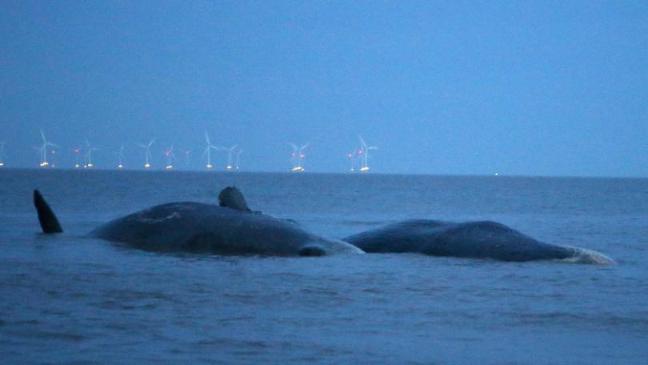
Feds Fear Whale Deaths from Wind Power Projects

At Da Signal, Associated Press Got It Wrong: Wind Farm Contractors Acknowledge Turbines Harm Dolphins, Whales

When wind turbine companies seek permission to harm sea life, reporters for The Associated Press blame The Heritage Foundation (where I work) and The Heartland Institute, instead of reporting the facts.

It was a Chico Marx moment: “Who ya gonna believe, me or your own eyes?

The misleading AP article—carried by WBTS-TV in Boston; The Daily Star newspaper of Oneonta, New York; and WTFX-TV in Philadelphia, among others—stated that “scientists say there is no credible evidence linking offshore wind farms to whale deaths” and that “offshore wind opponents are using unsupported claims about harm to whales to try to stop projects, with some of the loudest opposition centered in New Jersey.”

The article accuses opponents of causing “angst in coastal communities, where developers need to build shoreside infrastructure to operate a wind farm.”

If so, why are offshore wind farm companies asking Uncle Sam for permission to harm ocean mammals, and why are dead whales washing up on East Coast beaches?

According to AP reporters Christina Larson, Jennifer McDermott, Patrick Whittle, and Wayne Parry, “One vocal opponent of offshore wind is The Heritage Foundation, a conservative think tank based in Washington, D.C. Diana Furchtgott-Roth, director of the foundation’s center for energy, climate and environment, wrote in November that Danish company Ørsted’s scrapped New Jersey wind project was “unsightly” and “a threat to wildlife.” (The Daily Signal is the news outlet of The Heritage Foundation.)

If the four reporters had done their homework, they would have mentioned that in required environmental-impact filings with the National Oceanic and Atmospheric Administration, companies explain that sounds generated by their activities will harm ocean mammals.

For example, Atlantic Shores and Ørsted’s Ocean Winds both requested permission to harm ocean mammals in their applications for New Jersey offshore-wind projects. And, since boats ramped up offshore surveys in May 2022, 31 dead whales have washed up on New Jersey and surrounding beaches.

Ørsted, which in November pulled out of a proposed New Jersey offshore wind farm, requested permission to harm 30 whales, 3,231 dolphins, 82 porpoises, and eight seals through sound waves generated by its surveys—although the company claims that the damage would be negligible.

The precise numbers and detailed species can be found on the website of the NOAA, in Ørsted’s Application for Incidental Harassment Authorization (Table 9).

Atlantic Shores, owned by Dutch Shell oil and French EDF, is still seeking permission to locate an offshore wind farm in New Jersey. In its Request for Incidental Harassment (Table 6-3) it stated that acoustic waves associated with the siting of the wind turbines would likely affect 10 whales, 662 dolphins, 206 porpoises, and 546 seals (also termed a negligible amount). It received permission to harm these marine animals.

Although the companies describe effects as “negligible,” the NOAA website states that it’s difficult to measure the effects of manmade sounds on mammals.

“Acoustic trauma, which could result from close exposure to loud human-produced sounds, is very challenging to assess, particularly with any amount of decomposition,” or damage to the whale’s body, states NOAA on its website.

Sean Hayes, chief of protected species for the NOAA, wrote in a letter to Brian Hooker, lead biologist at the Bureau of Ocean Energy Management: “The development of offshore wind poses risks to these species [right whales], which is magnified in southern New England waters due to species abundance and distribution … . However, unlike vessel traffic and noise, which can be mitigated to some extent, oceanographic impacts from installed and operating turbines cannot be mitigated for the 30-year life span of the project, unless they are decommissioned.”

In addition, the AP article made no mention that some of the companies that would install these wind farms are owned by Denmark, the Netherlands, and France—despite the fact that renewable energy tax credits in the so-called Inflation Reduction Act are aimed at stimulating domestic firms to produce renewable energy. And there was no mention that New Jersey offshore wind farms would have practically no effect on mitigating global temperatures, either now or by 2100.

I'm still not convinced that offshore wind power projects will harm marine mammals, but theories that they will are pretty well founded in what we know about their biology. It's going to be a very difficult thing to prove one way or another. 

Monday, May 1, 2023

Feds Admit Offshore Wind Projects Hurt Whales

But you have to read between the lines. WUWT, Feds admit offshore wind can kill whales!

Despite public proclamations of innocence, it turns out BOEM and NOAA clearly acknowledge the deadly threat of offshore wind development to marine mammals. Not surprisingly they do it in documents that are subject to judicial review, lest they be caught fibbing.

Of course these admissions are well hidden, buried in the depths of thousand page documents, but they are there to be found. These are the Draft Environmental Impact Statements (DEIS) that precede each offshore wind project. They are jointly prepared by BOEM and NOAA.

The key is that the overall project EIS includes the EIS for NOAA’s harassment authorizations for the construction of that project. In fact you can find this language by searching the DEIS for the word “harassment”. I am told that this is standard language which varies little from project to project.

The standard language says just what we have been saying! Harassment is likely to lead to dangerous behavior, including increased likelihood of deadly ship strikes and entanglements. It also says, as we have, that having multiple projects increases these risks.


Here is a good example of admitting that harassment is can cause harm. I could not have said it better.

“It is possible that pile driving could displace animals into areas with lower habitat quality or higher risk of vessel collision or fisheries interaction. Multiple construction activities within the same calendar year could potentially affect migration, foraging, calving, and individual fitness. The magnitude of impacts would depend upon the locations, duration, and timing of concurrent construction. Such impacts could be long term, of high intensity, and of high exposure level. Generally, the more frequently an individual’s normal behaviors are disrupted or the longer the duration of the disruption, the greater the potential for biologically significant consequences to individual fitness. The potential for biologically significant effects is expected to increase with the number of pile-driving events to which an individual is exposed.”

Empire Wind DEIS v.1, Page 3.15-14, PDF page 372

Click to access Empire_Wind_DEIS_Vol1.pdf

This warning is about risks created by pile driving but all forms of acoustic harassment fit this description. NOAA harassment authorizations are based on the estimated number of critters that will be exposed to unsafe sound levels. The source of the dangerous sounds is irrelevant. What matters most is the volume. Sound is a pressure wave; the louder the sound the greater the physical pressure on the hearing system. Pain and physical damage are possible.

In fact the infamous sonar surveying sounds, implicated in the whale deaths to date, can be much louder that the incredibly loud pile driving. Driving the enormous piles for the proposed wind projects is estimated to create sounds around 190 decibels, which is painfully loud in humans.

But some sonar equipment deliberately emits sounds over 200 decibels. Decibels is a log scale so this is not just 5% greater than 190; it is much greater.

Thus it makes no sense that NOAA claims sonar surveys have no significant impact and so do not fall under NEPA, while pile driving does. This is especially true when, as just happened, a dozen different projects are given simultaneous authorization to acoustically harass large numbers of whales.

What is important is that NOAA and a BOEM are clearly stating that the acoustic threats we have been warning about and suspecting are real. The telling correlations between sonar blasting and increased whale deaths cannot be waived away.

Correlation is not causation, but correlation between cause and predicted effect is very strong evidence that the cause is effective. NOAA and BOEM’s repeated insistence that there is no evidence offshore wind development is killing whales is clearly contradicted by their own Environmental Impact Statements.

This doesn't prove that the recent spate of whale deaths and strandings on the East Coast is caused by the increased sonar testing for wind project siting, but it at least offers a plausible mechanism. As I noted previously, if the sonar testing were being done for oil or natural gas production purposes, the same people who are nay-saying the possible effects of the sonar testing on whales now would be demanding a halt on the testing based on the precautionary principle, if nothing more concrete.

Sunday, May 23, 2021

It Happens Every Year

WUWT, NOAA predicts another active Atlantic hurricane season
May 20, 2021 NOAA’s Climate Prediction Center is predicting another above-normal Atlantic hurricane season. Forecasters predict a 60% chance of an above-normal season, a 30% chance of a near-normal season, and a 10% chance of a below-normal season. However, experts do not anticipate the historic level of storm activity seen in 2020.

For 2021, a likely range of 13 to 20 named storms (winds of 39 mph or higher), of which 6 to 10 could become hurricanes (winds of 74 mph or higher), including 3 to 5 major hurricanes (category 3, 4 or 5; with winds of 111 mph or higher) is expected. NOAA provides these ranges with a 70% confidence. The Atlantic hurricane season extends from June 1 through November 30.

“Now is the time for communities along the coastline as well as inland to get prepared for the dangers that hurricanes can bring,” said Secretary of Commerce Gina Raimondo. “The experts at NOAA are poised to deliver life-saving early warnings and forecasts to communities, which will also help minimize the economic impacts of storms.”

I wouldn't call that the strongest warning possible. The nice thing is, regardless of what happens, they'll always be right. Have a big storm year? "Yeah, we told you so!". Have a weak year? "Well, we told you we had a 20% chance of a dud!"  And if it doesn't look like it's working out, they'll revise it at mid season


At least it doesn't look like they chose this moment to blame global warming for more and more intense hurricanes. Because that myth is thoroughly busted: CO2 Cyclone Doomsday Flat Out Refuted: 170 Years “Absolutely No Trend” In Hurricane Intensity/Frequency


Nevertheless, every time hurricanes and tropical storms are mentioned in the media, they always assert, without providing any evidence, that hurricanes and tropical storms are increasing in frequency and severity due to global warming.

It just ain't so.


Tuesday, March 16, 2021

We Noticed

WUWT: Broken Water Pipe Takes Out U.S. Buoy Data

I have gotten a number of emails from folks asking about the lack of U.S. buoy data during the past several days.

They are right…something has happened. A broken pipe and flooding has closed down a key NOAA data facility in Silver Spring, Maryland, and there is no estimate of when this data source will become available. And, in fact, other important data sources are also being affected, such as the coastal marine sites (CMAN) and even some airport locations.

The NOAA National Data Buoy Center page notes the situation:
Buoy data over the oceans is a very important weather data source, in support of both numerical weather prediction and marine activities. There are, in fact, two main types of ocean buoys: fixed or moored buoys, which possess a relatively wide range of weather/ocean observations, and drifting buoys that move around the ocean freely

We notice several days ago that the Extra-Tropical Storm Surge site that we monitor to see how likely the tide will  be has been having trouble, and would not come up. This explains it.

A broken water pipe? You can't do better than that?

Sunday, August 16, 2020

So You Wanna See a Pearl Necklace?

A special type of aurora, draped east-west across the night sky like a glowing pearl necklace, is helping scientists better understand the science of auroras and their powerful drivers out in space.

Known as auroral beads, these lights often show up just before large auroral displays, which are caused by electrical storms in space called substorms. Until now, scientists weren’t sure if auroral beads are somehow connected to other auroral displays as a phenomenon in space that precedes substorms, or if they are caused by disturbances closer to Earth’s atmosphere.

But powerful new computer models, combined with observations from NASA’s Time History of Events and Macroscale Interactions during Substorms – THEMIS – mission, have provided the first direct evidence of the events in space that lead to the appearance of these beads and demonstrated the important role they play in our local space environment.

Read more: https://www.nasa.gov/feature/aurora-m…


Sometime around the previous solar minimum there were several days when we could see auroras here in MD. Quite cool.  Never saw anything quite like that though.

The Wombat has Rule 5 Sunday: Kim Klacik up on time and under budget at The Other McCain.

Thursday, May 23, 2019

NOAA Goes Way Out on a Limb . . .

From NOAA press release:

NOAA’s Climate Prediction Center is predicting that a near-normal Atlantic hurricane season is most likely this year. This outlook forecasts a 40% chance of a near-normal season, a 30% chance of an above-normal season and a 30% chance of a below-normal season. The hurricane season officially extends from June 1 to November 30.
That's going to be tough to falsify. 
For 2019, NOAA predicts a likely range of 9 to 15 named storms (winds of 39 mph or higher), of which 4 to 8 could become hurricanes (winds of 74 mph or higher), including 2 to 4 major hurricanes (category 3, 4 or 5; with winds of 111 mph or higher). NOAA provides these ranges with a 70% confidence. An average hurricane season produces 12 named storms, of which 6 become hurricanes, including 3 major hurricanes.
It's safer to predict a little high; it's not like many people are disappointed that they didn't get the hurricanes they were hoping for.


And what will their names be?


Andrea done been and gone.

Monday, October 30, 2017

The Bay Journal Wants It's Money Back

As a news organization, it’s always uncomfortable to be in the news, as opposed to just reporting it. But political appointees in the U.S. Environmental Protection Agency have put us in the headlines.

As you have read in related articles, the EPA told us without warning in late August that it plans to revoke a six-year award to partially fund the Bay Journal, beginning in 2018.

Providing a political appointee with the power to revoke grants is uncommon and, as near as we can determine, unprecedented. Typically, if a grant is revoked, it is because of poor performance. The EPA specifically told us that was not the reason, but rather because of a “shift in priorities,” without saying what that shift was.

The decision’s potential impact goes well beyond the Bay Journal, as there is no point in the EPA, or any agency, asking people to go through the cumbersome process of applying for multi-year funding awards if a political appointee can reverse them on a whim. We will be appealing this decision.

As this process begins, it has been gratifying to see the outpouring of support for our work. We’ve seen an important uptick in donations, protest letters to lawmakers and EPA officials and other helpful offers of assistance — things I’ll be talking more about in the future.

The grant cancellation has also raised questions about the future of the 27-year-old Bay Journal. First, let me say that we believe the EPA’s action has no merit. But the case may well take months to play out, creating a prolonged period of financial uncertainty for us. Though EPA funding provides only 40 percent of the Bay Journal’s funding, it is the largest single chunk of our budget. If the cut is upheld, filling that gap will be a challenge.
As for a grant being revoked for "shifting priorities" being illegal, I was once in a NOAA grant that had it's money cut (but not eliminated) because they wanted to spend more money on satellites. We were pissed, but we didn't think it was illegal.

As much as I quote the Bay Journal, it's always bugged me the EPA and NOAA (who both fund) the Bay Journal, have funded what is basically a nominally private propaganda arm which can be relied on to take their side in public controversies. 

Friday, October 20, 2017

This Might Be Overstating It Just a Little

A Hard Shore Is a Dead Shore
The land beneath Chesapeake Bay, the largest estuary in the United States, is sinking. Couple that with climate change, and the sea level is rising twice as fast as the global average, chewing away at shorelines and drowning islands. Private landowners, who occupy about 85 percent of the shoreline, have responded with walls, rocks, and barriers, which have helped slow the losses. But evidence is growing that this coastal hardening may be insufficient at holding back future seas, and is doing serious damage to more than a dozen fish and crustacean species. Now, planners and landowners are hoping engineered living shorelines can solve both problems at once.

A hardened shore makes life more difficult for trout, perch, crab, and other species that need a natural shoreline to thrive, says Matthew Kornis, who recently published a paper evaluating the effect of shoreline hardening on these species.

Kornis, a fish biologist with the US Fish and Wildlife Service, studied hundreds of sites in and around Chesapeake Bay, from natural beaches and marshlands, to shores lined with riprap (cages of loose rock) and bulkheads (walls, often wooden). The harder the shoreline, he found, the harder hit the species. This was true even for riprap, which is often considered more environmentally friendly than sheer walls.

Kornis says natural shorelines offer things hardened shorelines don’t: juvenile fish live in the nooks and crannies of rocky shorelines, for instance, and these environments serve as nurseries. Fish also feed within beds of seaweed and seagrass. Hardening decimates these complex habitats, leaving nothing to eat and nowhere to hide.

Hardening isn’t unique to Chesapeake Bay. Estimates suggest that about 14 percent of the United States’ coast had been hardened, and the shorelines of Europe and China are also heavily armored. While the motivations for reinforcement vary (development, industry, sea level rise), most Chesapeake Bay residents are trying to protect their property from rampant erosion. Sea level rise is a relatively new problem for many coasts, but land subsidence means it’s been the norm in the Chesapeake for a long time.

“Erosion has been happening for centuries,” says Zoe Johnson, climate change coordinator with the US National Oceanic and Atmospheric Administration in Chesapeake Bay. Tide gauge data shows the water rose nearly a third of a meter in the past century. Similarly, the sea moved inland by roughly half a meter a year on average. But these rates are accelerating as climate change adds a rising sea to sinking land. “The influence of global factors will outpace the land subsidence,” she says.

In the early 2000s, Maryland convened a climate change task force, including Johnson, to study how to better adapt to these future seas. They identified one promising method that seemed to stand up to the sea: living shorelines.

Designs vary widely, but most living shorelines start with a barrier, such as a rock wall, oyster reef, or log, placed several meters out in the water. The barrier is then backfilled with plants and soil to make a marshy buffer zone. In 2008, Maryland passed the Living Shorelines Protection Act, which Johnson says requires owners to prove that a living shoreline will not work in their location before they can get a permit to construct a wall.

Along with erosion control, living shorelines have other benefits. Researchers in North Carolina showed that living shorelines can act as nurseries for fish and crustaceans, the way natural shorelines do.

Bhaskar Subramanian, the shoreline conservation section chief for the Maryland Department of Natural Resources, says his job now is to teach people about living shorelines, which he speaks of with infectious zeal. He sets up information sessions for planners and residents, talks to marine contractors and engineers about how to build living shorelines, and consults with homeowners about what would work on their properties.
I was present at the conception of the project that lead to this study. It was clear at the outset that NOAA and the rest of the management  agencies involved were aching for studies to justify their taking further control over the shoreline. One state regulator (not named in the article) got up and gave an impassioned speech about how we needed to disabuse land owners of their property rights.

But I'm sure much of what he says is true. The biota in Chesapeake Bay are adapted to soft shorelines, and many don't thrive around hard ones. And yet, some of my best fishing spots are along rip rap walls, which seem to attract a variety of animals, and predator fish that prey on them. I wonder how, if they are dead.

Wednesday, July 19, 2017

Apocalypse Postponed

Climate Scientist Moves Global Meltdown from 2018 to 2168
In 1988, climate change “scientist” James Hansen predicted that within 20 to 30 years New York City’s West Side Highway would “be under water.”

“And there will be tape across the windows across the street because of high winds,” Hansen said at the time, as recalled by reporter Bob Reiss during an interview 16 years ago with Salon. “And the same birds won’t be there. The trees in the median strip will change. There will be more police cars … (because) you know what happens to crime when the heat goes up.”

Uh huh …

That was about 30 years ago, yet not surprisingly, New York City remains OK for the most part, save for its radical leftist mayor, Bill de Blasio.

So now that Hansen’s predictions about New York City being flooded have clearly not come true, what has he done? Surprise, surprise — the fake “scientist” has upgraded his prediction by claiming in a paper published last year that if the United States continues to use fossil fuels, sea levels would increase by “several meters over a timescale of 50 to 150 years.”

And just last week he addressed the prospect of further temperature increases during an interview with New York magazine. Keep in mind that Hansen predicted in a greenhouse model that there would be “an increase of from two to five degrees Fahrenheit” in global temperatures by 2018, as quoted from December 1998 edition of Spin magazine.

“I don’t think we’re going to get four or five degrees this century, because we get a cooling effect from the melting ice,” he said last week. “But the biggest effect will be that melting ice. In my opinion that’s the big thing – sea-level rise – because we have such a large fraction of people on coastlines, more than half of the large cities in the world are on coastlines.”
And yet, still no sign of the promised acceleration of sea level rise over the last century.


It's become such a problem that global warming merchants have begun the practice of adjusting the past satellite data, lowering old rates of sea level rise, so that more recent rates will be elevated by comparison. Unfortunately, the individual tidal charts, like that of Baltimore above, are no subject to those "tweaks." At least not yet.

Thursday, May 25, 2017

Barely Above Average Hurricane Season Predicted

NOAA: Above-normal Atlantic hurricane season is most likely this year
Forecasters at NOAA’s Climate Prediction Center say the Atlantic could see another above-normal hurricane season this year.

For the upcoming Atlantic hurricane season, which runs from June 1 through November 30, forecasters predict a 45 percent chance of an above-normal season, a 35 percent chance of a near-normal season, and only a 20 percent chance of a below-normal season.
. . .
Forecasters predict a 70 percent likelihood of 11 to 17 named storms (winds of 39 mph or higher), of which 5 to 9 could become hurricanes (winds of 74 mph or higher), including 2 to 4 major hurricanes (Category 3, 4 or 5; winds of 111 mph or higher). An average season produces 12 named storms of which six become hurricanes, including three major hurricanes.

These numbers include Tropical Storm Arlene, a rare pre-season storm that formed over the eastern Atlantic in April.
Now that's an almost useless prediction. No matter what happens, they have it covered. It may be right, but it doesn't provide much guidance. Time to start getting ready.

Thursday, April 6, 2017

NOAA Admits No Link Between Hurricanes and Warming

But they're still holding out hope: Global Warming and Hurricanes – NOAA says no measurable effect yet
Two frequently asked questions on global warming and hurricanes are the following:

  • Have humans already caused a detectable increase in Atlantic hurricane activity or global tropical cyclone activity?
  • What changes in hurricane activity are expected for the late 21st century, given the pronounced global warming scenarios from current IPCC models?

In this review, we address these questions in the context of published research findings. We will first present the main conclusions and then follow with some background discussion of the research that leads to these conclusions. The main conclusions are:

  • It is premature to conclude that human activities–and particularly greenhouse gas emissions that cause global warming–have already had a detectable impact on Atlantic hurricane or global tropical cyclone activity. That said, human activities may have already caused changes that are not yet detectable due to the small magnitude of the changes or observational limitations, or are not yet confidently modeled (e.g., aerosol effects on regional climate).
  • Anthropogenic warming by the end of the 21st century will likely cause tropical cyclones globally to be more intense on average (by 2 to 11% according to model projections for an IPCC A1B scenario). This change would imply an even larger percentage increase in the destructive potential per storm, assuming no reduction in storm size.
  • There are better than even odds that anthropogenic warming over the next century will lead to an increase in the occurrence of very intense tropical cyclone in some basins–an increase that would be substantially larger in percentage terms than the 2-11% increase in the average storm intensity. This increase in intense storm occurrence is projected despite a likely decrease (or little change) in the global numbers of all tropical cyclones.
  • Anthropogenic warming by the end of the 21st century will likely cause tropical cyclones to have substantially higher rainfall rates than present-day ones, with a model-projected increase of about 10-15% for rainfall rates averaged within about 100 km of the storm center.

So let's look at these models:

Figure 1: Two different statistical models of Atlantic hurricane activity vs sea surface temperature (SST). The upper panel statistically models hurricane activity based on “local” tropical Atlantic SST, while the bottom panel statistically models hurricane activity based on tropical Atlantic SST relative to SST averaged over the remainder of the tropics.Both comparisons with historical data and future projections using this approach are shown. See Vecchi et al. 2008 for details

The first thing to note is that the model are very noisy, the collection of models have an extremely wide spread and even at the beginning, don't match the actual data (in black) very well. I presume the rise in the power dissipation in the top figure is based on model temperature rises, the very same models that have rather consistently over the predicted rate of rises in temperature by a factor of 3 or so. Second, if you base the models on relative sea surface temperature, a reasonable assumption, as it is the difference in temperatures that mostly drives the weather, a much more conservative result is scene, one in which the change over upcoming century is well within the model disagreements, and there is very little effect of warming on tropical storms. So, even if it does warm, hurricane activity is not likely to increase much, if at all.

Wednesday, November 25, 2015

Climate Scientists Unwilling to Reveal Their Motives

A report from the WAPO on the standoff between NOAA and the Congress over emails which might shed light on their motives: Standoff over government climate study provokes national uproar by scientists
A top House lawmaker’s confrontation with government researchers over a groundbreaking climate change study is provoking a national backlash from scientists, who say his campaign represents the most serious threat Congress has posed to scientific freedom.

Rep. Lamar Smith (R-Tex.), chairman of the House Committee on Science, Space and Technology, has subpoenaed scientists at the National Oceanic and Atmospheric Administration and demanded that they turn over internal e-mails related to their research. Their findings contradicted earlier work showing that global warming had paused, and Smith, a climate change skeptic, has accused them of altering global temperature data and rushing to publish their research in the June issue of the journal Science.
 The study in question, get this, "corrected" global temperature readings for the fact that old sea surface temperature readings were taken with a bucket and a thermometer, which would usually change slightly after collecting the bucket and while the thermometer settled. The adjustment, a few hundredths of a degree centigrade, applied over the right interval, we enough to "bust the pause" in temperature rise in the last 20 years and produce an upward slope, just in time for the upcoming Paris Climate conference. Never mind that the more comprehensive and reliable satellite temperature measurements show no increase in temperature over the same period.


[NOAA chief tells lawmaker: No one will ‘coerce the scientists who work for me’]
No one should have to coerce the scientists for their emails. NOAA has them in giant searchable servers already. Your geeks could produce the relevant emails in a few days; though it might take longer to sort the useful from the useless.
So far, NOAA officials have resisted Smith’s demands, and the showdown has escalated.
The lawmaker has threatened to subpoena Commerce Secretary Penny Pritzker, while scientists have rallied in solidarity with the researchers.

On Tuesday, seven scientific organizations representing hundreds of thousands of scientists sent an unsparing letter to Smith, warning that his efforts are “establishing a practice of inquests” that will have a chilling effect. . .
As a scientist I was twice involved in studies for the Smithsonian where we were specifically told to preserve all of our emails relating to a project because they might become targets of a lawsuit. It's absolutely not unheard of for scientists emails and other papers to be sought for evidence of motive. Just ask Willie Soon.

The fact that the scientists and NOAA are so determined to keep their internal deliberations hidden suggests they have something to hide.

Wednesday, May 6, 2015

NOAA Caught Fudging the Temperature Data . . .

. . .again. This time they're cooling Maine's past which makes the present seem warmer:
We have written a number of times about how government agencies, including the National Oceanic and Atmospheric Administration here in the U.S., have systematically adjusted temperature history to make the past look colder. They apparently do this, usually surreptitiously and without explanation, in order to stoke global warming hysteria. See, for example, He Who Controls the Present Controls the Past and Inside the Global Warming Scandal.

Now Mike Brakey, an engineering physicist and heat transfer specialist, has caught NOAA revising historic temperature data for Maine–as always, to make the past look cooler and the present warmer by comparison:

Over the last months I have discovered that between 2013 and 2015 some government bureaucrats have rewritten Maine climate history… (and New England’s and of the U.S.). This statement is not based on my opinion, but on facts drawn from NOAA 2013 climate data vs. NOAA 2015 climate data after they re-wrote it.

We need only compare the data. . . .


Yep, that's pretty suspicious looking, turning a basically flat record into a 2+ F temperature rise since 1900. Now there could be legitimate reasons for adjusting data that way. For example, older data may be daily maximums and minimums, while newer data is continuous, with a daily average. I don't know if that's what's being "corrected" here, but if it is, they damn well owe it to users of the data (that's us, the public), to make it clear just how they adjusted it, why they adjusted it, and the level of certainty of involved in the correction. To make these correction in the dead of night, without comment smacks of a conspiracy to make it look like the record is being rejiggered to show greater warming.