With Ele Bertoli, who seems to lack much affinity for palm trees, but seems to enjoy twilight:
One day you wash up on the beach, wet and naked. Another day you wash back out. In between, the scenery changes constantly.
Sunday, August 24, 2025
Sunday Sunrise
Monday, September 23, 2024
When Mother Earth Wore a Ring
Earth may have had a giant ring of space rocks surrounding it, similar to those around Saturn, which could have led to chaotic meteorite strikes on our planet's surface, new research suggests.
The hypothesized ring may have formed roughly 466 million years ago and was the remains of a gigantic asteroid tugged apart by Earth's tidal forces after passing our planet's Roche limit.
Casting a shadow across Earth's equator, the ring may have contributed to a global cooling event by blocking sunlight, while bombarding the surface with meteorites. The researchers published their findings Sept. 16 in the journal Earth and Planetary Science Letters.
"Over millions of years, material from this ring gradually fell to Earth, creating the spike in meteorite impacts observed in the geological record," study lead author Andy Tomkins, a professor of planetary science at Monash University in Australia, said in a statement. "We also see that layers in sedimentary rocks from this period contain extraordinary amounts of meteorite debris."
The scientists arrived at the startling hypothesis by studying a period in Earth's history known as the Ordovician (485 million to 443 million years ago). The Ordovician was a tumultuous time for our planet — it was one of the coldest periods in the last 500 million years and saw a dramatic uptick in the rate of meteorites striking Earth.
To investigate what could have caused these effects, the scientists mapped the positions of 21 Ordovician asteroid impact craters, which revealed that all the impacts occurred within 30 degrees of Earth's equator.
As 70% of Earth's continental crust was located outside this region, the researchers calculated that the probability of this happening by chance was the same as tossing a three-sided die 21 times and getting the same outcome 21 times.
With these highly unlikely odds in mind, the researchers settled on a hypothesis that could explain both the equatorial strikes and planet's cooling — a ring, the remnants of a smashed-up asteroid, encircling Earth at the equator.
More evidence is needed to support the hypothesis, but the ancient ring theory could explain many aspects of Earth's history, especially if rings appeared more than once above our planet before being slowly erased as their asteroids were sucked down by its gravity, the researchers said.
"The idea that a ring system could have influenced global temperatures adds a new layer of complexity to our understanding of how extra-terrestrial events may have shaped Earth's climate," Tomkins said.
Cool! In more ways than one.
Wednesday, April 3, 2024
The Science was Settled
![]() |
| Hubble Ultra Deep Field Space Telescope Photo Image |
Dr. Rajendra Gupta, a theoretical physicist from the University of Ottowa made a remarkable announcement recently. He claimed that new data suggests that the universe is nearly twice as old as the 14 billion-year figure we've been given for a very long time. And if that's true, he further claims that there is no need for anything like dark matter to exist because the universe is behaving precisely as it should. That would really change the landscape of current astrophysics. (Science Alert)
Sound waves fossilized in the maps of galaxies across the Universe could be interpreted as signs of a Big Bang that took place 13 billion years earlier than current models suggest.Gupta went on to state that if the universe is 26.7 billion years old as his team believes, "the Universe does not require dark matter to exist." I'm obviously nowhere near smart enough to grasp everything these eggheads are talking about, but the layman's explanation for this part of it boils down to missing data. Previous studies all suggested that the universe is expanding faster than it should be based on the amount of physical matter we are able to observe in space. That's why physicists had to dream up dark matter (and its corresponding partner, dark energy) to explain what was being observed. But the vastly larger universe now being posited would allow for the apparent motion of all of the heavenly bodies.
Last year, theoretical physicist Rajendra Gupta from the University of Ottawa in Canada published a rather extraordinary proposal that the Universe's currently accepted age is a trick of the light, one that masks its truly ancient state while also ridding us of the need to explain hidden forces.
Gupta's latest analysis suggests oscillations from the earliest moments in time preserved in large-scale cosmic structures support his claims.
Well, I can live with that. I had heard, though, that one of the more compelling arguments for dark matter was the rotation of galaxies; most galaxies rotated as though they were surrounded by a halo of matter which could not be observed, but a few galaxies had been observed that seemed to be striped of this excess mass by a galactic collision. I don't see how this observation explains that.
This one's not quite so stale. From Dave Strom at Hat Hair, The Beepocalypse Has Been Canceled. Remember, a few years ago all the concern that Honeybees were dying out from some "colony collapse disorder" of unknown origin? You might be shocked to find that now honeybees are so abundant as to be a "problem."
The beepocalypse was always a manufactured panic, although a rather profitable one for a small slice of the population who "consulted" on how to save the bees. Environmentalists loved the story because it provided another angle to attack industrial agriculture. And, of course, for the media, which regularly push false narratives to keep us excited.
The Washington Post presents a fascinating observation: never before in American history have there been more bee colonies. This intriguing trend, like many others, is a product of economic forces.
Back in the aughts, you couldn't get away from the beepocalypse story, and in certain circles it continues to be pushed. Environmentalists testify at legislatures with scare stories about the lack of pollinators and the coming collapse of agriculture. And tax breaks for planting flowers at solar farms popped up. Bees dying provided jobs and fodder for lobbying.
None of it was true. There was, indeed, an epidemic of colony collapse syndrome during the Bush administration, but it turns out that colony collapse syndrome goes back as far as records of bee colonies do. It apparently is cyclical, and nobody knows why.
Even at the height of the "colony collapse disorder" hysteria, it was pretty clear that honey bees weren't in any danger, the bee keepers had matters well in hand. Also, it was pretty clear that bees were being used as a weapon in the fight against neonicotinoid pesticides.
Search Google and you will see an unending list of attacks on these pesticides, mostly linked to how they kill off bees. Ironically, of course, we know that this is overblown because honeybees are constantly pollinating agricultural products using these insecticides, and there are a record number of hives and bees.And the reason for the apparent surplus of Honeybees may surprise you, but should not shock you. Tax policy in Texas!
Your plot of five to 20 acres now qualifies for agriculture tax breaks if you keep bees on it for five years.
Over the next few years, all 254 Texas counties adopted bee rules requiring, for example, six hives on five acres plus another hive for every 2.5 acres beyond that to qualify for the tax break.
As usual, follow the money.
Saturday, December 5, 2020
Is Climate Written in the Stars?
or in this case, the planets? WUWT, New Climate Theory – Jupiter Herding Micrometeors Towards Earth?
New theory suggests Earth’s 60‐Year climate cycle may be driven by planetary oscillations directing micrometeors toward Earth, creating more dust – which change cloud cover.
A paper published in Geophysical Research Letters claims there is increasing evidence that Earth’s 60-year climate cycle may be driven by planetary oscillations. They claim a 60-year climate cycle is found in the Atlantic Multi-decadal Oscillation, aurora sightings, rainfall, and ocean climatic records.
The paper says:“…the orbital eccentricity of Jupiter presents prominent oscillations with a period of quasi 60 years due to its gravitational coupling with Saturn.” The authors propose that the planetary system modulates the interplanetary dust falling on Earth and modifying the cloud coverage.The paper and abstract:
The orbital eccentricity of Jupiter presents a strong 60‐year oscillation that is well correlated with several climatic records and with the 60‐year oscillation found in long meteorite fall records since the 7th century.
Since meteorite falls are the most macroscopic aspect of infalling space dust, we conclude that the interplanetary dust should modulate the formation of the clouds and, thus, drive climate changes.”
A 60‐Year Cycle in the Meteorite Fall Frequency Suggests a Possible Interplanetary Dust Forcing of the Earth’s Climate Driven by Planetary Oscillations
Nicola Scafetta Franco Milani Antonio Bianchini First published: 14 September 2020 https://doi.org/10.1029/2020GL089954 . . .
Anthony Watts adds a postscript:
A caveat: In the past, I have dismissed much of Scafetta’s work as being little more than “cyclomania”, i.e. finding spurious cyclic correlations in data where there really isn’t any.
That said, there is a bit of plausibility in this idea that the gravitation of Jupiter might herd more micrometeors into Earths orbital path, and it is plausible that with more meteor dust in Earth’s atmosphere, that could form more cloud nuclei. Changes in cloud cover would modulate sunlight over time, and thus climatic records.
Or, it may be just another spurious correlation. Either way, I thought it was worth discussing. – Anthony
Could be? But skepticism is a good thing.
Monday, September 14, 2020
Life on Venus?
The news via Jazz Shaw at Hot Air, Did We Just Find Life On Venus? but let's let the scientists explain in their own words:
In this leaked video, astrobiologist Janusz Petkowski from MIT explains how they seem fairly convinced we’re on to something and they don’t have an explanation (yet) aside from life.
At some point, the planet may have been habitable, but it spiraled into an out-of-control greenhouse effect that changed it utterly. (We don’t know why that happened, but for now, I’ll just assume that the Venusian fracking program was insufficiently regulated by their global government.) Could some microbes have found a way to survive in the more pleasant conditions found in the upper atmosphere for all of this time? Perhaps.
But there is one other possible explanation to consider. Remember those Soviet probes I mentioned above? Couldn’t it be possible that some Earth microbes hitched a ride on one or more of them, peeled off as the probe entered the atmosphere, and basically seeded the clouds with a starter kit for life? In order to find out, I’m guessing that we’d have to have a probe capable of collecting and returning some samples and examine them. If they have the same DNA as the microbial beasties found on the Earth, we might have our answer. But if they are something almost entirely different, then the case could be made for a true Venusian Genesis, and wouldn’t that spur some interesting conversations? Of course, if you happen to believe in the panspermia hypothesis (as I do) then the galaxy is probably lousy with life and it all shares some common ancestor, modified through evolution to fit the environment where it lands.
My guess is that it will turn out to be an abiotic signiture somehow. Remember, we're still trying to puzzle out and explain the results of chemical experiments from the Viking mission on Mars.
Sunday, August 16, 2020
So You Wanna See a Pearl Necklace?
A special type of aurora, draped east-west across the night sky like a glowing pearl necklace, is helping scientists better understand the science of auroras and their powerful drivers out in space.
Known as auroral beads, these lights often show up just before large auroral displays, which are caused by electrical storms in space called substorms. Until now, scientists weren’t sure if auroral beads are somehow connected to other auroral displays as a phenomenon in space that precedes substorms, or if they are caused by disturbances closer to Earth’s atmosphere.
But powerful new computer models, combined with observations from NASA’s Time History of Events and Macroscale Interactions during Substorms – THEMIS – mission, have provided the first direct evidence of the events in space that lead to the appearance of these beads and demonstrated the important role they play in our local space environment.
Read more: https://www.nasa.gov/feature/aurora-m…
Sometime around the previous solar minimum there were several days when we could see auroras here in MD. Quite cool. Never saw anything quite like that though.
The Wombat has Rule 5 Sunday: Kim Klacik up on time and under budget at The Other McCain.
Saturday, July 18, 2020
Comet Watched
Maybe we'll try again one of these days soon,. since it should be around a few more days, and it will climb higher in the night sky as it fades away on its outbound orbit.
![]() |
| Not my jetty |
Monday, July 13, 2020
The Black Hole in the Backyard?
The hunt for the ever-elusive “Planet Nine” has taken scientists down some very strange roads. The idea that a planet exists in the outer reaches of our solar system and can’t be easily seen has been floating around for some time, and observations of other objects in the area suggest that there’s something big generating a gravitational pull. The easiest explanation would be a planet, but it’s not the only possibility.
Now, scientists from Harvard University in partnership with the Black Hole Initiative want to test the theory that the object that appears to be lurking on our system’s edge is actually a black hole. Yep, you read that correctly; there may be a black hole lurking right in our cosmic back yard.
The researchers plan on searching for this so-called “primordial” black hole using data from the Legacy Survey of Space Time, or LSST mission. The researchers say that they can use the data to search for evidence of accretion flares, which are created when objects get too close to a black hole.
“In the vicinity of a black hole, small bodies that approach it will melt as a result of heating from the background accretion of gas from the interstellar medium onto the black hole,” Amir Siraj of Harvard said in a statement.
. . .
A “planet-mass” black hole could exist with a mass of between five and ten times that of our own planet. Being a black hole, the object would be much, much smaller than Earth, and the researchers suggest it could be as tiny as a grapefruit. Even at that size, it would have enough gravitational oomph to produce the kinds of movements in nearby objects that have been observed on the edges of our system.
Friday, March 13, 2020
Steel Rain
Researchers using ESO’s Very Large Telescope (VLT) have observed an extreme planet where they suspect it rains iron. The ultra-hot giant exoplanet has a day side where temperatures climb above 2400 degrees Celsius, high enough to vaporise metals. Strong winds carry iron vapour to the cooler night side where it condenses into iron droplets.Add a little carbon, and it would be raining steel. One would think if the world is tidally locked, within a reasonable geologic time, all the metal that could be vaporized off the bright side would wind up on the dark side, and the rain would stop.
“One could say that this planet gets rainy in the evening, except it rains iron,” says David Ehrenreich, a professor at the University of Geneva in Switzerland. He led a study, published today in the journal Nature, of this exotic exoplanet. Known as WASP-76b, it is located some 640 light-years away in the constellation of Pisces.
This strange phenomenon happens because the ‘iron rain’ planet only ever shows one face, its day side, to its parent star, its cooler night side remaining in perpetual darkness. Like the Moon on its orbit around the Earth, WASP-76b is ‘tidally locked‘: it takes as long to rotate around its axis as it does to go around the star.
On its day side, it receives thousands of times more radiation from its parent star than the Earth does from the Sun. It’s so hot that molecules separate into atoms, and metals like iron evaporate into the atmosphere. The extreme temperature difference between the day and night sides results in vigorous winds that bring the iron vapour from the ultra-hot day side to the cooler night side, where temperatures decrease to around 1500 degrees Celsius.
Not only does WASP-76b have different day-night temperatures, it also has distinct day-night chemistry, according to the new study. Using the new ESPRESSO instrument on ESO’s VLT in the Chilean Atacama Desert, the astronomers identified for the first time chemical variations on an ultra-hot gas giant planet. They detected a strong signature of iron vapour at the evening border that separates the planet’s day side from its night side. “Surprisingly, however, we do not see the iron vapour in the morning,” says Ehrenreich. The reason, he says, is that “it is raining iron on the night side of this extreme exoplanet.”
“The observations show that iron vapour is abundant in the atmosphere of the hot day side of WASP-76b,” adds María Rosa Zapatero Osorio, an astrophysicist at the Centre for Astrobiology in Madrid, Spain, and the chair of the ESPRESSO science team. “A fraction of this iron is injected into the night side owing to the planet’s rotation and atmospheric winds. There, the iron encounters much cooler environments, condenses and rains down.”
This result was obtained from the very first science observations done with ESPRESSO, in September 2018, by the scientific consortium who built the instrument: a team from Portugal, Italy, Switzerland, Spain and ESO.
Wow, to be able to see that from 640 light years away is pretty amazing. When I was a kid, the study of our own planets was just getting really going.
Steel Rain is also the name of a 2017 Korean Film:
Saturday, January 11, 2020
Young Scientist Peaks Early
NASA's planet hunter satellite TESS has discovered an exoplanet orbiting two stars instead of one — and it was identified by a high school intern. The announcement of the circumbinary planet prompted comparisons with Luke Skywalker's home world of Tatooine in the "Star Wars" movie series, with its bewitching double sunsets.Three days into his internship? I'm shocked he wasn't still taking computer safety, sexual harassment and ethics training at that point.
But the newly found planet's size alone — it is 6.9 times larger than Earth, almost the size of Saturn — makes it unlikely to be livable. Named TOI 1338 b, it is the only planet in the TOI 1338 system, which lies 1,300 light-years away in the constellation Pictor, and orbits its stars every 95 days.
The two stars orbit each other every 15 days. One is about 10 percent bigger than our Sun, while the other is cooler, dimmer and only one-third the Sun's mass.
TOI 1338 b was identified by Wolf Cukier, a 17-year-old high school student who had an internship with NASA last summer.
"I was looking through the data for everything the volunteers had flagged as an eclipsing binary, a system where two stars circle around each other and from our view eclipse each other every orbit," Cukier said. "About three days into my internship, I saw a signal from a system called TOI 1338. At first I thought it was a stellar eclipse, but the timing was wrong. It turned out to be a planet."
The system had been flagged as an eclipsing binary, where two stars circle around each other and eclipse each other from our point of view. But after going over the data, Cukier realized that a planet was present too.
Circumbinaries are difficult to detect, and scientists have now confirmed about two dozen, with the first discovered in 1993.
I hope I'm wrong, and he goes onto a brilliant scientific career.
An interesting video on how the planet was discovered. I think it makes the data look cleaner than it actually is.
It must be pretty rare for the two suns and the planets orbit to line up with our solar system, so you can see the eclipses.
Monday, September 30, 2019
Could the Solar System have a Black Hole Planet?
Previous studies have suggested Planet Nine, which some astronomers refer to as “Planet X,” has a mass between five and 15 times that of Earth and lies between 45 billion and 150 billion kilometers from the sun. At such a distance, an object would receive very little light from the sun, making it hard to see with telescopes.The universe is a weird place. Who thought it up, anyway?
To detect objects of that mass, whether planets or black holes, astronomers can look for weird blobs of light formed when light “bends” around the object’s gravitational field on its journey through the galaxy (simulated image above). Those anomalies would come and go as objects move in front of a distant star and continue in their orbit.
But if the object is a planet-mass black hole, the physicists say, it would likely be surrounded by a halo of dark matter that could stretch up to 1 billion kilometers on every side. And interactions between dark matter particles in that halo—especially collisions between dark matter and dark antimatter—could release a flash of gamma rays that would betray the object’s presence, the researchers propose in a forthcoming paper posted on the preprint server arXiv.
The physicists will soon start to comb through publicly available data from the Earth-orbiting Fermi Gamma-ray Space Telescope, which has covered the sky in all directions since 2008. They’ll be looking in particular for groups of sporadic gamma ray flashes that would move slowly across the sky, as Planet Nine would be expected to do as seen from Earth. Although the physicists’ proposal is speculative, their search may yield all sorts of information about dark matter and the sources of gamma ray flashes—whether they lie within our solar system or far across the universe.
Saturday, July 20, 2019
50 Years Ago Today
That day, I was camping with my family in Oregon, and we didn't have TV, or a radio other than in the car, and really didn't think about it so much, although we did hear about it.
If you want to see better video of the actual first steps go to Watts Up With That, where Anthony Watts posted MUST SEE – Restored historic Apollo 11 “small step for man” video – like you’ve never seen it. #MoonLanding50
Althouse posted some nonsense about Norman Mailer.
Why haven't we been back since Apollo
Linked by EBL in Jessica Brown Findlay, Sharmila Nicollet 🏌🏽♀️, Tiger Human Encounter Ends Badly for Tiger 😿🐅, Sergio Mendes & Brasil 66: Fool On The Hill, Enough reminiscing about the Moon, it's time to head to Mars ♂️, Ice Cream Day 🍨🍦, Thieving Tiana Lowe and the Washington Examiner: Steal the Ilhan Omar marriage fraud story from David Steinberg, Alpha News, and Powerline without proper credit...🤔, Astronaut Wives 🌝 🇺🇸 and plays a dirty trick in A Rule 5 for the Ladies: Democrat Jerry Nadler's Big Day.
Monday, June 24, 2019
Is Somebody Farting on Mars?
This week, NASA’s Curiosity Mars rover found a surprising result: the largest amount of methane ever measured during the mission — about 21 parts per billion units by volume (ppbv). One ppbv means that if you take a volume of air on Mars, one billionth of the volume of air is methane.
The finding came from the rover’s Sample Analysis at Mars (SAM) tunable laser spectrometer. It’s exciting because microbial life is an important source of methane on Earth, but methane can also be created through interactions between rocks and water.
Curiosity doesn’t have instruments that can definitively say what the source of the methane is, or even if it’s coming from a local source within Gale Crater or elsewhere on the planet.

“With our current measurements, we have no way of telling if the methane source is biology or geology, or even ancient or modern,” said SAM Principal Investigator Paul Mahaffy of NASA’s Goddard Spaceflight Center in Greenbelt, Maryland.
The Curiosity team has detected methane many times over the course of the mission. Previous papers have documented how background levels of the gas seem to rise and fall seasonally. They’ve also noted sudden spikes of methane, but the science team knows very little about how long these transient plumes last or why they’re different from the seasonal patterns.
The SAM team organized a different experiment for this weekend to gather more information on what might be a transient plume. Whatever they find — even if it’s an absence of methane — will add context to the recent measurement.

Curiosity’s scientists need time to analyze these clues and conduct many more methane observations. They also need time to collaborate with other science teams, including those with the European Space Agency’s Trace Gas Orbiter, which has been in its science orbit for a little over a year without detecting any methane. Combining observations from the surface and from orbit could help scientists locate sources of the gas on the planet and understand how long it lasts in the Martian atmosphere. That might explain why the Trace Gas Orbiter’s and Curiosity’s methane observations have been so different.Personally, I suspect that all planets have deep reserves of methane from when the planetismals and asteroids that they coalesced from, and from more recent comet impacts. But I keep hoping for life on Mars, with a distinctive non-DNA form of genetics.
For more information about Curiosity, visit:
https://www.nasa.gov/mission_pages/msl/index.html
https://mars.nasa.gov/msl/
Wombat has Rule 5 Sunday: Cheryl Ann Tweedy working toward your amusement and education.
Friday, December 21, 2018
Happy Solstice!
It's will be good to see the days start to get longer again.
Winter solstice 2018: Full moon and meteor shower make it special
The Wombat has Rule 5 Sunday: Merry Christmas! ready for your digital pleasure.
Tuesday, August 7, 2018
Dark Star Detected from Aurora
But Is it a star or a planet? We're not really sure. It's a weird universe out there: Bizarre Rogue 'Planet' with Incredible Auroras Puzzles ScientistsA rogue, planet-size object 20 light-years away from Earth has stunned astronomers with its incredibly powerful magnetic field.On earth, auroras are the result of the interaction of the solar wind with earth's magnetic field and upper atmosphere. But in interstellar space? Galactic wind?
The scientists found that the object's magnetic field is more than 200 times stronger than Jupiter's, which, in turn, is between 16 and 54 times stronger than Earth's, according to NASA. How the object, which scientists call SIMP J01365663+0933473, can maintain a magnetic field so strong, as well as generate spectacular auroras, is still unclear.
"This particular object is exciting because studying its magnetic dynamo mechanisms can give us new insights on how the same type of mechanisms can operate in extrasolar planets — planets beyond our solar system," lead study author Melodie Kao, an astrophysicist at Arizona State University, said in a statement from the National Radio Astronomy Observatory published Aug. 2.
The object is what scientists call a brown dwarf. Nicknamed "failed stars," brown dwarfs are larger than planets, but not quite large enough to fuse hydrogen, the way stars do. The boundary line is still debated, but scientists tend to draw it at about 13 times the mass of Jupiter.
Originally, scientists thought SIMP J01365663+0933473 was a gigantic, old brown dwarf. But further study showed that it is instead relatively young, at 200 million years old, and is only 12.7 times the mass of Jupiter. That research also showed that the planet is on its own, not orbiting a star.
"This object is right at the boundary between a planet and a brown dwarf, or 'failed star,' and is giving us some surprises that can potentially help us understand magnetic processes on both stars and planets," Kao said in the statement. "We think these mechanisms can work not only in brown dwarfs, but also in both gas giant and terrestrial planets."
But that's not the only strange thing found recently: Astronomers Have Detected an Intense And Mysteriously Low Frequency Radio Signal Coming From SpaceAccording to a report in The Astronomer's Telegram, on the morning of 25 July 2018, an array of radio telescopes in British Columbia, Canada, detected a very strange FRB.I'm not saying it's aliens, but . . .
The fast radio burst has been named FRB 180725A after the year, month, and day it was detected.
The most interesting part is that the intense signal was transmitted in radio frequencies as low as 580 megahertz - making it the first detection of a FRB under 700 MHz.
The Astronomer's Telegram is a bulletin board of observations posted by accredited researchers - so while these are genuine detections, it's important to note that they haven't been peer reviewed as yet and independent teams haven't verified that the signals are from space.
That sounds like a silly thing to say, but let's not forget that back in 1998, researchers thought they had discovered a new type of radio signal coming from space, only to figure out 17 years later that it was coming from a microwave oven in their research facility. Or even the very recent rediscovery of Mars.
. . .
So what do scientists think these weird signals could be?
The most recent research on the repeating FRB suggests the source is a neutron star, but other hypotheses for FRBs include black holes, pulsars with companion stars, imploding pulsars, a type of star called a blitzar, a connection with gamma-ray bursts (which we now know can be caused by colliding neutron stars), and magnetars emitting giant flares.
It's also increasingly likely that there's more than one explanation for the explosive events.
We should add that it's also not impossible that FRBs could be engines firing on giant alien spaceships, either, according to a Harvard physicist.
Thursday, July 5, 2018
A New Comet Coming
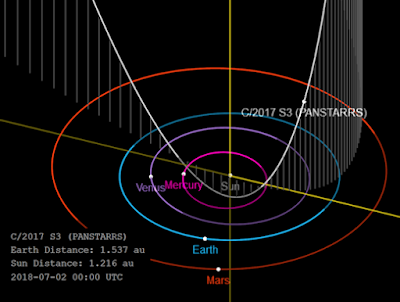
A comet that could become visible to the naked eye in August has just exploded in brightness. Amateur astronomer Michael Jäger of Austria reports that Comet PANSTARRS (C/2017 S3) brightened 16-fold during the late hours of July 2nd, abruptly increasing in magnitude from +12 to +9. He took this picture of the comet’s expanding green atmosphere shortly after the outburst:
“The gas cloud around the comet’s nucleus is about 4 arc minutes wide,” says Jäger. That means the comet’s atmosphere is 260,000 km in diameter, almost twice as wide as the planet Jupiter. These dimensions make it a relatively easy target for backyard telescopes.
Comet PanSTARRS is falling toward the sun from the Oort cloud, a vast reservoir of fresh comets in the distant outer solar system. It has never visited the inner planets before, and, as a result, no one can say what will happen when its fragile ices are exposed to solar heat as it approaches the sun in August. Previous estimates of the comet’s brightness max out at magnitude +4–that is, barely visible to the unaided eye from dark-sky sites. Additional outbursts could boost its visibility even more.
The comet was discovered on Sept. 23, 2017, by the PanSTARRS telescope on the summit of the Haleakalā volcano in Maui. PanSTARRS’s primary mission is to detect near-Earth asteroids that threaten our planet. In the process,it sweeps up variable stars, supernovas, and comets like this one. With almost a year of data in hand, astronomers have been able to nail down the comet’s orbit. Click on the image to launch an interactive 3D visualization from JPL:
This is an extraordinarily cool animation. Go play with it!
Comet PanSTARRS is approaching the sun on a hyperbolic orbit–a narrow open-ended path that will ultimately fling it back to the outer solar system. At perihelion (closest approach to the sun) on August 15-16, the comet will be inside the orbit of Mercury, blasted by solar radiation at point-blank range. What will happen then?I hope this one is clearly visible from earth. I've been disappointed by comets before.
Saturday, June 23, 2018
Reason #5943 That Trump Was Elected
The White House has announced plans to find a way to protect the Earth from dangerous Asteroids.
This Is NASA’s New Plan to Detect and Destroy Asteroids Before They Hit Earth
By Hanneke Weitering, Space.com Staff Writer | June 20, 2018 06:30pm ET
NASA has updated its plans to deflect potentially hazardous Earth-bound asteroids — and none of them involve Bruce Willis.
The White House Office of Science and Technology Policy released a new report today (June 20) titled the “National Near-Earth Object Preparedness Strategy and Action Plan.” The 18-page document outlines the steps that NASA and the Federal Emergency Management Agency (FEMA) will take over the next 10 years to both prevent dangerous asteroids from striking Earth and prepare the country for the potential consequences of such an event.

I read somewhere that a living persons chances of dying from an asteroid strike is greater than their chance of dying in a plane crash. It's not so much that the chance of the earth being hit by a large asteroid is so high, it's just that the potential number of casualties is effectively only limited by the number of people alive, where as the number of people killed in a plane crash has a fairly low upper limit as catastrophes go, a few hundred at most.Officials with NASA, FEMA and the White House discussed the new asteroid-mitigation strategies in a teleconference with the media today. “An asteroid impact is one of the possible scenarios that we must be prepared for,” Leviticus Lewis, chief of FEMA’s National Response Coordination Branch, told reporters during the teleconference, adding that a catastrophic asteroid strike is “a low-probability but high-consequence event” for which “some degree of preparedness is necessary.” [Related: How Trump’s Space Force Would Help Protect Earth from Future Asteroid Threats]Read more: https://www.space.com/40943-nasa-asteroid-defense-plan.html
“This plan is an outline not only to enhance the hunt for hazardous asteroids, but also to better predict their chances of being an impact threat well into the future and the potential effects that it could have on Earth,” NASA’s planetary defense officer, Lindley Johnson, said during the teleconference. Johnson added that the plan will help NASA “step up our efforts to demonstrate possible asteroid deflection and other mitigation techniques, and to better formalize across the U.S. government the processes and protocols for dissemination of the best information available so that timely decisions can be made.” …
Asteroids are low risk high impact events – the probability of serious impact occurring in anyone’s lifetime is low, even less the probability of actually being personally affected by an impact. But a big impact could destroy a city, or an entire region. A really big impact could destroy civilisation, maybe even wipe out all life on Earth.
Here ya go: What Are the Odds a Meteorite Could Kill You?
Putting a probability number on the chances of being hit by a space rock is difficult, since the events are so rare. Still, Tulane University earth sciences professor Stephen A. Nelson published a paper in 2014 that made the effort. He put the lifetime odds of dying from a local meteorite, asteroid, or comet impact at 1 in 1,600,000.So yeah, maybe it's time to get serious about protecting civilization from asteroid strikes. And, who knows, maybe eventually we can pay for the system with minerals extracted from the asteroids.
Compared with 1 in 90 for a car accident, 1 in 250 for a fire, 1 in 60,000 for a tornado, 1 in 135,000 for lightning, 1 in 8 million for a shark attack, or 1 in 195 million for winning the PowerBall lottery.
Nelson put the risk of dying from a large, global asteroid or comet impact at 1 in 75,000. If that seems surprisingly high, it's because when massive objects have hit the Earth in the geologic past, they have wiped out millions of organisms, even whole species. Most of the creatures aren't killed from the direct impact, but from the aftereffects, which include heat, radiation, and dust that clouds out the sun.
Linked at Pirate's Cove in the "Sorta Blogless Sunday Pinup" and links.
Wednesday, June 13, 2018
. . . In the Sky with Diamonds
For decades, astronomers have puzzled over the exact source of a peculiar type of faint microwave light emanating from a number of regions across the Milky Way. Known as anomalous microwave emission (AME), this light comes from energy released by rapidly spinning nanoparticles – bits of matter so small that they defy detection by ordinary microscopes. (The period on an average printed page is approximately 500,000 nanometers across.)
So not much value for jewelry.“Though we know that some type of particle is responsible for this microwave light, its precise source has been a puzzle since it was first detected nearly 20 years ago,” said Jane Greaves, an astronomer at Cardiff University in Wales and lead author on a paper announcing this result in Nature Astronomy.
Until now, the most likely culprit for this microwave emission was thought to be a class of organic molecules known as polycyclic aromatic hydrocarbons (PAHs) – carbon-based molecules found throughout interstellar space and recognized by the distinct, yet faint infrared (IR) light they emit. Nanodiamonds — particularly hydrogenated nanodiamonds, those bristling with hydrogen-bearing molecules on their surfaces — also naturally emit in the infrared portion of the spectrum, but at a different wavelength.
![]() |
| HD 97048 |
That's a big pile of very tiny diamonds.
A series of observations with the National Science Foundation’s Green Bank Telescope (GBT) in West Virginia and the Australia Telescope Compact Array (ATCA) has — for the first time — homed in on three clear sources of AME light, the protoplanetary disks surrounding the young stars known as V892 Tau, HD 97048, and MWC 297. The GBT observed V892 Tau and the ATCA observed the other two systems.
“This is the first clear detection of anomalous microwave emission coming from protoplanetary disks,” said David Frayer a coauthor on the paper and astronomer with the Green Bank Observatory.
The astronomers also note that the infrared light coming from these systems matches the unique signature of nanodiamonds. Other protoplanetary disks throughout the Milky Way, however, have the clear infrared signature of PAHs yet show no signs of the AME light.
This strongly suggests that PAHs are not the mysterious source of anomalous microwave radiation, as astronomers once thought. Rather, hydrogenated nanodiamonds, which form naturally within protoplanetary disks and are found in meteorites on Earth, are the most likely source of AME light in our galaxy.
“In a Sherlock Holmes-like method of eliminating all other causes, we can confidently say the best candidate capable of producing this microwave glow is the presence of nanodiamonds around these newly formed stars,” said Greaves. Based on their observations, the astronomers estimate that up to 1-2 percent of the total carbon in these protoplanetary disks has gone into forming nanodiamonds.
Evidence for nanodiamonds in protoplanetary disks has grown over the past several decades. This is, however, the first clear connection between nanodiamonds and AME in any setting.
Statistical models also strongly support the premise that nanodiamonds are abundant around infant stars and are responsible for the anomalous microwave emission found there. “There is a one in 10,000 chance, or less, that this connection is due to chance,” said Frayer.
. . .
Nanodiamonds likely form out of a superheated vapor of carbon atoms in highly energized star-forming regions. This is not unlike industrial methods of creating nanodiamonds on Earth.
Wombat-socho has "Rule 5 Monday: Shakira Law And The Rock Sharky" ready for your digital pleasure.
Friday, May 18, 2018
Black Hole Sun Disappears in a Flash
A star turned into a black hole before Hubble’s very eyesWhile some supernova events are explosive and leave clouds of debris for thousands of years (aka nebula) like SN 1054, the star in question seems to have begun to explode and then had all its gas sucked right back into the black hole at the center. This can happen when the core collapse of the star is especially massive. Rather than exploding, the gas collapses directly into the core of the star.Wow, what were the chances of seeing that?
Only a few of these so called “massive fails” (yes, that’s what they’re calling them) have been spotted, so astronomers are cautious about the results. But this particular star, located in the galaxy NGC 6946, was bright enough to see from 22 million light years away and faded in an instant, suggesting a massive stellar-mass black hole was the driving culprit.
Better than the original: Haley Reinhart does "Black Hole Sun" with Post Modern Jukebox.
Ravi Shankir's daughter is no slouch either. Wombat-socho has "Rule 5 Sunday: Hockey Girls" up and ready for action.
Tuesday, April 24, 2018
Uranus Stinks
![]() |
| Uranus |
Uranus smells like rotten eggs, and that is not a joke. A new study finds that the seventh planet from the sun has an upper atmosphere flush with hydrogen sulfide.On the other hand, hydrogen sulfide is remarkably toxic, more toxic than hydrogen cyanide and for a similar reason, it binds cytochromes, and blocks cellular respiration. The only reason that isn't terribly well known is that the smell is so powerful and obnoxious it usually drives people away before they get a significant dose. However, the nose gets saturated by the odor, and that sometimes allows people to get poisoned.
Hydrogen sulfide is a gas best known for its repulsive smell; the gas emanates from sewers and volcanoes on Earth, explaining why some hot springs, which are fed by geothermally heated water, smell like breakfast gone bad. Astronomers have now discovered that the gas is common in the cloud tops of Uranus.
That hydrogen sulfide composition is different than what is found in the upper atmospheres of Uranus' fellow giant planets Jupiter and Saturn, where ammonia dominates, said Leigh Fletcher, a study co-author and senior research fellow in planetary science at the University of Leicester in England.
. . .
"If an unfortunate human were to ever descend through Uranus' clouds, they would be met with very unpleasant and odiferous conditions," study co-author Patrick Irwin, a professor of planetary physics at the University of Oxford, said in the statement. That is, they would if that person miraculously lived to take a whiff.
"Suffocation and exposure in the negative 200 degrees Celsius [minus 328 degrees Fahrenheit] atmosphere made of mostly hydrogen, helium and methane would take its toll long before the smell," Irwin added.
Hydrogen sulfide is also the smell of "black mud", the result of the anaerobic decomposition of organic matter in the presence of sulfate, in a process called sulfate reduction, by sulfate reducing bacteria.
Georgia helped study the role sulfate reducing bacteria in the methylation of mercury. It turns out that many, but not all sulfate reducing bacteria can produce methyl mercury, the toxic form that accumulates in fish, and most of the methyl mercury in the environment is produced by them. Consequently, she and the lab she worked for, spent a lot of time visiting, sampling and measuring muddy environments with that nasty rotten egg odor. We jokingly called it the smell of money.