Showing posts with label gardens. Show all posts

Thursday, January 22, 2026

Maryland, My Maryland

From the Baynet, Maryland Tightens Regulations on Invasive Plants As New Rules Take Effect

Maryland officials moved forward this week with expanded restrictions on the sale and possession of invasive plant species under updated regulations that took effect Jan. 15, 2026.

The Maryland Department of Agriculture has revised and expanded its Prohibited Invasive Plant List, adding multiple nonnative species determined to pose a threat to native ecosystems. The changes stem from a statewide overhaul of how invasive plants are evaluated and regulated, replacing older classifications with a science-based assessment process.

Plants placed on the prohibited list may no longer be sold or acquired in Maryland after their effective dates. To reduce economic disruption, the state is allowing phase-out periods for existing inventory — one year for potted plants and two years for in-ground plantings — before full removal is required.

Officials say invasive plants can spread aggressively, displacing native vegetation, altering wildlife habitat and increasing long-term management costs for landowners and local governments. The updated regulations are intended to slow that spread while encouraging the use of native and noninvasive alternatives.

Nurseries, garden centers and landscapers have been preparing for the changes since the regulations were finalized, adjusting inventories and educating customers ahead of the January 2026 effective dates.

We have had a few of these in the garden. Our Wisteria didn't make it, but the Nandinas were indeed, invasive, spreading into the woods, and the Privet hedge was obnoxious enough that we had to put it down, which took some effort, beyond the chain saw. I collected both Blue Flag and Yellow Flag Iris from wild patches, before I knew the Yellow one was non-native. They worked well in the pond, and a few seeds sprouted in the garden, but in the long run didn't make it in garden because it was too dry.


Tuesday, October 8, 2024

Forget It Jake, It's Baltimore

Probably not Baltimore
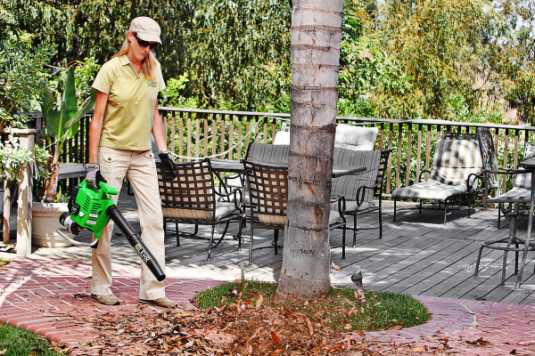
Focusing on the Big Problems, Fox 5 Baltimore, Baltimore City Council votes to ban gas-powered leaf blowers

The Baltimore City Council voted 10-5 to ban gas-powered leaf blowers Monday night.

The ordinance takes effect Dec. 15 for all city entities and contractors.

Landscape companies and residents may use gas-powered leaf blowers between Oct. 15 and Dec. 15 of 2025 and 2026 before the ordinance goes into effect year-round.

In one hour, a commercial gas-powered leaf blower emits as much pollution as driving a car for 1,100 miles and four times as much as commercial lawn mowers, the environmental group the National Audubon Society said in a letter supporting the ordinance.

I don't believe the last set of statistics, unless they picked they dirtiest leaf blower, and the cleanest car they could find. But even if it is, so what? It's not that air pollution from leaf blowers is really a significant problem in Baltimore. 

They just like to ban things.

The Wombat has Rule 5 Sunday: Well Rounded up and garnering clicks at The Other McCain.


Sunday, January 14, 2024

Palm Sunday

 With Montse Roura:

When we think of “tropical,” we envision lazy summer vacations, sultry afternoons for ice creams or chilled drinks, and pleasant palm trees. If you’re misty-eyed with nostalgia and yearning for a tropical touch in your house, why not let the miniature version of these tropical trees be a part of your house? Yes, we are talking about the sago palm tree!

Although they have the name and appearance of a palm, sago palms are actually cycads, a group of tropical and subtropical plants that are one of the most ancient. Native to warm parts of Japan, they are also called Japanese sago palms, with ancestors dating back to prehistoric times.

The history of these evergreen perennials is proof of their incredible survival instincts. If they can survive in nature for centuries, they can definitely thrive in your house or yard!

Depending on where you live. We have a large Sago Palm that I have mentioned a few times. We bought it when Alex was in 1st grade as a small potted plant. It is now huge, and takes up most of a room in winter. They will tolerate mild frosts, but not hard ones. They are tolerant of dryness, sun or shade, and not desirable to most pests. Ours has repeatedly generated side shoots at the base, which can be cut off and rooted easily, and gifted. We gave one to Alex (it's his fault after all), and we have another small one growing now. But they are a plant for the patient, our large one produces a new set of leaves every 2-3 years now (it produced a set per year when it was small). 

Linked at The Pirate's Cove in the weekly Sorta Blogless Sunday Pinup and links. The Wombat has Rule 5 Monday: Happy Lee-Jackson Day! up at The Other McCain.

Tuesday, October 10, 2023

The End of the Pineapple Experiment

Back in July and August, I reported briefly on a experiment we made in growing a pineapple plant from the top of an old pineapple. After 3 years as a potted plant, that we had to take in for winter and out for summer, this year it finally made a fruiting stalk, bloomed and produced a small (very small) pineapple. With the weather getting colder, descending into decidedly un-pineapple friendly temperatures, we decided it was time to harvest it, and end the experiment. 

Behold, the Maryland homegrown pineapple, on the right, sitting next to a store bought specimen.

I sliced it up, and Georgia and I each tried a slice. It's obviously not anywhere near ripe, and it's not too tart, but not really recognizable as a pineapple to the taste.

It was a fun experiment, but we don't see the need to repeat it.


Tuesday, August 15, 2023

Home Grown Pineapple Update

Someone asked for an update. Well, the Pineapple continues to develop. I'd kind of forgotten that Pineapples are a flowering plant, and the pineapple is a fruit, and flowers come before fruit. Since the first post, the homegrown Pineapple has extended out of the plant on a thick stalk. About a week ago, we noticed that the individual "cells" that made up the pineapple were growing purple buds, which then blossomed into red tubular flowers, from the bottom up:


Do they need to be pollinated to grow the subsequent fruit? It will be amusing to see if it keeps growing and how big it manages to grow.

Wednesday, July 19, 2023

Home Grown Pineapple!

Three years or so ago, I took the top of a pineapple that Georgia had cleaned for dinner and discarded into the compost pile, put it in a pot with some potting soil, and made sure it got watered mostly. It took, and started growing.
We had to bring it in for winter, of course, pineapples not appreciating frost, or even weather colder than about 60 F. It got big and ugly and prickly and Georgia has been threatening to throw it away for quite some time, but it is finally bearing a pineapple down in the center! It's been growing fast for the last few days, and it will be interesting to see how large the fruit will actually get, and whether it will ever get anything like ripe.


Tuesday, November 29, 2022

Can Acorns Save the Bay?

I doubt it. But, at the Bay Bulletin, Acorns In Short Supply: Volunteers Collect Acorns For A Cleaner Bay Watershed

Raking up fallen leaves is a staple of autumn yardwork. But for some people in Maryland and Virginia, fall is also acorn collection season. These all-too-often ignored seeds are actually critical to creating a future Chesapeake Bay watershed that has cleaner air, cleaner water, and more green spaces for all.

People who collect acorns are a large part of making this future possible. During the 2022 acorn collection season, which ended in October, public contributions in Virginia were higher than ever.

Joshua McLaughlin, the assistant nursery manager at the Virginia Department of Forestry’s Augusta Nursery, estimated that four to five tons of seeds were collected by the public. McLaughlin explained that the nursery will grow the seeds for a season before selling the seedlings for primarily reforestation, riparian buffers, and watershed planting projects on private and state property.

“We’re thinking about the forests of tomorrow,” he says.

Alexis Dickerson, senior director of community conservation at the Potomac Conservancy, is thinking along similar lines. Dickerson helps run a program called Tomorrow’s Trees, which focuses on “community-powered collective action” and getting people involved in more meaningful conservation work connected to their everyday lives.

Rebranded from a previously fizzled program, Tomorrow’s Trees focused this year on laying the groundwork for future acorn collection and tree planting work. They helped to establish seed drop off sites and built capacity within communities so they can run their own seed collection, since seeds drop off trees at different times each year.

Acorn collection is more important now than ever because of state tree planting targets. Virginia has a goal in their plan to clean up the Chesapeake Bay to plant nine million new trees by 2025. Last year, Maryland passed a law requiring the state plant five million native trees by 2031.

“These initiatives put pressure on state nurseries,” Dickenson explains. “Every seed that you plant isn’t going to germinate. If you want to plant five million trees, you’re going to need tens of millions of seeds.”

“Good quality, native tree seeds are one of our most limiting factors to achieving our 5 million trees goal,” Anne Hairston-Strang, acting director of the Maryland Forest Service, said.

Public acorn collection can make the difference for these state nurseries that are competing with commercial suppliers for the same seed stock. People power can also help out staff like Francis Smith, a natural resources planner with the Maryland Department of Natural Resources, who is the only staff member delivering seeds to the state nursery.

“We are obviously in need of volunteer help,” he said.

Last year, I think our yard alone could have provided most of the 4 or 5 tons of acorns sought. This year, we had hardly any. That's the way it goes with trees that have mast years.

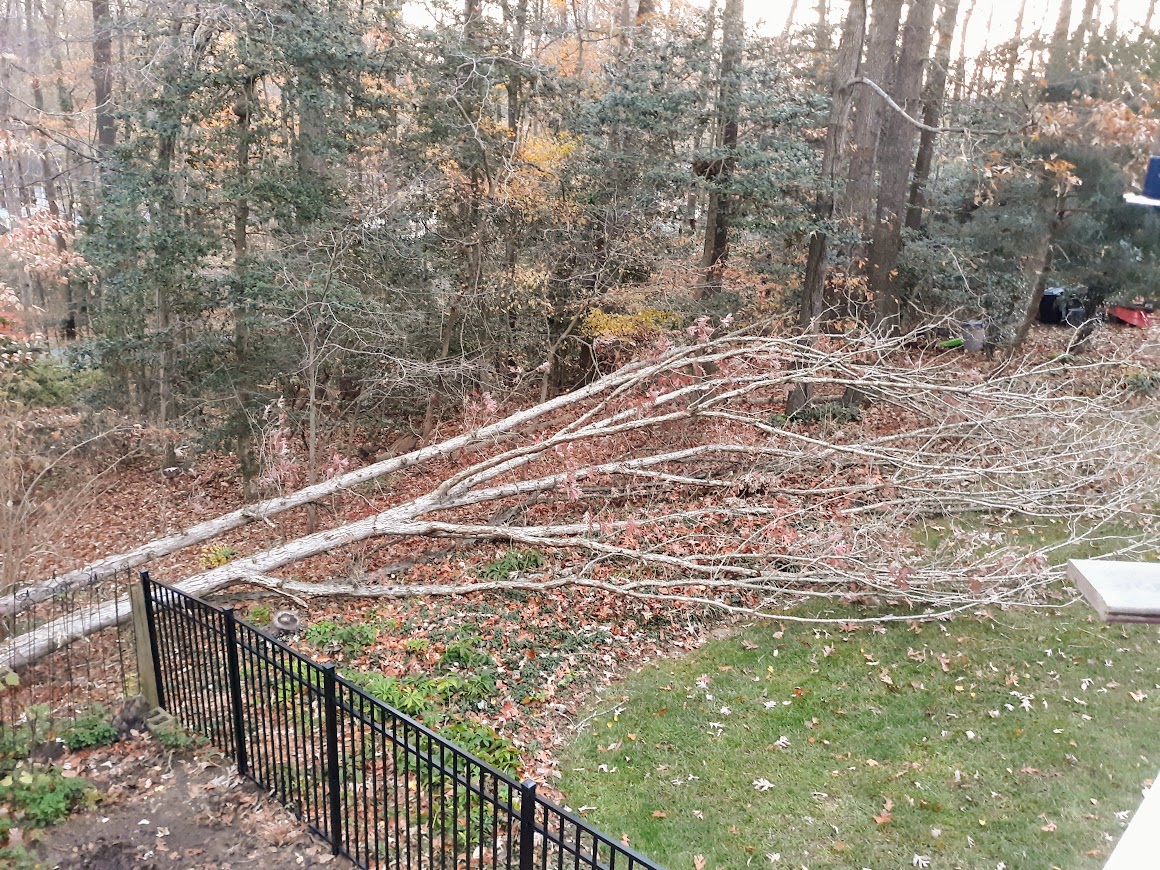
We lost a big oak in the back lot last night. We had noticed it was leaning, but based on the direction of the lean, we thought it wasn't going to hit anything costly. Fortunately we were right.


Tuesday, June 28, 2022

Reuse and Recycle


One of the "benefits" of owning a Siberian Husky is the shedding period, from roughly January through August, when they discard copious amounts of fine soft white underfur, which needs to be combed, brushed or blown out at regular intervals to keep the house from filling with it (and to prevent it from getting matted). I regularly curry Skye and get mounds of hair. Georgia takes a small amount of it, and stuffs it into a suet feeder (As an Amazon Associate, I earn from qualifying purchases) for birds, and hangs it near the feeder. Chickadee, Titmice and other birds stop with some regularity to take it for nesting material. It's funny to watch a Titmouse keep grabbing it until it has a ball much bigger than its head. I even think I caught a glimpse of a female Ruby Throated Hummingbird picking some up the other day. In this photo, a female American Goldfinch is apparently getting ready to line a new nest. 

Thursday, February 18, 2021

Ice Storm Cedar Waxwings

A little while ago, the neighbor called to tell us there was a flock of Cedar Waxwings in the American Holly bushes between our houses. I grabbed the camera and went out and looked around for them to no avail, and then, just as I was about to go back in a small flock of them flew into one of the oak trees 


Not the best possible photos, but I was pleased with the combination of ice and birds.


Wednesday, September 2, 2020

To Bee or Not to Bee

Blue Orchard Mason Bee
OK, this is the first I've heard of them, but I've probably seen them:  A key bee at Chesapeake orchards - The mason bee is a productive pollinator for all types of native fruits
Between September and October, orchards in Virginia, Maryland and Pennsylvania burst with wide varieties of local apples. In Pennsylvania, the Historic South Mountain Fruit Belt in Davison County is the sixth largest producer of apples in the nation. Though these farms have typically used honeybees to pollinate their fruit-trees, a growing number of small to mid-size orchards are employing the native mason bee to help get to the job done.

While honeybees are an important agricultural resource nationwide, research has shown that mason bees are a far better pollinator of local fruit. According to Penn State University Extension, six mason bees can pollinate an entire tree, where as it would take 360 honeybees to do the same job. Part of the reason that mason bees are such good fruit-tree pollinators is that they emerge in early spring before many others. From that point on, their life cycle coincides with the blossoming of various fruit trees, and they are generally only active for a few weeks in March and April when fruit blooms. With honeybee numbers in decline, mason bees have gotten even more recognition as an alternative fruit-tree pollinator for the Chesapeake region.
Japanese Orchard Bee
The blue one is not familiar looking, but the Japanese one is.

The two species of mason bees best suited for apple orchard pollination are the blue orchard bee (Osmia lignaria) and the Japanese orchard bee (Osmia cornifrons), which was brought to the United States in the 1990s to help grow fruit. Though a non-native, the Japanese orchard bee is now well-established in the wild and is not considered to be invasive. Together, these species are earning attention among farmers and gardeners alike, and are some the few bee species to be managed at farms.

Of course, apples aren’t all the mason bee is good for, and there are many more species than the blue orchard and Japanese orchard. There are around 20 species of springtime mason bees in the Mid-Atlantic, and there are 140 species of Osmia (the mason bee genus) in North America. All of them are known for visiting fruit trees, such as apples, plums, pears, almonds, peaches and cherries, as well various flowers.
For many years now, actual Honeybees have been virtually absent from our region. Did a disease get them, or does nobody nearby keep beehives? I don't know. But still, all our flowers seem to be constantly visited by a variety of little bee-like  critters, and lots of seed and fruit get formed (except on our lone apple tree, which is another story). I'm beginning to doubt the seriousness of the honeybeecalypse.

Sunday, July 12, 2020

Friday, June 12, 2020

A Quick Trip Through the Garden

A Great Spangled Fritillary in the Butterfly Weed, a horticultural milkweed, and very attractive to butterflies, and a wide variety of insects
Showing the underside of the wings, with the great spangles. The butterfly weed also comes in yellow.
An American Lady on the Verbena. The butterly is easily separated from the Painted Lady, using the little white spot in the red, and the two large, and not four eye-spots on the rear wings from underside.

The Verbena is a great plant for butterflies too. The flowers last all season. They are perennial, but also come up readily from seeds they shed continually. Gold Finches like the seeds.
 Our old friend the Zabulon Skipper.
 I'm not sure which skipper this is.
One of our easiest skippers to identify, the Silver-Spotted Skipper, although if it were up to me, I'd call it the White-Spotted Skipper.
 A Crossline Skipper?
A Bumble-bee of some sort. They seem to replace honey bees locally. Oh well, the honey bees are non-native. 
 A couple of Georgia's lilies.

Wednesday, September 11, 2019

Butchart Gardens

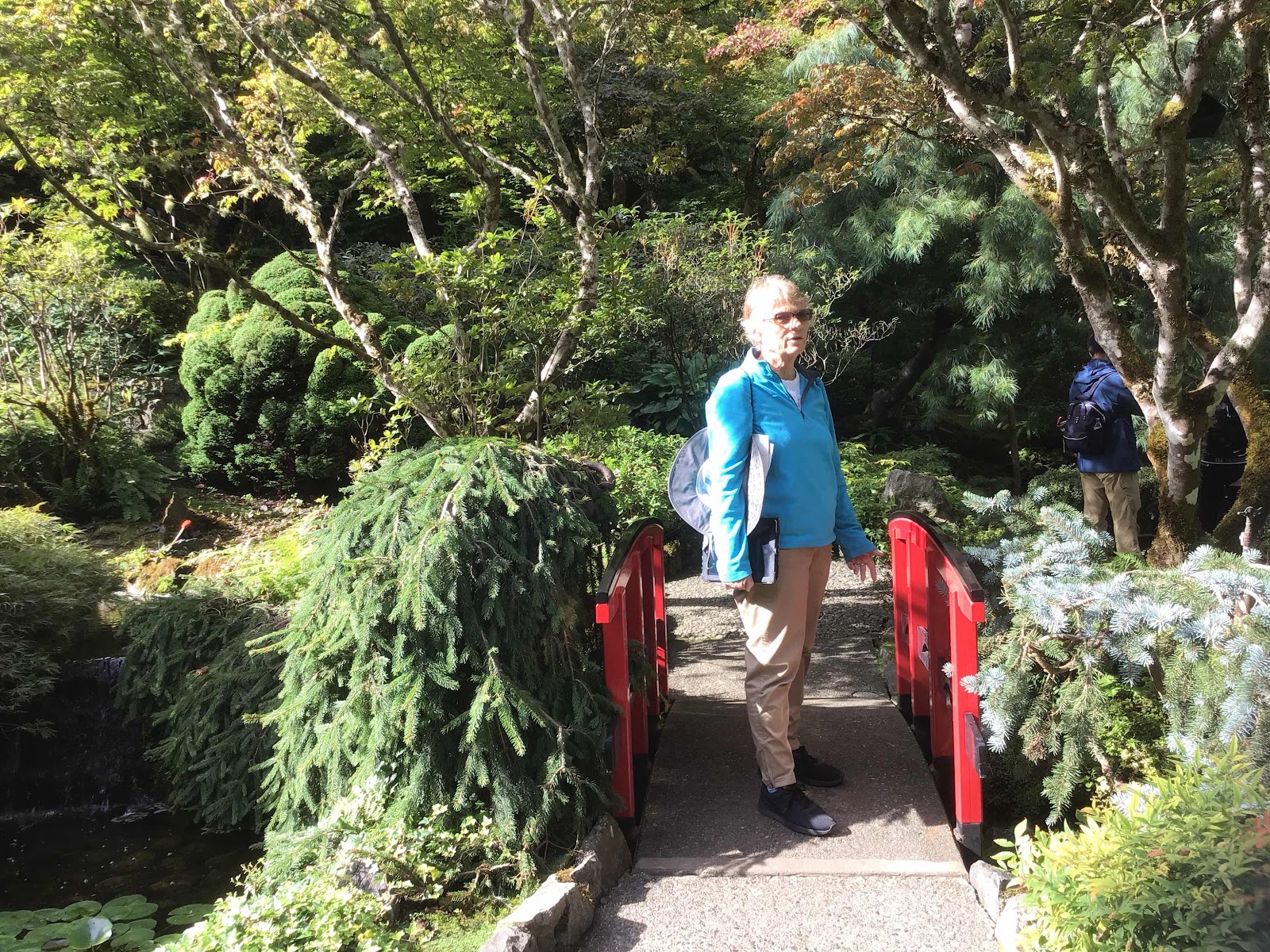
After the Butterfly Garden we headed off to Butchart Gardens, which we visited once before, about 40 years ago. They’re still stunning:


Sunday, July 28, 2019

A Weird One

So I went out into the garden with the camera today to look for butterflies, and there in front of me on the deck was this one:


It is clearly a female Eastern Tiger Swallowtail, but the color pattern is off. As you may (or may not) know, females Eastern Tigers come in two morphs, a yellow morph, like all the males, except for the blue field on the hind wings:


and the black, or dark morph, thought to be mimic of the poisonous and inedible Pipevine Swallowtail:


But this one seems to be splitting the difference. Much lighter than the black morph, it's like a yellow morph covered in soot, and with a wedge of darkness from the top of the wing to the tail:


Sunday, June 2, 2019

A Walk Through the Garden

I could put up a beach post, but it just wasn't that exciting today, so instead:


Sunday, January 20, 2019

An Uncommon Visitor

A few days ago, Georgia got word that a neighbor on the street below us had reported an uncommon bird in the area. Not rare exactly, but uncommon, one that had not been seen in the area for years. Then our next door neighbor told Georgia that it had been coming to her feeder regularly. Georgia even watched it using binoculars. She changed the food in her feeders, and added fresh suet and meal worms hoping to attract it. But after several days, nothing. She started to mutter about the ungrateful bird

But then yesterday it worked! She managed a few shots with the good camera, and this one came into good focus.


A Red-Headed Woodpecker.
The gorgeous Red-headed Woodpecker is so boldly patterned it’s been called a “flying checkerboard,” with an entirely crimson head, a snow-white body, and half white, half inky black wings. These birds don’t act quite like most other woodpeckers: they’re adept at catching insects in the air, and they eat lots of acorns and beech nuts, often hiding away extra food in tree crevices for later. This magnificent species has declined severely in the past half-century because of habitat loss and changes to its food supply.

Friday, July 27, 2018

Morning Butterfly Post

Georgia called me out to the garden this morning to see this caterpillar that was chewing away at her Butterfly Weed. As I expected it might be, it was a Monarch Butterfly caterpillar, and it wasn't alone. There are at least three in the same area.
The Butterfly Weed is a form of Milk Weed, the sole food for Monarch caterpillars. It endows them with a superpower, that is, internal poison and bad taste that carries over into the the adult butterfly, and discourage predators.
You might remember that one year we raised a Black Swallowtail caterpillar from a tiny thing, through the chrysalis and metamorphosis to an adult. We decided not to try that here. But we are glad to see the Butterfly Weed serving as host to the Monarchs. That's one of the reasons for planting it.
Butterflying has been slow this year; I only have 23 species on this years list. It seems the cold spell in winter might have set them back. However, it seems to be picking up; the Butterfly Bush was full of Eastern Tiger Swallowtails this morning. There were a bunch of Silver Spotted Skippers, and one transient Zebra Swallowtail as well (not pictured)
A male and female share a cluster of blossoms
Two black morph Tiger Swallowtails (always female) compete with a more common yellow female.

Friday, June 8, 2018

All The Better to Check for Ticks

World Naked Gardening Day was May 5. Did you (un)dress for the occasion?
World Naked Gardening Day is an opportunity to pull weeds, plant flowers, and harvest vegetables while getting some sun where it doesn’t usually shine.

While you might get a little dirty, the intention is good, clean, fun in the sun, and a move towards becoming more comfortable in our skin with “non-sexual nudity.

Inspired by World Naked Bike Ride events, Mark Storey (consulting editor for Nude & Natural magazine) and permaculturalist Jacob Gabriel founded World Naked Gardening Day as a project of Body Freedom Collaborative (BFC). Some of Storey’s other mischievous pranks are rooted in guerrilla gardening in urban environments.
No, we did not participate, if only because because I didn't find this until yesterday, and besides, we don't look good naked anymore.
Corky Stanton of Clothes Free International assisted Storey with web hosting and promotion of the project. Stanton also provided web hosting and promotion for World Naked Bike Ride from the beginning of the project.

The event is not intended to be a large gathering at any particular location, but something people can practice on their own time and at their own will, however they please. Storey notes in the New York Daily News that, “No particular organization owns World Naked Gardening Day.”


The website acted as a seed for the concept, which has been left to grow organically on its own through participants providing the necessary nutrients in order for it to continue to grow.

The first annual World Naked Gardening Day event took place on September 10, 2005. In 2007, the event date was moved to the first Saturday in May where it still takes place to this day. The day before, International Permaculture Day, also takes place on the first Sunday of May.
The ticks have been bad here this spring. I had to pull two off myself the other day, and I'm hoping a bulls eye rash doesn't form.

Linked at Pirate's Code in the weekly "Sorta Blogless Sunday Pinup" and links. Wombat-socho has "Late Night With Rule 5 Monday: Eunice Gayson, RIP" ready.

Wednesday, June 6, 2018

It was a Beautiful Day in the Neighborhood

But a little noisy. Yesterday, the Red-Shouldered Hawks that nest in the tree in the lot behind our house fledged their two babies, kicked 'em right out of the nest, and spent all day shepherding them around, accompanied by a great deal of squawking. In the photo on the left, one of the parents perches on a branch above one of the two fledgelings.
 Some close ups that actually came into focus.
Note, Georgia took all the hawk pictures.

In the afternoon, Trevor and I tried our luck fishing down at "Location X."

A small shower passed well to our south, where an LNG tanker is getting it's fill at the Cove Point gas dock.
Fish were abundant but small. At times we were completely surrounded by schools of breaking Stripers. Nothing made the trip home.
Today seems destined to be a repeat of yesterday. Temperatures are in the mid 60's, the humidity is tolerable, the sun is out.

The hawks are still squawking up a storm.