Showing posts with label flowers. Show all posts

Sunday, September 8, 2024

Beach Report 9/8/24

Definitely a fallish day, with temperatures in the low 60 under mostly blue skies. A bit of north wind initially, but that mostly died over the course of the walk.

One of the local Great Blue Heron's hoping I'll walk by without breaking his concentration on fishing. We worked it out. 
I haven't done much with butterflies this year, but this one is worthy, a Viceroy, a Monarch mimic (or maybe they mimic each other) in the Kudzu, which, by the way is blooming, and making a delightful grape soda smell.
The best of 13 teeth, a nice Lemon Shark.


Monday, May 27, 2024

Beach Report Memorial Day 5/27/24

A warm day, in the low 70s despite solid overcast, and even a bit of rain.
Georgia excused herself because of a cold, so I had the low tide all to myself. 
The best of 15 teeth, a smallish, but nicely fresh Snaggletooth lower. 
The native cactus, Prickly Pear, aka Devil's Tongue is blooming in the sand dunes. I need to be careful where I step with bare feet.


Tuesday, August 15, 2023

Home Grown Pineapple Update

Someone asked for an update. Well, the Pineapple continues to develop. I'd kind of forgotten that Pineapples are a flowering plant, and the pineapple is a fruit, and flowers come before fruit. Since the first post, the homegrown Pineapple has extended out of the plant on a thick stalk. About a week ago, we noticed that the individual "cells" that made up the pineapple were growing purple buds, which then blossomed into red tubular flowers, from the bottom up:


Do they need to be pollinated to grow the subsequent fruit? It will be amusing to see if it keeps growing and how big it manages to grow.

Wednesday, July 19, 2023

Home Grown Pineapple!

Three years or so ago, I took the top of a pineapple that Georgia had cleaned for dinner and discarded into the compost pile, put it in a pot with some potting soil, and made sure it got watered mostly. It took, and started growing.
We had to bring it in for winter, of course, pineapples not appreciating frost, or even weather colder than about 60 F. It got big and ugly and prickly and Georgia has been threatening to throw it away for quite some time, but it is finally bearing a pineapple down in the center! It's been growing fast for the last few days, and it will be interesting to see how large the fruit will actually get, and whether it will ever get anything like ripe.


Sunday, July 2, 2023

Sunday, June 12, 2022

Beach Report 6/12/22

On the way down to the beach, actually from a couple of days ago, but it could have been today. They watch Skye and I pass intently, but did not bolt off.
We had rain most of the morning, culminating in a T-storm around 11 AM. By noon it was over and the sky was clearing by the time we had lunch and headed to the beach. 
It wasn't very hot, mid 70s, but very humid. The high tides are around mid day these days, with a bit of east breeze, off the water.
Some "wild" Daylilies growing in the dunes near the parking lot.
The orange or tawny daylily (Hemerocallis fulva), common along roadsides in much of North America, is native to Asia. Along with the lemon lily (Hemerocallis flava), it is the foundational species for most modern cultivars.
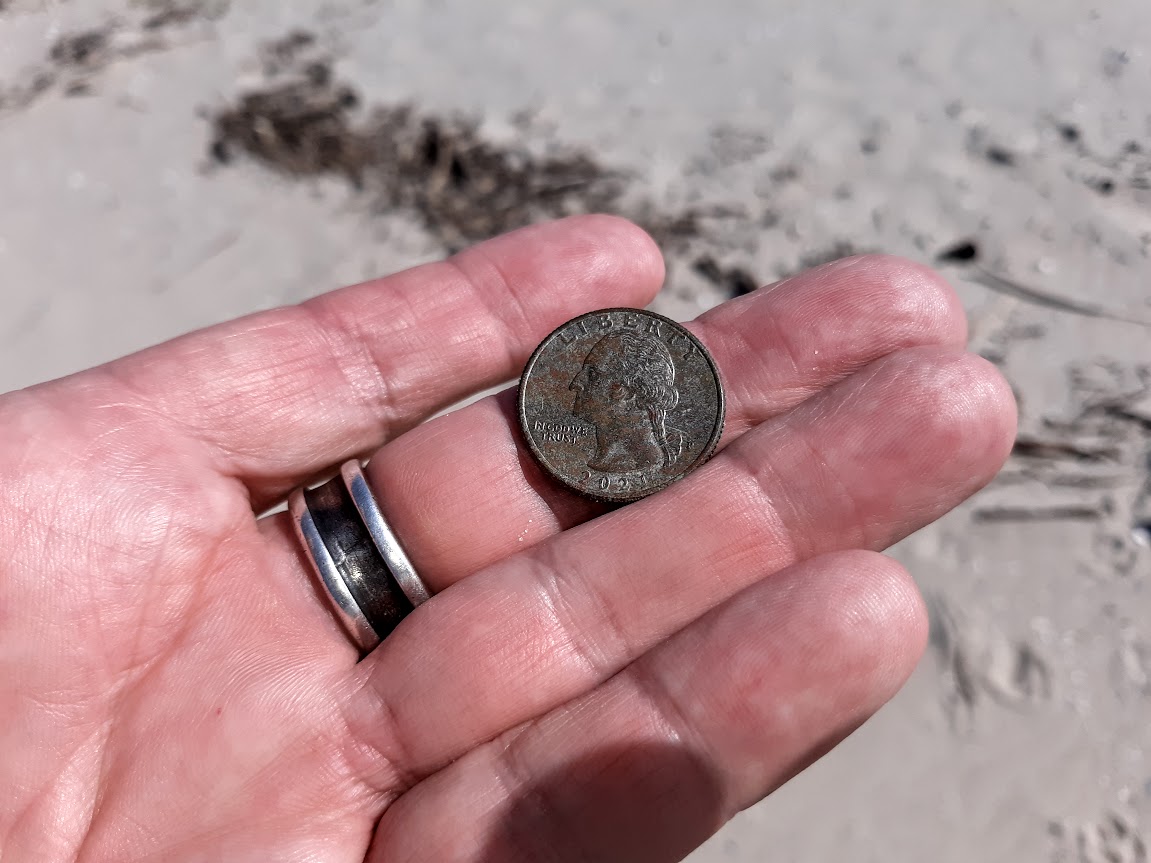
For the previous couple of days fossil hunting had been tough, only a couple of teeth each. Today was slightly better, we topped 20 together, with the usual crab claw, a couple drum teeth, and a ray chevron. Still, this was the most valuable thing I found.


Thursday, October 14, 2021

10/14/21 Beach Report

It's starting to get a little late in the year for butterflies, but in a patch of asters on the way down to the beach with sky, I found this Pearl Crescent . . .
and in some grass beside the harbor, this Common Buckeye.
About as nice a day as one could hope for, 70 F, blue skies. If I had one complaint, it would be the north wind was a little stiff, and muddied up the water, and made it hard to look for fossils.
There was a lot of leaf and wood debris piled up in the weather side of the jetty.
We still managed 14 teeth, of which this big, broken Snaggletooth was the biggest disappointment. I'm going to take Paul's lead, and call it "bite damage" and consider is special
There was still at least one Osprey still around. I saw some eagles at a distance. 
Amidst the debris on the beach there were many discarded Horseshoe Crab shells. They appear to undergo a mass molt in the fall.


Tuesday, August 10, 2021

Weed du Jour

I spotted this thing in a thicket along the way to the beach the other day. It had a weird little complicated yellow-green flower, largish three lobed leaves, and was a climbing vine with tendrils. I thought to myself that the flower sure looked like a tiny version of a Passionflower, but discounted it:

It took a little juggling to get the photo shifted from my computer to the IPad so I could use Leafsnap, but the app correctly identified it as Yellow Passionflower:

Passiflora lutea, the yellow passionflower, is a flowering plant in the family Passifloraceae, native North America, in the eastern and south-central parts of the United States from Pennsylvania west to Kansas, and south to Florida and Texas. It is the northernmost species of Passiflora,  occurring slightly further north than P. incarnata, and tolerant of winter temperatures down to −15 °C, and even −30 °C for short periods.

It is a perennial herbaceous climbing or trailing vine that can reach 3–5 m in length. The leaves are trilobed, 3–7 cm long and 3–15 cm broad, with a 5 cm petiole; in the north of its range, it is deciduous. The common name as well as the scientific name refers to the small, 1-1.5 cm diameter chartreuse (yellow-green) or off-white flowers it produces in summer. The flowers are followed by small black berries that contain seeds that are brown and bumpy. P. lutea grows in bright shade to sunny places with moist, rich soil. Very similar to Passiflora suberosa.

Yellow passionflower is often good for butterfly gardens, as it is a host for Gulf fritillaries, julia butterflies (Dryas julia), and zebra longwings (Heliconius charitonius). It is also the only pollen source used by an unusual specialist bee, Anthemurgus passiflorae, which is the sole member of its genus; this rare bee is unusual in that despite its obligate relationship with the plant (oligolecty), it rarely pollinates it.

Passiflora lutea is considered an endangered species in Pennsylvania.

I think I'll keep track of it, and collect some seeds. It would be a fun plant in the garden. 

Sunday, August 8, 2021

Beach Report 8/8/21

Is it really August? We had nice temperatures today, 75-80 with low humidity and bit of a NE breeze. As you can see, Matoaka is doing a booming business
Well up the cliffs, a Red-Spotted Purple butterfly, the first I've seen this year, stopped to try to sip some mineral rich water out of the clay in a fresh fall area. It's been a slow year for butterflies. I can't explain it.
Georgia pokes around in the stream that flows between Calvert Beach and Matoaka. It paid off, she found at least one shark's tooth in there. Overall, an adequate, but not awesome day for fossils; 26 shark's teeth, 4 drum's teeth and a couple crab claws, but nothing especially picture worthy.
A Ring-Billed Gull on the posing post
Evening Primrose blooming in the dunes: 
Oenothera biennis, the common evening-primrose. . . native to eastern and central North America, from Newfoundland west to Alberta, southeast to Florida, and southwest to Texas, and widely naturalized elsewhere in temperate and subtropical regions. Evening primrose oil (EPO) is produced from the plant. . . Blooming lasts from late spring to late summer. The flowers are hermaphrodite, produced on a tall spike and only last until the following noon. They open visibly fast every evening producing an interesting spectacle, hence the name "evening primrose". . . The seeds of the plant are important food for birds, and it is a larval host for both the primrose moth and the white-lined sphinx moth.

Saturday, July 31, 2021

Walk and Beach Report 7/31/21

A cool front came through last night, and dropped the temperatures into the low-mid 70s, so Skye and I decided to walk to the beach (instead of driving) and meet Georgia there. In a neighbors lawn I saw this pretty little flower. Leafsnap identified it as Virginia Buttonweed:
Virginia buttonweed, Diodia virginiana, is one of the most difficult weeds to manage in home lawns throughout Louisiana. It is a deep-rooted perennial plant with a spreading growth habit.
One of main reasons why Virginia buttonweed is so difficult to manage is because it can reproduce itself by seeds, roots, or stems. Regular mowing of the lawn has the potential to spread Virginia buttonweed around the yard because stem fragments can easily root and start new plants. Some homeowners often resort to hand pulling but this too can lead to the spread of root and stem pieces. The best approach to managing Virginia buttonweed in the home lawn is to take an integrated approach and combine several control methods together.

I hope it didn't follow me home.

Anyway, it was a pretty nice day at the beach, though fossil hunting was mediocre because of all the sand, and muddy water. Oh well, we only had 615 teeth for July (I counted the month jar after we got home).
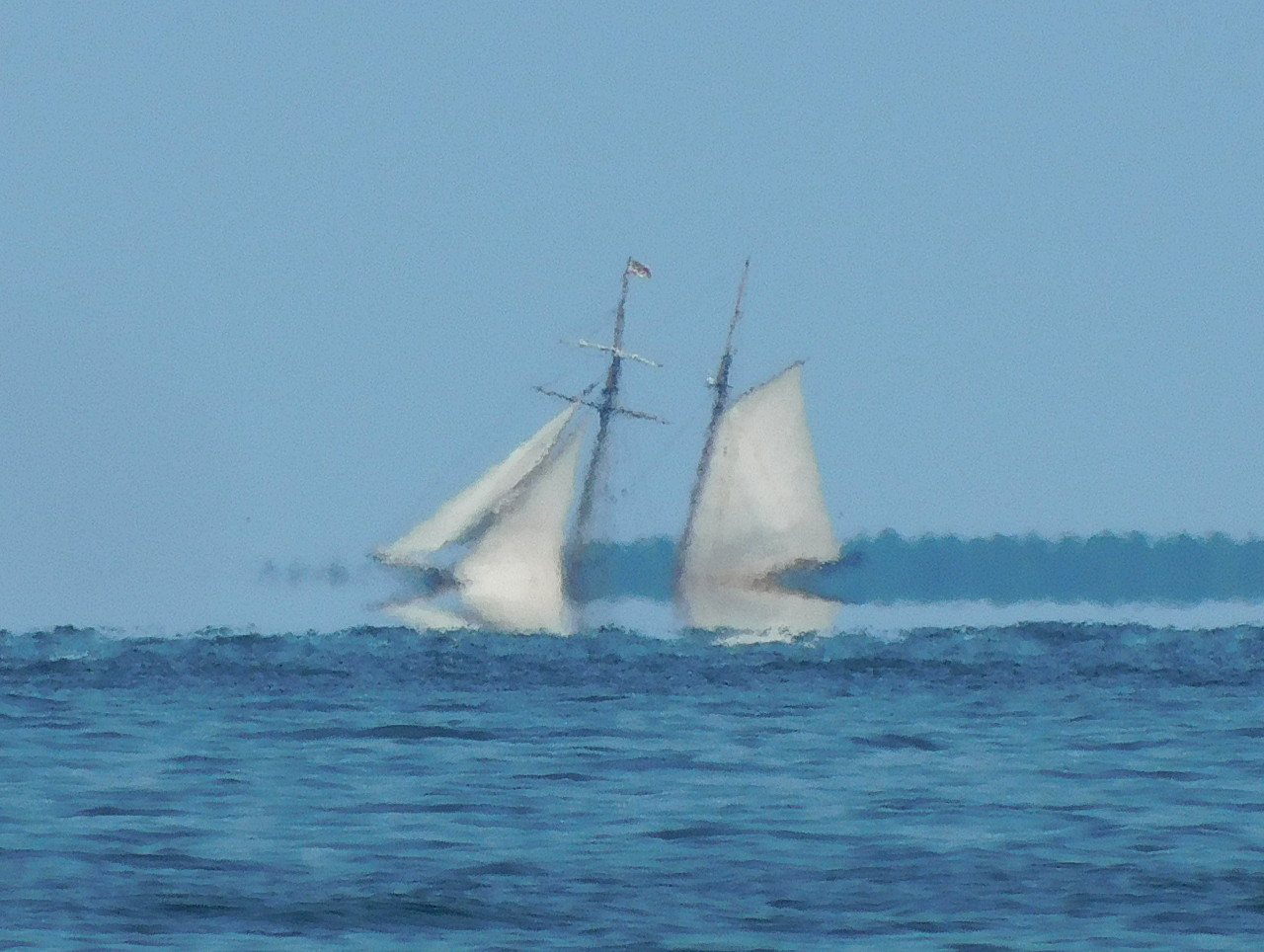
I saw a set of sail on a double masted boat way across the Bay. The combination of the mirage, the Schlieren Effect, and the earths curvature rendered it quite a remarkable image.
With full magnification out of my camera. I had a suspicion, but Marinetraffic.com confirmed that it was, in fact, the Pride of Baltimore II, under sail.


Sunday, July 4, 2021

Beach Report, July 4, 2021

Skye and I headed down toward the beach right after lunch, despite the high tide. On the way we found this black morph Eastern Tiger Swallowtail butterfly on the Buttonbush we stopped at yesterday. Its distinctive swallowtail was mostly missing, probably from a bird attack.
Georgia met us at the beach, and I must say, I think it was the busiest day I've ever seen. Which is great for Skye, since it's more people to try to get pets from and more other dogs to sniff. The temperature is in the low 80s, with a touch of humidity, but not horrible. Skies threatened rain which never materialied

Perhaps because of the heavy beach traffic, fossiling was hard; I only found one shark's tooth, but it was a good one, a 1 1/2 inch White Shark tooth. The blade is in fine condition, but the root is kind of rough. Some people claim this means it was swallowed by the shark, and the digestive acids ate at the root but not the blade. Could be!


Saturday, July 3, 2021

Beach Report 7/3/21

The Buttonbush is in bloom down in the swampy spot on the way to the beach.
From the scratch on her side, I'm pretty sure this is the same deer we saw a while ago. I swear she was following along with us, and popped out of the brush to check us out. She and Skye were nearly nose to nose, and neither of them seemed particularly upset or excited about it.
We had partly to mostly cloudy skies and stiff breeze, but the shocking thing was July temperatures in the high 60s.
Between the high tide, and the chop, fossil hunting wasn't too good. 
Not too choppy for a tow on an inflatable. 


Monday, June 21, 2021

Beach Report 6/21/21 - Shark Escape

A huge Trumpet Vine bush, with a few other things mixed in swallows a sign by the beach

Long reddish orange tubular flowers make it a classic hummingbird pollinated flower. Surprisingly, it's a native plant.

Although today was mostly cloudy, and a touch windy with the passage of what used to be Tropical Storm Claudette to our south, this photo caught us in one of the few sunny spells. 
A typical beach family catching rays.
Shark attack! Actually, the little boy was desperately trying to catch up to his float toy, which was getting away in the breeze. He was unable to catch up.
Even as the shark went belly up.

But a nice older guy waded out and intercepted it before it got blown too far down the beach.
Almost done!

A terrible day for shark's teeth; between a very high tide, and a good chop, it was hard to find much, but we managed 6 shark's teeth, the usual crab clay and a Tilly bone.