Monday, May 7, 2012

Let 'Em Get Down and Dirty, Part Deux

Probably not Amish
Amish farm kids remarkably immune to allergies
Amish children raised on rural farms in northern Indiana suffer from asthma and allergies less often even than Swiss farm kids, a group known to be relatively free from allergies, according to a new study.

"The rates are very, very low," said Dr. Mark Holbreich, the study's lead author. "So there's something that we feel is even more protective in the Amish" than in European farming communities.
Even less likely to be Amish
Probably because the Amish are even less likely than modern rural European farmers to abide by "modern" standards of hygiene, and thus Amish kids are exposed to more potential immune stimuli earlier in life.
What it is about growing up on farms -- and Amish farms in particular -- that seems to prevent allergies remains unclear.

Researchers have long observed the so-called "farm effect" -- the low allergy and asthma rates found among kids raised on farms -- in central Europe, but less is known about the influence of growing up on North American farms.
In a previous post we saw that even in the more general population, greater exposure to "dirt" decreased the chance of children developing asthma and hay fever.

Immune systems "learn by doing" and apparently early exposure to different materials and organisms helps to "train" the immune system to sort out the benign from the truly harmful.  Of course, greater exposure to the environment entails a certain risk of encountering a dangerous pathogenic disease.  But, really, at this point in our civilization, it seems to me that the major pathogens are well under control (and largely curable), while a large number of people suffer from obnoxious (and sometimes even life threatening) allergies.

So maybe we need to let the kids play in the dirt, collect the bugs and frogs, and keep strange pets more than we do now.

Thanks to Wombat-Socho for taking my early submissions for the weekly Rule 5 link around at The Other McCain's "I Need to Know", and also to The Classical Liberal who linked it with "She's the Woman."

Sunday, May 6, 2012

Midnight Magic - A Kid and A Guitar

Taxamageddon to Crush Stock Market?

After year-end, under current law, the top dividend tax rate will rise to 43.4% from 15%. That's not only because the temporary low 15% rate granted under the 2001 Bush tax cuts will revert to the prior rate of 39.6%. In addition, a provision of ObamaCare slaps a 3.8% surtax on all forms of investment income, including dividends—the resulting total is 43.4%.

So on Jan. 1, an investor won't keep $8.50 of that dividend—he'll pay a 43.4% tax and keep only $5.66. Suddenly, a stock that yielded him 8.5% now yields only 5.66%.

If 8.5% was the after-tax yield that investors demanded in order to allocate their capital to that particular company, then 5.66% will not be sufficient. That company's stock price will have to fall until it once again offers an 8.5% after-tax yield.

Precisely, the stock price has to fall by the percentage difference between $8.50 and $5.66. It will therefore fall to $66.60 from $100—that's 33.4%. And it's also a good first approximation of how much the overall stock market will fall when dividend taxes rise to 43.4% from 15%.
 Unless Congress acts.  Good luck with that. Time to buy gold? or lead...

Found at TaxProf  by way of Insty's replacement, Ed Driscoll.

Of Big Animals and Early Americans


The idea is not really new; we've had human artifacts and megafauna remains that date from the same period for quite some time.  In fact, it's been dogma that human hunting and other influences played a large role in the disappearance of the megafauna from North America.  But what these researchers have that they claim others don't is human and megafauna bones in deposits that come from the same age:
Ground Sloth spine and ribs
A new University of Florida study that determined the age of skeletal remains provides evidence humans reached the Western Hemisphere during the last ice age and lived alongside giant extinct mammals.

The study published online May 3 in the Journal of Vertebrate Paleontology addresses the century-long debate among scientists about whether human and mammal remains found at Vero Beach in the early 1900s date to the same time period. Using rare earth element analysis to measure the concentration of naturally occurring metals absorbed during fossilization, researchers show modern humans in North America co-existed with large extinct mammals about 13,000 years ago, including mammoths, mastodons and giant ground sloths.
Ground Sloth paw

"The Vero site is still the only site where there was an abundance of actual human bones, not just artifacts, associated with the animals," said co-author Barbara Purdy, UF anthropology professor emeritus and archaeology curator emeritus at the Florida Museum of Natural History on the UF campus. "Scientists who disputed the age of the human remains in the early 20th century just did not want to believe that people were in the Western Hemisphere that early. And 100 years later, every single book written about the prehistory of North America includes this site and the controversy that still exists."
Ground Sloth claw

Following discovery of the fossils in South Florida between 1913 and 1916, some prominent scientists convinced researchers the human skeletons were from more recent burials and not as old as the animals, a question that remained unanswered because no dating methods existed.
Giant Sloth Hands

"The uptake of rare earth elements is time-dependent, so an old fossil is going to have very different concentrations of rare earth elements than bones from a more recent human burial," said lead author Bruce MacFadden, Florida Museum vertebrate paleontology curator. "We found the human remains have statistically the same concentrations of rare earth elements as the fossils."

Strangely, pretty girls seem to pose with Ground Sloth fossils.  Maybe they were onto something.

 My belated thanks to Wombat-Socho for linking this in "Rule 5 Tuesday" at The Other McCain.

Sunday, May 6 Beach Report

Today was not a repeat of yesterday's good sunbathing weather. It had cooled to the high 50's, and the area was blanketed by clouds.  Looking southeast across the Bay to Taylor's Island, the sky fairly glowers.
Looking north, it didn't look a whole lot better.  The Bay was a bit choppy, but not horrible.
We met Joel and Red on time.  Red found this nice stinky fish to pull out of the surf.  Fortunately, he was persuaded from making a meal out of it.
There were a few of these beetles washed up on the beach.  This one was battered, but still crawling.  What amazing colors!
Salsify, or Goat's Beard (Tragopogon sp., probably dubius).
Some kind of Milkweed (Asclepias) that is quite common on the dunes.
Pollination in this genus is accomplished in an unusual manner. Pollen is grouped into complex structures called pollinia (or "pollen sacs"), rather than being individual grains or tetrads, as is typical for most plants. The feet or mouthparts of flower visiting insects such as bees, wasps and butterflies, slip into one of the five slits in each flower formed by adjacent anthers.

The bases of the pollinia then mechanically attach to the insect, pulling a pair of pollen sacs free when the pollinator flies off. Pollination is effected by the reverse procedure in which one of the pollinia becomes trapped within the anther slit.
While editing the picture above, I accidentally hit the "threshhold" control in GIMP. I kind of liked the effect. I played with it for a minutes, and decided to keep this one....

Canada Drops the Penny


What a great title!
Canada minted its final penny today as Finance Minister Jim Flaherty said the coin was too expensive to produce and no longer needed for business.

“The real issue was that people weren’t using them, they were putting them in jars at home, and we were doing the same thing at my house,” Flaherty said. He spoke today at the Royal Canadian Mint in Winnipeg, Manitoba, before pushing a button that stamped the last one-cent coin.

The longest-serving finance minister in the Group of Seven nations promised in his March 29 budget to save C$11 million annually by eliminating the coin that he says costs 1.6 cents to mint. The price of copper, which is used in the penny’s production, has surged more than 330 percent since 2000.
Copper made sense as  metal for minting coins of small value back in the days before copper became metal in enormous demand due to it's value in electrical  and other industrial equipment.  Once that occurred it started to become too valuable waste in small coins.  The US briefly dropped copper pennies in 1943, replacing them with steel pennies ('steelies') due to the demand for copper in wartime.  I remember when they used to be in general circulation.
Getting rid of the coin will have little impact on inflation, the Bank of Canada said in a May 2010 report. Electronic transactions will still be priced in cents, while retailers will round cash transactions to the nearest five-cent interval, according to the budget documents. The coin will still be usable in payments.

“It’s a bit hard to swallow,” said Francois Gendron, the 34-year veteran press operator who helped Flaherty strike the last coin. “It’s a bit of history.”
The Canadian penny has always been a bit of an embarrassment in the US.  Because they are the same size and shape as a US penny, they tend to circulate across the border and mix in with population of pennies in the States.  In the good old days, when the Canadian dollar was worth less than the US dollar, getting a Canadian penny in change was kind of like getting getting cheated of a trivial amount of money (not enough to complain about though).  Never mind that you would just pass it on the next time you could spend a penny.  Once the Canadian dollar became more valuable than the US dollar, a Canadian penny became a bit of mockery, that our super power had become downgraded with respect to the little country that floated like scum on the top of ours. Right now, they're about dead even, with just a beaver hair favoring the Canadian dollar.

The Obama Administration's 'War on Students'

The latest available data from the federal courts show that during March 2012 the government sued 279 individuals seeking recovery of defaulted student loans. According to the case-by-case information analyzed by the Transactional Records Access Clearinghouse (TRAC), this number is up 25.7% over the previous month when the number of civil filings of this type totaled 222. ...
Come on, let's create a new meme...

UPDATE:  Walter Meade does me one better, and names it "The War Against the Young":
Since the Obama administration took office, there has been an epochal shift. Young workers have continued to lose jobs and incomes, while older workers have actually gained ground.

In fact, the Obama administration has seen a boom in the prospects of the 55+ crowd; their (I should say ‘our’) employment stands at a 42 year high. Net, there are 3.9 new jobs for people over 55 since the recession began in December 2007, but there are 8.1 million fewer jobs for the young folks since that time.

But Was It In Tune?

Grand Piano found on sand bar in Biscayne Bay


Maybe a plot line out of CSI: Miami or, Miami Vice.

Saturday, May 5, 2012

First Grader Suspended for Bad Taste

A 6-year-old boy was suspended from his suburban Denver school for three days after school officials said he told a girl “I’m sexy and I know it,” a line from a popular song.

D’Avonte Meadows, a first-grader at Sable Elementary School in Aurora, is accused of sexual harassment and disrupting other students, according to a letter the school district sent to his mother after he was sent home Wednesday.

The Anti-Julia

The internet is ablaze with the "Julia" meme, the composite girl who grows up benefiting from the munificence of government under Barack Obama.  Most people on the left nod in assent, while those on the right find the story chillingly patronizing.  Lots of good stuff out there on Julia.

By way of Ann Althouse, this story of the real girl who made her way up from nothing to Harvard, with a little help from her community.

Girl, 18, who grew up homeless and didn't know how to wash wins scholarship to Harvard
Homeless, abandoned by her parents and once declared a high school dropout, a hardworking 18-year-old has turned her life around earning her acceptance into Harvard University with scholarship this fall.

High school graduate Dawn Loggins says her life in Lawndale, North Carolina first started out in decay, among bullying and a broken home surrounded by drug use and squalour before eventual abandonment by her parents.
But at some point, a guidance counselor took interest in her, and got her on a path to well, somewhere.
Others in her community pitched in as well with her school offering her a job as a high school custodian. A local dentist gave her toothpaste and a toothbrush.
Remember all the libs getting down on Newt Gingrich for saying that underprivileged kids should be given paying jobs cleaning the schools?  Hey, turns out it works!  Whodda thunk?
Aiming to one day major in Biology, her work in honour and Advanced Placement courses all came to a glorifying reward last March when she opened up acceptance letters from not just four universities she had applied to, but her dream school: Harvard.

'Dear Ms Loggins,' the letter read, according to the Gaston Gazette. 'I am delighted to report that the Admissions Committee has asked me to inform you that you will be admitted to the Harvard College class of 2016... We send such an early positive indication only to outstanding applicants...'
I discourage you from going into biology.  Aim for medicine.  Goodness knows we need the doctors, and we'll need them even more in the future.
As far as school costs, the university has offered to pay for tuition as well as room and board, but she will have to find other ways to pay for books and living expenses she said.

After meeting with financial aid they plan to help her find at job on campus as well.

'If there is anybody at all who has a dream,' Ms Loggins told WBTV, 'then they can definitely make it happen. There are no excuses. It depends on you and no one else.'
That's a good use of all the money that Harvard has piled up in its endowment.

Cinco de Mayo at the Beach

It was odd, but good odd, weather this morning at the beach.  There were thin clouds overhead, and even mist in the distance, but it was mildly warm and pleasant.  Great weather to get a sun burn in

The wild roses, which cover much of the cliffs were in full bloom.  They smell wonderful, almost overpowering at times.
Skye and Red stalk a victim, someone who might have a snack or a sandwich.
Turns out she didn't have a snack after all, or at least chose not to share it.  Sunbathing season is here, no doubt.


There were lots of butterflies out today.  This Eastern Tiger Swallowtail came up almost focused...
While this Clouded Sulphur gave me a pretty good shot of the underside of its wing.  We also saw lots of Red Admirals, though not as many as last week.
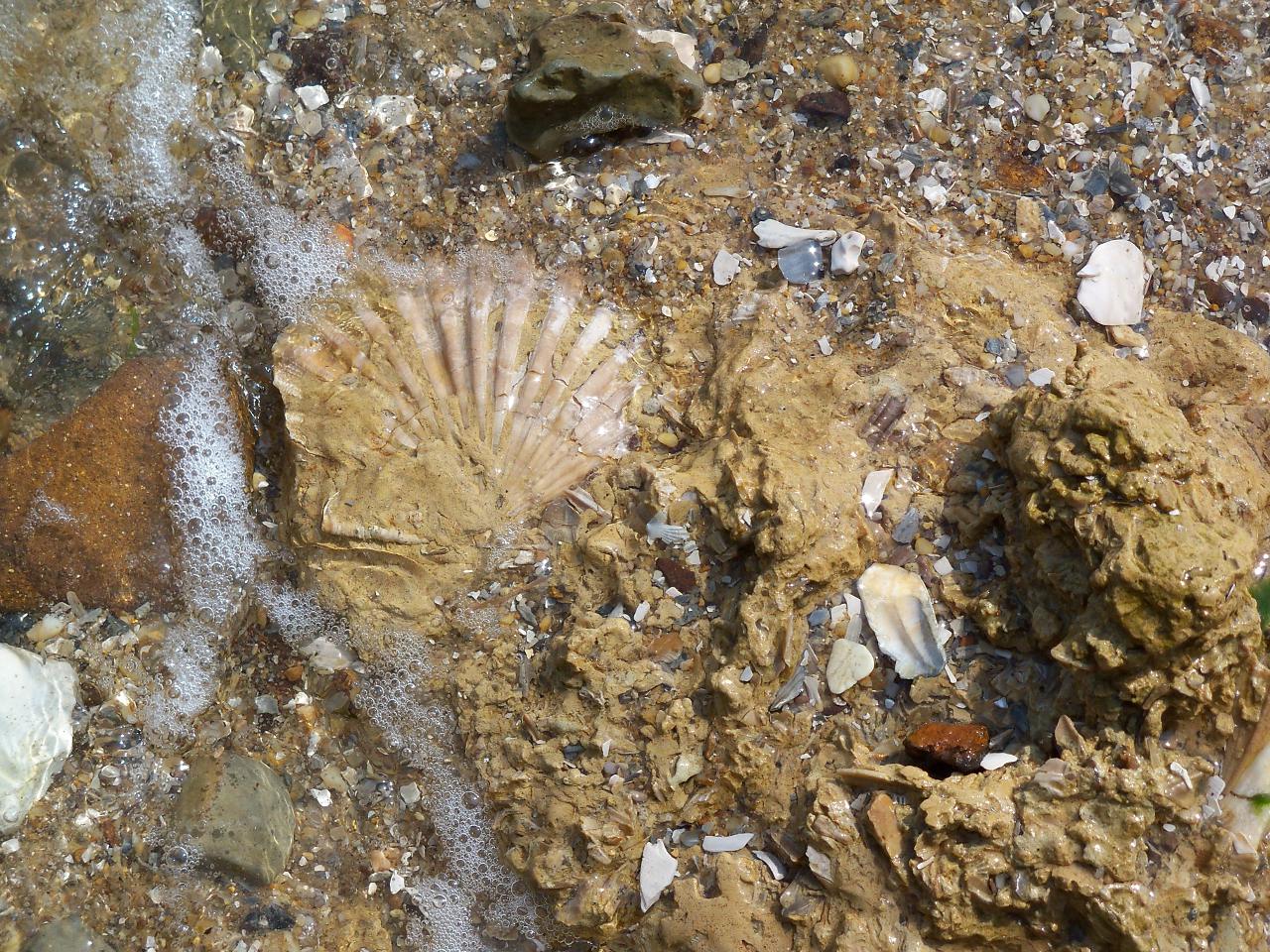
 Fossil cast of the extinct scallop, Chesapecten.
We met Ernie and his water-loving labs.  They would just swim out for the sake of swimming


Aw, Dad, do we have to go home now?

Somehow Appropriate


Thanks to Capt. Mike, I think..

Rule 5 Saturday - Who's Up Next, Doc?

Jenna-Louise Coleman, the new Who "companion"
Who is the new Dr Who girl?
A 25-year old soap opera actress beat hundreds of hopefuls to travel the universe alongside the Time Lord in one of the most sought after roles on British television.

Jenna-Louise Coleman was chosen to become the new companion of the 11th Doctor Who (Matt Smith) on the show of the same name, replacing Karen Gillan, who plays Amy Pond.

Best known for her roles in British soap Emmerdale and school drama Waterloo Road, Coleman will replace Gillan and her on-screen partner Rory Williams (Arthur Darvill) when they depart the series in a heart-breaking departure planned later this year.

I haven't followed Dr. Who for years.  It used to be great fun, laughing at the truly stupid plot lines, and the sets that couldn't have cost more than a quid or two, assuming they didn't just use junk that was lying around.  When I started on this project a few days ago, I found a site that had all the various incarnations of the Doctor and his various companions.  I was amazed at the number of Doctors that had passed by and the variety of the companions.
The new companion and her new home

Executive Producer Steven Moffat said the storyline for Doctor Who this season will be full of thrills, adventures and big surprises as the show builds up to its 50th anniversary.

"Jenna is going to lead him his merriest dance yet. Who she's playing, how the Doctor meets her, and even where he finds her, are all part of one of the biggest mysteries the Time Lord ever encounters, Moffat said.

"Even by the Doctor's standards, this isn't your usual boy meets girl."

Viewers will have to wait until Christmas to meet Coleman's character, who is described by Moffat as being even more talkative than the current doctor.
Jenna-Louise replaces Karen Gillian who played companion Amy Pond from 2010 to 2012.  I believe Karen was recently killed off in an episode of Eureka, but I've been unable to verify that...

UPDATE: Refuted.  The cute redhead on Eureka was Felicia Day.


So, below are few of the other women who have traveled around the universe with the Doctor:


The Power of the Internet

I've seen the video before, of course, but some of the back story here, and the outcome of the video is new to me:
Musician Dave Carroll had difficulty with United Airlines. United’s baggage handlers damaged his $3500 custom guitar, and he spent over 9 months trying to get United to pay for damages.

During his final exchange with the United Customer Relations Manager, Dave stated that he was left with no choice other than to create a music video for YouTube exposing United’s lack of cooperation. The manager responded: “Good luck with that one, pal.”

Dave shot and posted his video on YouTube. The video has since received over 11 million hits. (You’ll soon see why!)
United Airlines contacted Dave and attempted settlement in exchange for pulling the video.

Naturally Dave’s response was: “Good luck with that one, pal.”
The resulting video, made for $150.


From the book "United Breaks Guitars".
Four days after its launching, the first million people had watched “United Breaks Guitars.” United stock went down 10 percent, shedding $180 million in value; Dave appeared on outlets as diverse as CNN and The View. United relented. And throughout the business world, people began to realize that “efficient” but inhuman customer-service policies had an unseen cost—brand destruction by frustrated, creative, and socially connected customers.
 Seen at Volohk's Conspiracy.

Friday, May 4, 2012

Whenever You See a Hearse Go By...


On the origins of the "The Hearse Song." Quite a distinguished history for a nasty little child's song.

Trading Pollutants to Save the Bay

A few days ago, I blogged an article about how the Bay environmentalist community was being split over the idea nutrient trading, with the Bay Foundation being 'pro', and the more grassroots Riverkeeper community being 'anti'.  Today we see a report that seems to strongly support the 'pro' position:

Pollution trading could trim bay cleanup costs
Steep projected costs for cleaning up the Chesapeake Bay could be trimmed by billions of dollars, a new study suggests, by allowing polluters to buy "credits" for less-expensive reductions made by others.

The study, presented Thursday to the Chesapeake Bay Commission, an advisory panel of legislators from Maryland, Pennsylvania and Virginia, estimates that nutrient pollution trading could trim projected costs for upgrading sewage treatment plants and controlling urban and suburban storm water pollution by $1 billion or more a year baywide.

Millions more could be saved, the report says, by letting developers and communities pay farmers to plant trees or create wetlands on their land to offset nutrient pollution produced by growth and new development.

The economic analysis, done by RTI International of Research Triangle Park, N.C., comes as officials in the six-state watershed, which includes the District of Columbia, Delaware, New York and West Virginia, wrestle with hefty preliminary cost projections for reducing nutrient and sediment pollution enough to comply with a bay restoration plan imposed by the Environmental Protection Agency.

Maryland officials have estimated cleanup could cost $15 billion in the state alone by 2025, the deadline for meeting the bay's "pollution diet." Virginia officials have projected costs of $7 billion to nearly $15 billion.

Maryland, Pennsylvania, Virginia and West Virginia have embraced varying approaches to nutrient trading as part of their bay cleanup plans.
Saving a billion bucks isn't a bad thing.  Nutrient trading, handled right, is a reasonable free market solution to the nutrient problem, by letting individual polluters decide how much it's worth to reduce flow of nutrients into the Bay.

Bay Foundation, EPA at Odds Over Steel Mill

A federal judge's approval of a monitoring agreement between the owners of the Sparrows Point steel plant and environmental regulators is being appealed by the Chesapeake Bay Foundation, the environmental group announced Wednesday.

In March, U.S. District Judge J. Frederick Motz approved the agreement between RG Steel and federal [EPA] and state regulators [MDE]. Under the agreement, which followed a lengthy dispute over monitoring for toxic contaminants at the mill outside Baltimore, the company is required to sample sediments no more than 50 feet offshore. Environmentalists have argued contaminants have been found much further offshore.

The foundation said it was seeking a much more comprehensive assessment in Bear Creek and the Patapsco River near the hulking Baltimore County mill.

"All existing evidence indicates a broad belt of toxic pollution around the steel plant extending hundreds of feet into Bear Creek. The neighbors of the plant have the right to know what is in the water where they swim, crab and fish," said Kim Coble, vice president of the Chesapeake Bay Foundation. "We can't accommodate polluters at the expense of the public."
Yes, Baltimore Harbor is polluted over a wide area, by a large number of sources, including stormwater, shipping activity and other industrial sites, which is precisely why a broad scale monitoring plan is not warranted.  If you want to find changes that suggest recent pollution, you want to look for changes close to the steel mill.  Metals in particular, are notoriously particle reactive, and turn up in the sediments very close to site of release.

Frankly, in the environment of  Baltimore Harbor, I wouldn't hold out much hope for a monitoring program to find anything but a catastrophic release of metals.  Concentrations in the sediments there are already so high, and so spatially variable, the chance of a minor release being observed as a statistically significant increase in the sediments is very low.

I suspect the Bay Foundation simply wants the steel mill to pay for a wide spread monitoring program as a punitive matter, and as a way of identifying other offenders it can go after as well (as there almost certainly are.
The Maryland Department of the Environment issued a statement saying the current plan could lead to further sampling.

"MDE's and EPA's teams of toxicologists, geologists and engineers are in complete agreement that the court approved off-site sampling plan will achieve its goal. The goal is to develop a final human health and ecological assessment which will then lead to the development of a clean-up plan," the statement said. "If there is reason to believe that a plume extends beyond 50 feet, the agencies would direct RG Steel to conduct additional sampling."

The federal judge ruled last year that a prior owner wasn't responsible for pollution that occurred before Bethlehem Steel's 2003 bankruptcy sale of the mill, but current owners could be required to study offshore pollution.

Elizabeth Warren - Indian Princess

This story has been around for a few days, and I haven't done anything with it yet, so I thought I should:

The facts (at least as I have seen them):

Elizabeth Warren, blonde, blue eyed, Harvard Professor in bankruptcy law, failed appointee to the Consumer Financial Protections Bureau (blocked by Senate Republicans) and currently candidate for Senator of Massachusetts, facing Scott Brown, was revealed to have had herself listed in faculty lists as a minority member when she was hired.

She was listed as a minority professor in the Association of American Law Schools desk book as a minority professor through the 80's and 90's, while she taught at a number of different schools.The listing disappeared after she obtained tenure at Harvard.

She claims that she is part Cherokee from a triple great grandmother, which would make her only one thirty second Cherokee.  The claim is only weakly verifiable at this point; an electronic record seems to suggest it, but actual paper documents dating to the period are still absent.

She has said listed herself as a minority professor to get social invitations from other Indian Native American professionals, and dropped the listing when those invitations did not materialize (Hey, maybe you have to be the one to reach out).  She also claims to believe the ancestry claims because of her (and her grandfather's) high cheek bones....

The (mostly negative) suppositions:

First, it's a reasonable supposition that she first started using the Indian Native American label when she was an up and coming professor at lessor schools, in an era when schools were under lots of pressure to hire minority candidates.

Did it matter that she was listed as a minority candidate; did she get any positions that she might ot have had she not claimed minority status? It's highly unlikely any paperwork exists that shows that she was selected over more worthy candidates due her status as a minority.  At best, it was something bandied about in meeting between deans and faculty, possible with deans promising that faculty would be allowed more faculty if they would just select a minority.  Hey, it happens.  I don't doubt her qualifications, as much as I think her politics are dead wrong.

Second, she dropped the listing when she reached the pinnacle of Academe, a professorship at Hahvahd, and didn't need it anymore, and that it became a liability (oh, you were only hired because you were a minority). Even worse, if you get into politics, people actually start checking your claims...

So yes, I think she was at least attempting to take unfair advantage of the Affirmative Action programs.  I don't know whether she succeeded or whether we'll ever know for sure.

And here's what I think about that...

Your Friday Monkey Dacker Bird Lover


I think he's saving it for a snack later.

Thursday, May 3, 2012

Mass Transit - Chinese Style

OK, OK, I Got Another One

We've been watching the "war of farming" in the Chesapeake Bay for a while.  Clearly, agriculture is a big source of the nutrients that plague the Bay.  But so is the poorly treated sewage that gets dumped by any number of municipalities around the watershed as well.  The following two article show the level of inequality in how the various state "invest" to fix the Bays issues:

Board of Public Works Approves $312,882 in Agricultural Cost-Share Grants

(in best Dr. Evil voice) "Wow! $300,000.  That's a lot of money, right!",

But of course, it has to be shared across the whole agricultural community:
Governor Martin O’Malley announced that the Board of Public Works approved $312,882.17 in agricultural cost-share grants in 15 counties for 44 projects that will prevent soil erosion, manage nutrients and safeguard water quality in streams, rivers and the Chesapeake Bay. Together, these projects will prevent 5,425.58 pounds of nitrogen, 2,317.12 pounds of phosphorus, and 1,686.40 tons of soil from entering the Bay and its tributaries. These projects are funded by state general obligation bonds and are not part of MDA's general fund budget allocation. The Board is comprised of the Governor, Treasurer Nancy K. Kopp, and Comptroller Peter Franchot.
Now compare to the treatment of municipalities...

Porter-Tower Joint Municipal Authority receives $11 million to upgrade wastewater treatment facility

$11,000, 000 for just one sewage system. How much is going to sewage overall?
The Porter-Tower Joint Municipal Authority received $11 million in state funds as part of a $115 million investment in water infrastructure projects throughout the state announced April 25 by Gov. Tom Corbett.

"These projects will significantly continue to improved waterways, including the Chesapeake Bay, and will also create hundreds of new jobs that are so vital to our local communities," Gov. Corbett said in a press release. "These projects serve the dual purposes of responsible environmental stewardship and steadfast economic recovery, both of which are critical to the future of Pennsylvania."

The $115 million investment consists of $82 million in low-interest loans and $33 million in grants for 28 projects in 17 counties.
$100 million?  Chickenfeed!

According to EPA Chesapeake Bay Program, the Bay Foundation, and Chesapeake Bay Action Plan  agriculture is one of the great contributers to pollution in Chesapeake Bay.  But when push comes to shove, they'd much rather invest in the pollution from the city governments than in the privately owned agricultural industry.  If they were really results oriented, they'd be investing money where they get the biggest bang for the buck.  If agriculture really is the big source they say it is (and I assume it as well), they should be investing approximately equally in pollution reduction.

Partly, of course, it's about buying votes.  The sparsely populated agricultural areas have relatively few votes, and the farm owners affected have even fewer.  By offering thousands of jobs (even if they are constructing and working in sewage treatment plants), politicians hope to encourage people to keep them in office.

Cleanup On Isle 5

Either the EPA is slacking off, or they caught onto the fact that I make fun of their press releases, and cut me off; I didn't get my daily assortment of Bay press releases at any of my accustomed email addys.  But I did manage to find this article about the Potomac and Anacostia Rivers in WAPO, so I'll have to milk it for everything it's worth:

Potomac River’s and Anacostia River’s cleanup makes progress, but much work remains:
It’s Saturday morning on the Anacostia River, and the sun is filtering through the trees on Kingman Island. In the distance, a pair of deer splash across a large, lush cove. Six turtles tumble, one by one, from a sun-soaked log into the river below.

“This is exactly what you think of when you think of Ward 7,” said a sarcastic Brent Bolin, director of advocacy for the Anacostia Watershed Society, who is steering the boat through Kenilworth Marsh. “The sad thing is, there are people living less than a mile away who have no idea this is here.”
That has been my observation numerous times when visiting the Anacostia; you drive through the most depressing neighborhoods imaginable (no, I take that back, Camden, NJ was worth), but once you get of the water, it's hard to see that your even in the city, at least in the upper part.  A few bridges go overhead, but for the most part, activity in the area is focused away from the River.  No houses or businesses look out on it; even the parks that border have no human traffic nearby.  If it weren't for the absolutely astonishing amount of trash that washes in the River from nearby streets and subsurface drainage, you could even imagine it being clean (it isn't)..
That’s because for many years, the Anacostia was one of the most polluted rivers in the country. Meanwhile, its larger neighbor, the Potomac, was the focus of a major ongoing cleanup.
And still is.  Not much has changed, and it would take a lot to change it; like a complete change of the bottom sediments.
This could slowly be changing. Inlets such as Kenilworth Marsh are starting to show signs of revival. With the rise of nearby high-profile development projects such as Nationals Park and luxury apartments by the Navy Yard, the neglected Anacostia riverfront is getting attention.
The last batch of work I did up on the Anacostia was in preparation for building the new stadium, located in the lower zone.  That portion of the waterfront, that used the be the all but abandoned Navy Yard, was perhaps the most blighted ares.  It looks better now, but as far as I know, the same dirty sediment is still in the River in front of it.
But environmentalists stress that because the region’s waterways are connected — the Anacostia flows into the Potomac, which flows into the Chesapeake Bay — a holistic approach to cleaning them is necessary. If one river is neglected, the region suffers.

“The greatest concentration of PCBs [polychlorinated biphenyls], a serious poisonous toxicant in the Potomac, is the spot where the Anacostia enters it,” said Ed Merrifield, head of the Potomac Riverkeeper group. “So if you care about one, you care about the other.”
True, but the Potomac is many times bigger than the Anacostia, and while pollutants do slosh back and forth between them with the tide, the influence of the Anacostia is substantially diluted out in the Potomac.
There are several arguments as to why the Anacostia has been so neglected, primarily that it doesn’t supply drinking water, but the prevailing theory is that the communities surrounding the river — wards 6, 7 and 8 — have been forced to bear the brunt of the District’s waste.

“America has a shameful history of putting our pollution on poor minorities, and there’s no other way to say it,” said Mike Bolinder, head of the Anacostia Riverkeeper group. “You can slice and dice it any way you want, but the Potomac got cleaned up first because it isn’t near poor minorities and toxic landfills.”
OK, watch your wallet, because here comes that "Environmental Justice" crap again.  The Anacostia got dirty because the government built itself up around it.  I don't think it's a coincidence that one of America's dirtiest rivers happens to flow through the nations capital.  Frankly, the government is the first to exempt itself from environmental and health laws that it inflicts on the rest of the country (for a fine example, look to the military), and cares less about it's citizen than it does about spending they money they've coerce out of their hands the way it want than taking care of them.

You can bet that if the majority of the land on either side of the Anacostia were in private hands it would be a lot better of.

Lioness Attempts to Eat Child, Mother Giggles


It is mildly amusing...

Chain Saw vs Samurai Sword - Predictions?

Both lost...  pieces.

Bloody battle between neighbors sees man's arm almost severed with a chain saw... and another's finger chopped off with a SAMURAI sword
In a bloody battle between two warring neighbors in Australia today, one man's arm was almost severed with a chain saw, while another had a finger chopped off with a Samurai sword.

Surgeons were later trying to save the arm of the chain saw victim, Mark Jorgenson, 29, while his neighbor Troy Thornton, 26, was being treated after losing his finger to the Samurai sword.

Police who rushed to the small town of Minto, south west of Sydney, found pools of blood in the street and Mr Jorgenson crying in pain from his almost-severed arm. Detectives are investigating claims that after the two men argued over loud music and reckless driving, Mr Thornton went to Mr Jorgenson's house with the chain saw.
Loud music and reckless driving?  Sounds like any neighborhood anywhere.  At least they could have picked the fight over something meaningful, like a girl.

What's Up With the Sun?

The current prediction for Sunspot Cycle 24 gives a smoothed sunspot number maximum of about 60 in the Spring of 2013. We are currently over three years into Cycle 24. The current predicted size makes this the smallest sunspot cycle in about 100 years.

The prediction method has been slightly revised. The previous method found a fit for both the amplitude and the starting time of the cycle along with a weighted estimate of the amplitude from precursor predictions (polar fields and geomagnetic activity near cycle minimum). Recent work [see Hathaway Solar Physics; 273, 221 (2011)] indicates that the equatorward drift of the sunspot latitudes as seen in the Butterfly Diagram follows a standard path for all cycles provided the dates are taken relative to a starting time determined by fitting the full cycle. Using data for the current sunspot cycle indicates a starting date of May of 2008. Fixing this date and then finding the cycle amplitude that best fits the sunspot number data yields the current (revised) prediction.
This matters if you believe that the sunspot cycle strongly effects the earth's climate.  Evidence suggests that in the past, the low sunspot cycles of the Maunder and Dalton minimums coincide with periods of cool average climate on Earth. Recent progression of the cycle suggests that the sun may be going into a minimum now, which may rival the Dalton minimum, and may reach the low levels seen in the Maunder minimum.

A mechanism for the relationship between the sunspot cycle has been proposed.  The solar magnetic field (also tied to sunspots) deflects cosmic rays from earth.  Cosmic rays, in turn, ionize atoms in the Earth's atmosphere, and help to seed clouds.  Thus, periods of low sunspots correlate to greater cloudiness, high albedo, and lower temperatures on Earth.

So far, every revision of the next solar cycle has been downward.  Will they earth's climate cool as solar activity recedes?  Stay tuned for further developments:

Previous posts on the solar cycle/climate link:

Japanese Scientists Warm of Cooling Climate 
A View from the Beach: Ain't No Sunspots...
Solar Magnetic Activity Linked to Climate Via Cosmic Rays
Solar Breakdown - AAS Predicts Solar Minimum
CERN Head Censors Scientific Thinking
Dalton or Maunder?
CERN Study Finds-Climate Cosmic Ray Link 


Found at Watts Up With That.

Wednesday, May 2, 2012

To Be Completely Fair

The Japanese don't have a monopoly on weird...


Are those outfits supposed to reminiscent of Roman Legionnaires?


Over at The Other McCain, Wombat Socho's Rule 5 Sunday done come on Monday this week.

EPA Shirks Stormwater Duty


A pretty good article on how EPA is going slow on making the regulations and enforcement on an upcoming rule on stormwater on pre-existing development.  Sort of insider baseball sort of stuff, but it bears out much of my thinking on how things get done within the Bay.
On Friday, E&E News reported that EPA had – for the fifth time – missed its deadline for proposing regulations governing stormwater discharge from post-construction activities. Apparently, EPA and the Chesapeake Bay Foundation, which was the plaintiff in the original litigation, are negotiating a new deadline. Good luck with that.

EPA is not in a good place at the moment. There is significant congressional opposition to any rule, with comments questioning not just the wisdom of a rule, but EPA’s authority to issue a post-construction rule at this point. Addressing stormwater will undoubtedly be extremely expensive. The same E&E story noted that EPA just approved a new stormwater plan for Philadelphia with an expected price tag of $2.4 billion. Even though the Philadelphia plan is a separate issue from regulation of post-construction discharges, it does give some idea of the economic magnitude of the issue.

By the way, did I mention that there will be an election in the fall? I know from experience in Massachusetts that even Democratic members of Congress are very sympathetic to claims from municipalities that they simply cannot afford to comply with EPA stormwater requirements. There may be less sympathy, at least on the Democratic side, with private landowners, but EPA has to be aware that it does not have a broad popular mandate for this rule.

EPA cannot make this about big, bad, coal companies. This is about municipalities and private landowners. The regulated community with respect to stormwater is very large. Sometimes a large number of opponents is too diffuse to act and faces free rider problems. That does not seem to be the case here, as the costs are sufficiently high that they still matter to individuals, and there are large, well-funded, trade groups to minimize the free rider problem.
Indeed, the EPA is at it's most powerful when it attacks, crucifies if you will, isolated and potentially unpopular targets like oil and energy companies.  When it has to pass and enforce regulations that effect the large Blue interests in urban areas, it's a lot slower and more careful.

Building from the Bay

Storm sediment finds new use in Havre de Grace: Debris once clogged boating channels
Sediment that clogged boating channels in Havre de Grace following two major storms last fall is being put to a new use.

The sediment dredged from the boating channels has been used to form a pond and a scenic path around the new waterway.

The pond and paths were built by a partnership between the Maryland Department of Natural Resources Boating Services, the Harford County Department of Parks and Recreation and the Swan Harbor Farm project.

The site also helps filter stormwater before it reaches the Chesapeake Bay and will be used to store material dredged from boat channels in the future.
The rivers pour enormous amounts of sediment into the Bay.  In most places, it just builds up, making the Bay more shallow, and eventually choking it out.  It can be calculated that if the Bay survives another 40,000 years before a new Ice Age, the continuing sedimentation will fill it up.  I'm not holding my breath.

However, making good use of the sediment that must be moved out of boat channels makes a lot of sense.

I wonder if the huge amounts of sediment building up behind Conowingo Dam could also be put to good use.  Most of it is old farmland that washed out of Pennsylvania.  Could it be used as a soil conditioner?  It's full of nutrients, but is it too contaminated by metals and organics to be safely used to grow food for human consumption?

Live Blogging the Commute

We signed the IPad up for wireless last night, and now I'm testing my abilities to blog away from the home network.


Oh look, a blurry picture from the backseat of a moving SUV!


The Best Thing Gov. Moonbeam Ever Did


PJ inspired this.

Senior Survives Alligator Attack in Florida

75-Year-Old Man Bitten, Dragged by Alligator at a Golf Course Pond
...Miller, 75, is at home recovering from being bitten and dragged by a 9-foot alligator while he was playing golf last Wednesday. Miller was playing a four-ball tournament with his friend, 66-year-old Ted Price last Wednesday at Lake Ashton Golf and Country Club.  Price said his ball landed closest to the 15th hole, but Miller had hooked his into the water that borders the green.

The golf course uses the pond for irrigation water, Price said, so the water is clear, not muddy. No one saw an alligator, Price said, but in retrospect believes they should have been more cautious because of that.

Miller went over to the edge of the water with a ball retriever tool, and found two balls that weren't his, so he turned to leave.
Pretty clever of the gator to leave a few spare golf balls nearby as bait.
That's when the alligator launched at him from under the water and got him by his left knee. "He lifted me up three feet and slammed me down," Miller said. Price ran over and grabbed Miller under his shoulders while the animal was thrashing and pulling. The other two golfers in the foursome ran over to help.

Miller said the animal took one look at him and clamped down harder. "It was excruciating to say the least," Miller said.

As the animal started dragging Miller into the water, Miller prayed for a miracle. He got one.

"He let me go," Miller said. "I was three feet from my life. He had me submerged up to my belt buckle. That was my miracle of the month."
I guess it's a good thing golf isn't a solitary sport.

I used to wade in Florida ponds at night while fishing.  Sometimes I even had stringers of fish tied to my leg.  Never saw a gator, but I know some were around.  Ah, the stupidity of youth....
In the emergency room at Winter Haven Hospital, Miller had to have 35 to 40 stitches to close a 10-inch lance wound, and two other 5-inch wounds. "He just filleted me," he said. "You could see into the bone." Miller also had puncture and claw marks. He was worried to lose his knee capsule — a water-tight fibrous casing that encloses the space within the joint.

If that was punctured, he would face several surgeries and long rehabilitation. So far, it appears to be OK, but his knee is too swollen for doctors to get good CAT scan or MRI images of the joint, Miller said.
Hat tip to Eatmofish. 

Choot him, Elizabeth!

Tuesday, May 1, 2012

Now That's a Guard Dog!

Check Your Wallet

Officials with the federal Environmental Protection Agency and the U.S. Forest Service plan to visit a Baltimore middle school along with city officials on Tuesday to see work being done to confront environmental justice challenges. The term environmental justice applies to efforts to ensure that environmental laws and regulations are applied equally to all areas, regardless of the income, race or other factors.

Green efforts at the school as well as projects to reduce stormwater runoff are among those that federal and city officials will review. Runoff is a growing problem in the Chesapeake Bay watershed where stormwater carries pollutants into waterways and the bay, harming water quality.
The United States Environmental Protection Agency defines Environmental Justice as follows:
Environmental Justice is the fair treatment and meaningful involvement of all people regardless of race, color, national origin, or income with respect to the development, implementation, and enforcement of environmental laws, regulations, and policies. EPA has this goal for all communities and persons across this Nation [sic]. It will be achieved when everyone enjoys the same degree of protection from environmental and health hazards and equal access to the decision-making process to have a healthy environment in which to live, learn, and work.
This point of view overlooks a basic fact of human nature; poor people will take greater risks with their life and health than the wealthy in an attempt to make ends meet and become wealthy.  You don't see many billionaires working to make their money crabbing on the Bering Sea in winter (I have Deadliest Catch on in the background right now).  The poor are and should be more willing to take on the challenges of living.  All evidence suggests, that in the absence of government intervention, they are.  Environment Justice is an excuse for government and the NGOs that feed of it's leavings to intervene in the free market, nothing more.

Girls Fix High School's Storm Water Problem


Normally I skip by these feel good stories about kids winning the science fair with a Bay related project or similar items.  This one seemed pretty good, though.  It's a useful project, it actually address Bay issues in a reasonable way
Every year, a pipe behind River Hill High School in Clarksville drains six billion gallons of unfiltered water into the Chesapeake Bay.

That's changing, however, thanks to a new rain garden unveiled recently at the school. The new rain garden provides 2,000 square-feet of bio-retention: rocks, soil and plants that clean the water of pollutants before it goes to the Bay.

"Every single time it rained, something like 200,000 gallons of water would go through that pipe, even with just one inch of rain," said Danielle Fallon, 17, a junior at River Hill and one of the driving forces behind the rain garden.

Fallon has spent the last three years getting the project up and running through the G/T Intern Mentor program, working with River Hill's Youth Environmental Coalition, the Green Building Institute and the Chesapeake Bay Trust.
I hope the students math and research skills are better than the reporters.  Assuming it rained an inch a day, for a total of 300 inches per year, 200,000 gallons per inch of rainfall would total 60 million gallons per year. But what's two orders of magnitude when you're trying to make a point?  Oh, and the actual annual rainfall for Baltimore is more like 40 inches annually, so make that three orders of magnitude.  And if the girls gave the reporter the figures and he ran with it, it's still his error...
The project was made possible through a $5,000 "mini-grant" from the Chesapeake Bay Trust, said Connie Chen, president of Youth ECo, 18, and a River Hill senior. An additional $2,500 was raised from the community, she said. The garden was planted by students over the course of two April weekends.

All the plants, Chen said, are native to Maryland, which means they require less maintenance and don't need fertilizers. The pollutants fertilize the plants, Chen said.

"We got really into making something tangible, something that would make a difference for the Bay," Chen said. "This was just laying there, waiting to happen in our backyard."
Good for them.

Shhhhhhh, Don't Tell Anyone


An updated version here.

Wind Power Adds to Global Warming

Researchers used satellite data from 2003 to 2011 to examine surface temperatures across as wide swath of west Texas, which has built four of the world's largest wind farms. The data showed a direct correlation between night-time temperatures increases of 0.72 degrees C (1.3 degrees F) and the placement of the farms.

"Given the present installed capacity and the projected growth in installation of wind farms across the world, I feel that wind farms, if spatially large enough, might have noticeable impacts on local to regional meteorology," Liming Zhou, associate professor at the State University of New York, Albany and author of the paper published April 29 in Nature Climate Change said in an e-mail to Discovery News.
The effect seems to be largely due to mixing; at night, the wind turbines mix the cool layer of air close to the ground with warmer air above, resulting in warmer average temperatures at the surface.

Wind turbines also heat the air for another reason; friction and the 2nd law of Thermodynamics.  Wind is the sun's thermal energy converted (however inefficiently) to kinetic energy.  To capture that energy back from the wind using the wind turbines involves friction along the blades, and the conversion of that energy to electricity, all of which, by the 2nd Law, involve to loss of some of that energy as heat.

There have been a number of "gotcha" type articles on this in the skeptical media. Wind Power adds to Global Warming!  Oh Nooes!

I'm sympathetic to the viewpoint because the AGW side takes every bit of weather news, and turns it into a screed against Global Warming.  It gets extremely tiring to hear about the death of mountains because a few herbs have shifted their range vertically a fraction of a meter a year, or that home runs have become easier due to thinner air caused by global warming. The list of thing that have been blamed on global warming is just astonishing (and funny as hell).

So, while I tend to discount the importance of the warming of Texas due to Picken's Propellers, a little turnabout is fair play.

Not Yet...