Showing posts with label paleontology. Show all posts

Tuesday, February 20, 2024

Local Man Make the News

Seal heel bone with Great White Shark tooth fragment
Southern Maryland Chronicle  Ancient Shark vs. Seal Battle Captured in 4.5 Million-Year-Old Fossil

SOLOMONS, MD – A groundbreaking discovery has brought to light an ancient interaction between two of the ocean’s most formidable creatures. Scientists have uncovered the first-ever evidence of a great white shark tooth embedded in a fossilized seal bone, marking a significant milestone in our understanding of prehistoric marine life.

The remarkable find, consisting of the tip of a fossilized great white shark tooth within a seal’s heel bone, was surface collected by Paul R. Murdoch Jr. at the Mosaic’s South Fort Meade Mine in Florida, USA. This discovery provides concrete evidence that seals and great white sharks have been engaged in a predator-prey relationship for over 6 million years, a fact previously hypothesized but not directly proven until now.

Originating from the Pliocene Epoch, specifically within the Bone Valley Member of the Peace River Formation, the isolated seal bone is approximately 4.5 million years old. The partial tooth embedded in the bone has been identified as belonging to an Early Pliocene great white shark, scientifically known as Carcharodon carcharias. This instance represents the first occurrence of a great white shark tooth found embedded in any fossilized bone, offering a unique glimpse into the interactions between these ancient marine animals.

The international research team, including Stephen J. Godfrey from the Calvert Marine Museum in Maryland, USA; Paul R. Murdoch Jr. (CMM Research Associate);Leonard Dewaele of the Institute of Natural Sciences and Antwerp University, Belgium; Victor J. Perez from St. Mary’s College of Maryland, USA; and Clarence Schumaker of Day Break Studios, published their findings in the journal Comptes Rendu Palevol (https://sciencepress.mnhn.fr/en/periodiques/comptes-rendus-palevol).
Paul Murdoch (back right) with
Girl Scout troop on Fossil tou
r
The presence of the shark tooth in the seal’s hind flipper bone suggests an active predatory encounter rather than scavenging behavior. This deduction is further supported by the lack of evidence indicating any healing on the part of the seal, implying that the seal succumbed to the attack. This detail underscores the predatory prowess of the great white shark and provides a vivid snapshot of the natural history that has shaped the evolutionary paths of both species.

The discovery not only confirms the long-standing interaction between seals and great white sharks but also contributes significantly to our understanding of the ecological dynamics of ancient marine environments. By unveiling this direct evidence of predation, scientists can gain deeper insights into the behavior, diet, and hunting strategies of one of the ocean’s most iconic predators, as well as the survival challenges faced by its prey.

Paul Murdoch is a local guy with a long standing interest in paleontology. He has found at least one new species of dolphin in fossils from the cliffs, which he kindly had named after his wife, Hillary. He is a very active member of the community, serving on both the local water board (with me), and in the local homeowners association (with Georgia). He is a regular on the beach, where he supplements his retirement income by leading fossil finding tours with his company Chesapeake Heritage And Paleontology Tours, aka CHAP tours, which I recommend to anyone who wants to start fossil hunting more systematically that wandering on the beach and picking up things, which is our strategy. 

Friday, February 9, 2018

Early Brits had Dark Skin, Blue Eyes

DNA from a 10,000-year-old skeleton found in an English cave suggests the oldest-known Briton had dark skin and blue eyes, researchers said Wednesday.

Scientists from Britain's Natural History Museum and University College London analyzed the genome of "Cheddar Man," who was found in Cheddar Gorge in southwest England in 1903.

Scientists led by museum DNA expert Ian Barnes drilled into the skull to extract DNA from bone powder. They say analysis indicates he had blue eyes, dark curly hair and "dark to black" skin pigmentation.

The researchers say the evidence suggests that Europeans' pale skin tones developed much later than originally thought. "Cheddar Man subverts people's expectations of what kinds of genetic traits go together," said Tom Booth, a postdoctoral researcher at the museum who worked on the project.

"It seems that pale eyes entered Europe long before pale skin or blond hair, which didn't come along until after the arrival of farming."

"He reminds us that you can't make assumptions about what people looked like in the past based on what people look like in the present, and that the pairings of features we are used to seeing today aren't something that's fixed," Booth said on the museum website
Bear in mind that 10,000 years ago was not long after the beginning of the end of the last glacial period (which peaked about 14,000 years ago), so the first inhabitants of Europe were relatively fresh immigrants from the tropics, where a darker skin is more advantageous.

Incidentally, 10,000 year is the far limit of a previous estimate of the time of origin of blue eyes in Europe.

Thursday, February 1, 2018

The Beltway Dinosaur Track

. . . on a summer day in 2012, a self-taught fossil hunter named Ray Stanford noticed the unmistakable shape of the nodosaur’s track as he drove out of a parking lot at what is now  NASA’s Goddard Space FlightCenter in Greenbelt.

Years of excavation and analysis revealed the contours of that fossil print and dozens more on a single 8.5-foot-long slab of sandstone, Stanford and his colleagues announced Wednesday. It is the largest and most diverse assemblage from the dinosaur age found in the Mid-Atlantic region — and it ranks among the best fossil trackways in the world.

“I like to call it the Rosetta Stone,” said Martin Lockley, a dinosaur track expert at the University of Colorado Denver who participated in the research. The evidence on that slab surface preserves animals as they lived rather than as they died — revealing the ecology of their age in exquisite detail, he said.

And because no prints overlap, Lockley thinks the tracks were laid down and preserved in a “geologic instant” — no longer than a few days but, more likely, during a few hours. In such a contained setting, herbivore and carnivore, reptile and mammal, predator and prey all intersected and potentially interacted.

“One could literally make a movie about everything going on in this slab,” Stanford said.
Sorry, it's behind the paywall at the WaPo, so I'll quote generously.
The excavated slab weighed more than four tons, so the space flight center arranged to have paleontologist Stephen Godfrey make a fiberglass cast that would be easier to study. In fall 2015, the model was installed in Stanford’s basement, where he would meticulously brush fine silt grains into the mold’s dips and divots to reveal the prints. Then came hours of staring at the slab and attempting to divine what happened 110 million years ago from the faint impressions on its surface.

“I could not sleep,” he recounted this week. “It was a time of total amazing discovery.”

“Every time you came down and looked at it and turned the light at a different angle, you’d see something new,” added his wife, Sheila, who often joined him in surveying the slab. Like her husband, she has no formal paleontology training. But she spotted some of the slab’s more interesting features, including the impression of a winged pterosaur dipping its pointed jaw into the earth in search of food, then pushing off from the ground to take flight.

In all, the slab contains about 70 footprints from at least eight types of animal, the Stanfords and their colleagues report in an article published Wednesday in the journal Scientific Reports. Just one other discovery from the Mesozoic era (the 200 million-year span during which dinosaurs roamed Earth) bears as many mammal prints.
Wombat-socho has "Rule 5 Sunday: Eagles With Elbows" ready and waiting.

Saturday, January 13, 2018

Megalodon Great Grandpa Discovered in Alabama

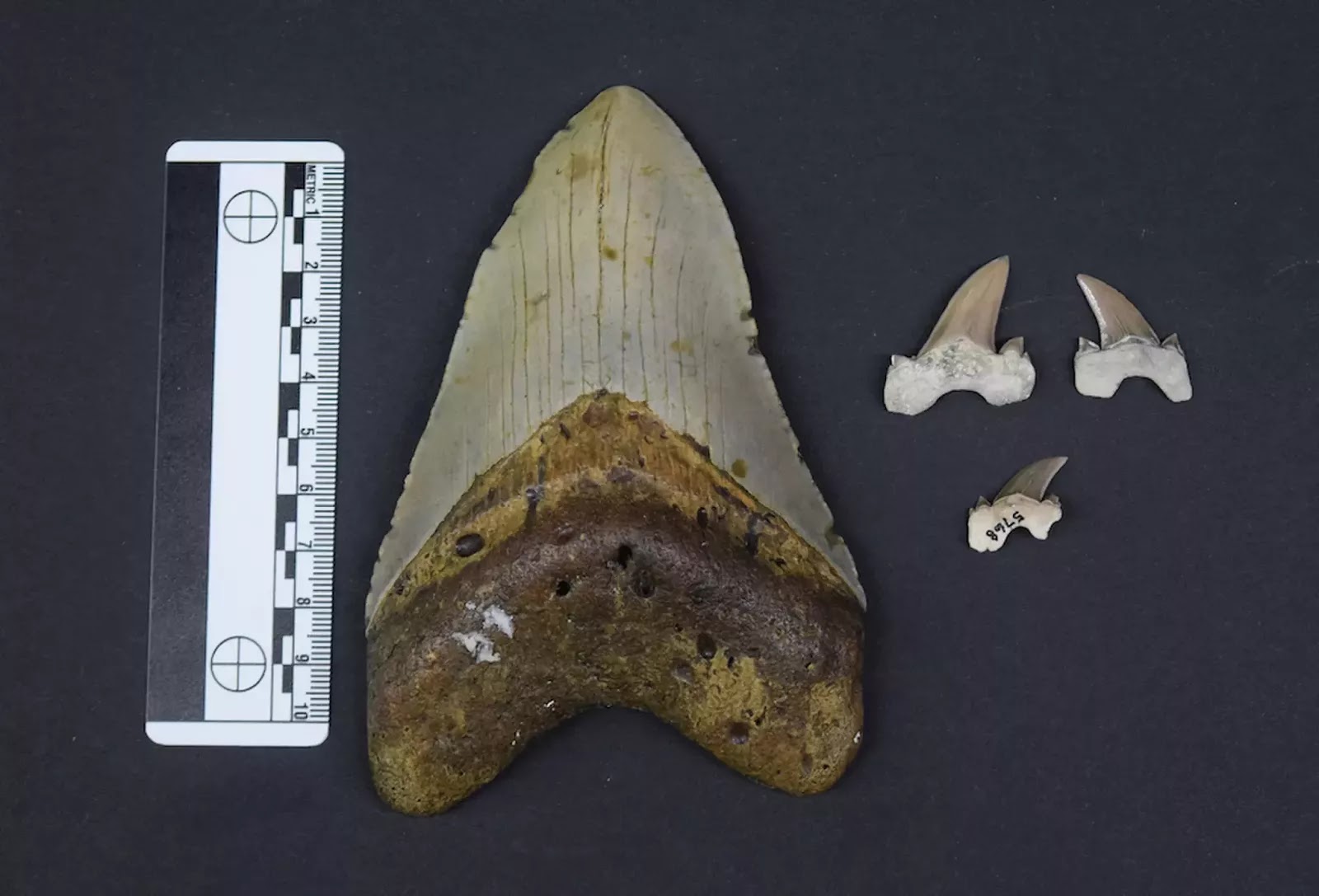
The Bryant Shark teeth are tiny compared
 to a giant megalodon tooth.
Megalodon Ancestor: Fossil Teeth Link Beast to Earth’s Largest Shark
It took nearly 40 years, but researchers have finally collected enough fossil teeth in Alabama to properly identify a previously unknown species of ancient shark — one that was a possible ancestor of megalodon, the largest shark to ever exist.

The newly identified mega-toothed shark lived about 83 million years ago, during the dinosaur age. Its largest tooth discovered so far measures about 1 inch (2.7 centimeters) long, which is substantially smaller than the 7-inch-long (17.7 cm) teeth sported by megalodon (Carcharocles megalodon), the researchers said in a new study.

"Over time, the sharks in the megalodon line acquire [tooth] serrations, lose their cusplets (the little 'fangs' on the sides of the main cusp) and grow to enormous sizes," said study lead researcher Jun Ebersole, director of collections at the McWane Science Center in Birmingham, Alabama. The newfound shark is an early member of this family, so its teeth are small and unserrated, with up to two pairs of cusplets, he said.
. . .
He added that it's difficult to calculate the length of C. bryanti based on its teeth alone. However, the shark's crown teeth are similar to a those of a mako shark, even though the two species are not related. "Thus, using recent makos as a modern analogue, the Bryant Shark may have reached lengths of up to 15 feet [4.5 m]," Ebersole told Live Science.
Still looking for that 7 inch Meg tooth. The best I have is barely 5 inches.

Sunday, January 7, 2018

Sunrise Girl Casts Light on Human Conquest of Americas

Ancient DNA Reveals a Completely Unknown Population of Native Americans
Sunrise girl-child ("Xach'itee'aanenh T'eede Gaay") lived some 11,500 years ago in what is now called Alaska, and her ancient DNA reveals not only the origins of Native American society, but reminds the world of a whole population of people forgotten by history millennia ago.

It's widely thought that the first American settlers crossed over into Alaska from Siberia via the Bering Land Bridge, which once linked up Asia and North America – although scientists are ever debating how these ancient travellers made their journey.

What's less clear is who these people were, how many groups made the trip, and how they then settled the new continent under their feet. That's where sunrise girl-child comes in.

Her remains, and those of another ancient infant known as "Yełkaanenh T'eede Gaay" (dawn twilight girl-child), were found by Potter and fellow researchers at an Interior Alaska archaeological site called Upward Sun River during excavations in 2013.

In a new study published this week, the team reports that a genetic analysis of sunrise girl-child's DNA shows she belonged to a forgotten people called the Ancient Beringians, unknown to science until now.

Before now, there were only two recognised branches of early Native Americans (referred to as Northern and Southern). But when the researchers sequenced sunrise girl-child's genome – the earliest complete genetic profile of a New World human to date – to their surprise it matched neither.

Using genetic analysis and demographic modelling, the team concludes a single founding ancestral Native American group split from East Asians around 35,000 years ago, most likely somewhere in north-east Asia. At some point, it's suspected these people moved as one in a single mass migration into North America, before – some 15,000 years or so later – the population split into two groups.
What could be so awful as to spur a mass migration across a nearly glacial, low lying tundra?
One of the groups became the Ancient Beringians – the other group were the ancestors of all other Native Americans – although it remains possible this division was already occurring before the Bering Land Bridge was crossed. "We were able to show that people probably entered Alaska before 20,000 years ago," says evolutionary geneticist Eske Willerslev from the University of Cambridge in the UK.

"It's the first time that we have had direct genomic evidence that all Native Americans can be traced back to one source population, via a single, founding migration event." Countless generations after the trek, sunrise girl-child and dawn twilight girl-child – thought to be first cousins – were born into an isolated people in the icy Alaskan wilderness of the Late Pleistocene.
This seems to settle the question of whether humans were in the New World prior to Clovis Man. They clearly were. It does not account for some of the extreme ages assigned to some pre-Clovis sites south of Alaska. I think there's still room for some "leakage" of population around the glacial barrier, possibly by skipping down the coast from safe harbor to safe harbor.

Wombat-socho has "Late Night With Rule 5 Sunday: Stacey Dash" ready for your browsing pleasure at The Other McCain.

Friday, December 22, 2017

Can a California Mastodon Remake the History of Men in America?

How the discovery of an ancient mastodon ignited debate over humans’ arrival in North America

Cutting to the chase, a mastodon fossil in San Diego, dated to 130,000 years ago, shows signs of being broken while fresh using heavy stones, also found at the site. The people who examined the fossil could think of only one explanation, humans (or hominids) breaking the bones to extract the marrow. Unfortunately, there is no good evidence for the presence of humans in North American anywhere near that early, as even in the most fevered dreams of Pre-Clovis belief, humans only arrived in the New World about 15,000 years ago, as the last glaciation was starting to lose it's grip. This find would put the date to just prior to the start of the glacial warm period before our nice, comfy one.


Needless to say, the suggestion doesn't sit well with many paleontologists.

Regardless of the truth of the allegation, it would appear likely that any prior invasion of the North America by humans was unsuccessful, as the genetics of the modern Redskins Indians Native Americans can be closely tied to the modern inhabitants on the other side of the Bering Strait.

Maybe it was the Denisovans. They seem to have gotten around a bit and left only a couple of bones, and a few genes behind.

Wombat-socho has "Rule 5 Sunday: Merry Christmas!" up and running.

Sunday, September 10, 2017

Mexican Skull Pushes Back Date for Human Invasion of Western Hemisphere

At least it's the first example of human remains that date to before the opening of the Cordilleran ice-free corridor: The Oldest Known Human Remains in the Americas Have Been Found in a Mexican Cave
An ice-free corridor between the Americas and Asia opened up about 12,500 years ago, allowing humans to cross over the Bering land bridge to settle what is now the United States and places beyond to the south. History books have conveyed that information for years to explain how the Americas were supposedly first settled by people, such as those from the Clovis culture.

At least one part of the Americas was already occupied by humans before that time, however, says new research on the skeleton of a male youth found in Chan Hol cave near Tulúm, Mexico. Dubbed the Young Man of Chan Hol, the remains date to 13,000 years ago, according to a paper published in the journal PLOS ONE.
I think the pre-Clovis hypothesis is pretty well established by now. What we don't understand clearly is how many different migrations into the America's occurred and when they occurred.
How he arrived at the location remains a great mystery given the timing and the fact that Mexico is well over 4,000 miles away from the Bering land crossing.

“Scenarios of travel by boat along the Pacific shoreline, the ‘Kelp Highway,’ must be taken seriously, but alternative migration routes by boat from Europe along the Greenland ice margin or via Antarctica are also possible, though highly speculative,” lead author Wolfgang Stinnesbeck of the Institute of Geosciences at Heidelberg University said.

“If travel by boat is correct,” he added, “then likely camp sites are now set underwater due to the early Holocene rise of sea level.”
Sea level has risen approximately 300 feet since the low point at the peak of the last glaciation about 14,000 years ago, so remains from a sea-going culture might be rare on land now, especially in areas where the land is flat, and the old coastline is some distance away. If Europeans came via the Atlantic passage, they do not appear to have left a significant genetic component in the Native American genome.
Chan Hol, meaning “little hole” in a Mayan language, is also underwater now, and was first explored by diver Kim Davidsson in 2004. It has since become a popular site for cave diving in Mexico.

Scientists grew interested in the caves as well, with exploratory dives beginning around 2006. That same year, co-author Arturo González of the Desert Museum in Saltillo, Mexico and his team discovered the remains of Young Man of Chan Hol. Additional human remains have been found in underwater caves near Tulúm, which is 80 miles south of the beach resort city of Cancún.
The caves were above water when the remains were deposited there.
For the new study, González, Stinnesbeck, and their colleagues dated the Young Man of Chan Hol’s remains by analyzing the bones’ uranium, carbon, and oxygen isotopes, which were also found in stalagmite that had grown through the pelvic bone.

The scientists believe that the resulting age of 13,000 years could apply to at least two other skeletons found in caves around Tulúm: a teenage female named Naia and a 25–30-year-old female named Eve of Naharon.

González said that the shape of the skulls suggests that Eve and the others “have more of an affinity with people from Southeast Asia.” He and his team further speculated that the individuals could have originated in Indonesia.
But we've seen in the other studies that early Americans seemed to have a different appearance than modern Redskins Indians Native Americans, who seem to have evolved their classic appearance after the invasion of the Western Hemisphere.

Wombat-socho has "Rule 5 Sunday: Not All That Obscure" up and ready for business.

Monday, July 17, 2017

Trouble for the "Out of Africa" Hypothesis?

Dienekes thinks that new results may be suggesting that the "Out of Africa" hypothesis of the origin of anatomically modern humans may be faulty, and that the split between modern man, Neandertal and Denisovans may have occurred in Eurasia: Deepest Neandertal mtDNA split
The authors interpret the new result from HST as placing a lower boundary on an introgression from Africans to Neandertals at more than 290kya, which explains why Africans are genomically closer to Neandertals than to Denisovans.

Of course, when one looks at the mitochondrial phylogeny, it has the form:

(Denisovans, (Neandertals, Modern Humans))

Within the Modern Humans, Eurasians are a branch of a tree which is mostly African. This has been interpreted for decades as evidence for the Out of Africa hypothesis for the origin of Modern Humans. But, within the phylogeny as a whole, Modern Humans are a branch of the Eurasian tree. This has not (why?) in general been interpreted as evidence for Out of Eurasia for the common ancestor of Modern Humans and Neandertals.

It seems to me that this hypothesis, that Modern Humans and Neandertals stem from a non-African ancestor (a non-African population of H. heidelbergensis, for example), has much to recommend it.

Eurasia has twice the size of Africa and has been home to hominins for ~1.8 million years. It was inhabited by diverse hominins, and thanks to blind luck we discovered that as late as a few tens of thousands years ago, it also sported two of the populations that split off before anyone else: first H. floresiensis, and second Denisovans.

While a North African source of modern humans is plausible, the data seems to favor a Eurasian origin of the (Modern Human, Neandertal) ancestor.
I guess the science isn't quite settled yet.

Wombat-socho checks in a little late with "Early Morning Rule 5 Monday."

Thursday, April 27, 2017

Progress in Human History

I think I saw her in Walmart last week
A few interesting items in the older history of the human race. First, this news that the Indonesian Hobbit, Homo floresiensis, was probably a more distant relative of humans than we might have thought: Origins of 'hobbit' species discovered
Scientists have discovered the origins of a short, ancient species of human nicknamed 'hobbits' due to their small stature, putting to rest several other theories that had been hotly debated ever since its discovery.

Homo floresiensis stood at an average height of three feet and six inches. Fossils from the species were found on the island of Flores in Indonesia in 2003.

One popular theory about its origins was that the species evolved to a smaller size from the taller Homo erectus, which has been found on nearby Java in Indonesia.

Another theory was that it wasn't a new species at all but an early human ancestor with some kind of genetic disorder — possibly Down Syndrome.

But new research by Dr. Debbie Argue from the Australian National University in Canberra, and published in the Journal of Human Evolution, has determined that Homo floresiensis is its own distinct species with roots dating back 1.75 million years.

Argue and her team studied 133 different characteristics of the Homo floresiensis skull, jaw, teeth, shoulders, legs and arms, and compared them to all other known hominid species.
I'd feel better about it if this were DNA evidence, but that's a lot to ask at this point. Even if they got good DNA from an H. floresiensis tooth or bone (and I'm sure they're trying), where would they get H. habilis DNA to compare it to? It's remarkable enough that they have good DNA from the Neandertals and Denisovans, much more recent.

They found that it's a long-surviving cousin of Homo habilis, an early human ancestor with roots in Africa. None of their tests yielded evidence to support the theory that Homo floresiensis evolved from Homo erectus.

"These two species are most likely to have shared a unique common ancestor that was not shared with any other species in our analysis," she said. "But [Homo floresiensis] lived half a world away, and is separated in time by maybe two million years."

Argue says one of the most interesting things about the species is that it lived until about 54,000 years ago — which is very recent, evolutionarily speaking.
Apparently, the little guys and gals were pretty successful in their own little world, and hung around a long time on the Indonesian  archipelagos. I suspect that when they really start looking around they'll find more relatives. They clearly overlapped with a number of other primitive humans, Homo erectus, Denisovans, and Neandertals and modern Homo sapiens to name a few.

Moving forward a few tens of thousands of years, Ancient humans may have reached Americas 100,000 years earlier than thought
In a provocative and controversial claim, scientists say a scattering of bones and stones suggests ancestral humans reached the New World more than 100,000 years earlier than previously thought.

Most genetic and archaeological evidence shows humans first entered the Americas some 15,000 years ago. But a study nearly 25 years in the making in this week’s Nature finds that the 130,000-year-old bones of a mastodon, an extinct relative of the mammoth, unearthed in California were split open with blows from rocks. Rocks discovered near the bones bear the hallmarks of use as hammers, the scientists report.

The smashed bones may have been the handiwork of a Neanderthal, the scientists say, or the more ancient human relative called Homo erectus, or even our own species, Homo sapiens.

“We are making a claim that’s kind of out there,” acknowledges study co-author Daniel Fisher of the University of Michigan. “We have had to toil over years to make sure we have considered every angle.”
Again, if true, this really revolutionizes our ideas of how the Americas were colonized. Did Neandertals or even Homo erectus get there across Beringia during a previous glaciation? Did they muck around on the continent long enough to bump into (and interbreed) with the proto-Amerindians? Cool if it happened. I'd be much happier with this if there were actual hominid bones to go with it, but I wouldn't expect them to bury their dead with their dinner.

Finally, moving to (almost) civilized man, some scientists are claiming that one of the earliest stone monuments of man, via Dieneke's Blog:  Younger Dryas comet impact encoded in Göbekli Tepe?
We have interpreted much of the symbolism of Göbekli Tepe in terms of astronomical events. By matching low-relief carvings on some of the pillars at Göbekli Tepe to star asterisms we find compelling evidence that the famous ‘Vulture Stone’ is a date stamp for 10950 BC ± 250 yrs, which corresponds closely to the proposed Younger Dryas event, estimated at 10890 BC. We also find evidence that a key function of Göbekli Tepe was to observe meteor showers and record cometary encounters. Indeed, the people of Göbekli Tepe appear to have had a special interest in the Taurid meteor stream, the same meteor stream that is proposed as responsible for the Younger-Dryas event. Is Göbekli Tepe the ‘smoking gun’ for the Younger-Dryas cometary encounter, and hence for coherent catastrophism? Link (pdf)
I looked at the link, and you have to give them bonus points for creativity. Their interpretations of ancient star maps carved in stone are interesting, but not convincing. But they get double bonus by combining it with the Younger Dryas cooling event.

Wombat-socho is back on schedule with "Rule 5 Sunday: Formal Affairs".

Monday, August 22, 2016

The Death of the Cordillera Ice Free Corridor Hypothesis?

A final blow to myth of how people arrived in the Americas
. . . It all comes down to timing, according to new research published Wednesday in the journal Nature. The ice-free corridor through the Canadian cordillera couldn't have supported human migration until about 12,600 years ago. But the Clovis people were already living south of the ice sheets by 13,500 years ago.

So what did happen?

The broad strokes haven't changed. When the Ice Age lowered sea levels and turned the Bering Strait into a land bridge, ancients migrated from Siberia to present-day Alaska, where they encountered a massive icy roadblock preventing further migrations deeper into the Americas. So the people hunkered down in that small Alaska region, called Beringia, for thousands of years.

It's not as simple as figuring out when the ice-free corridor opened up. The corridor is thought to have actually been open around 15,000 to 14,000 years ago – early enough to predate the Clovis settlements south of the ice (although they would have had to hustle to make it from Beringia to those settlements via the corridor).

But just because there wasn't an ice sheet in their way anymore, doesn't mean that people could have migrated down the approximately 930-mile-long corridor. After being scoured down to bedrock by mile-high ice sheets, it took time for the land to become biologically rich enough to support migrating humans.
Evidence from the rest of the world suggests that it doesn't take much of an environment to support people. There are, or at least were, primitive humans living in the most forbidding environments, from the arctic Greenland to the Kalahari desert.
Plants and animals would have to be thriving along the whole corridor to provide inviting food sources, wood for fire, and other survival needs. Humans venturing out from Beringia likely didn't know what lay to their south, so they wouldn't have prepared for a long journey. They would have simply seen a new region of land to settle.

And, as Meltzer told Nature, "It's 1,500 kilometres. You can't pack a lunch and do it in a day."
No, but supremely practiced survivalists could do it in less time than you think. A few practice round trips by the more adventuresome Beringians, and I suspect that they would be be itching to put together a mission to take the wife(s) and kids to the promised land of milk and honey, or at least mammoths and elk south of the ice.

I think it's a mistake to underestimate the adventuresome nature of mankind.  I'm sure that once the corridor opened, humans were exploring it, looking for something, anything really, they could exploit. And of all the people we know, the Clovis culture may have been the most adventuresome. In the course of a few hundred years, they left their tools over two continents, and then disappeared. It's hard to imagine it was from population pressures, or even lack of resources, as the last of the North American Megafauna were found all over the continent, having never been hunted by man previously and relatively naive to the threat posed by the simian invasive species. Nope, they just had a bad case of wanderlust.

I'm not arguing for the central corridor route over the coastal route. Humans have oriented to water for food and transportation for a long time, and likely had the ability to make canoes capable of long sea trips. However, in the absence of proof that they could not come through the ice free corridor, I would expect the answer to be both rather than one alone.

Wombat-socho snuck in late with "Rule 5 Sunday: Viva Los Lobos!".

Wednesday, June 8, 2016

Hobbits Predated Humans

We've seen news about the "hobbits" (diminutive fossil hominids of the Indonesian island of Flores) before. Now, new fossils suggest that they were present on the island for a long period, starting before modern humans evolved in Africa. Miniature 'Hobbit' Humans Had Even Smaller Ancestors
A recent full-body reconstruction of LB1,
 the ‘little lady of Flores’,
Ancestors of the mysterious extinct human lineage nicknamed "hobbits" may have been discovered, a new study finds.

The newfound individuals may have been even littler than the hobbits, and date much further back in time (from some 700,000 years ago), scientists added. This suggests these ancestors may have shrunk rapidly after reaching the islands where the hobbits lived, the scientists said. Those islands include Flores, where the hobbit remains were originally found.

"These are priceless treasures that provide the first real insight into the evolutionary history of the mysterious 'hobbits' of Flores," said Adam Brumm, an archaeologist at Griffith University in Nathan, Australia, and co-lead author of one of two studies on the new finding published in the June 9 issue of the journal Nature.[See Images of Homo floresiensis, the Hobbit]
Island or insular dwarfism is a well known phenomenon, where populations of large animals on small islands tend to evolve towards smaller sizes, and populations of small animals tend to evolve towards larger sizes, producing mini-mammoths and giant rats.

Scientists have proposed that H. floresiensis evolved from a group of Homo erectus, an extinct human species that is the earliest undisputed ancestor of modern humans. Scientists also proposed that this population shrank in size either shortly before or after reaching Flores.

Another possibility is that H. floresiensis evolved from even more primitive hominins with more ape-like skeletons and smaller brains, such as the extinct human species Homo habilis or even the prehuman Australopithecus species. Researchers have argued that if the hobbit did have such ancient origins, this would reveal that hominins left Africa much earlier than previously thought.

The new discovery — which includes seven fossils that date back a half-million years earlier than those of H. floresiensis — points to the H. erectus link, the researchers noted.
Initially when H. floresiensis was found, some proposed that they were really abnormal modern humans. The new dates make that impossible.
The fossils include an adult jaw fragment and six teeth from at least three individuals, including two tiny "milk teeth" from separate infants. The researchers found that these remains are at least 700,000 years old, dating to a time "when there were no modern humans on the planet," Yousuke Kaifu, a paleoanthropologist at Japan's National Museum of Nature and Science in Tokyo and co-lead author of one of the two studies, told Live Science. (Previous research has suggested that modern humans arose in Africa about 200,000 years ago.)
So, there really were hobbits. Now we need to find some elves, or dwarves. Maybe the Denisovans were the dwarves.

 Alongside the Mata Menge fossils, the scientists found stone tools that were markedly similar to artifacts found with the Liang Bua hobbits. The researchers also noted that previous research unearthed stone tools on Flores that were at least 1 million years old, suggesting that hobbits and their ancestors lived on the island for at least that long.

The researchers noted these fossils are less ape-like than Australopithecus and H. habilis, suggesting that H. floresiensis is a dwarfed descendent of H. erectus, van den Bergh said. "The Mata Menge fossils are intermediate in shape between Homo erectus and Homo floresiensis from Liang Bua," van den Bergh said.

Monday, February 15, 2016

Depressed About Smoking, Blood Clots or Skin Cancer? Blame the Cavemen in Your Family Line

From Dieneke's Blog: Phenotypic effects of Neandertal admixture
The phenotypic legacy of admixture between modern humans and Neandertals - Corinne N. Simonti et al.

Many modern human genomes retain DNA inherited from interbreeding with archaic hominins, such as Neandertals, yet the influence of this admixture on human traits is largely unknown. We analyzed the contribution of common Neandertal variants to over 1000 electronic health record (EHR)–derived phenotypes in ~28,000 adults of European ancestry. We discovered and replicated associations of Neandertal alleles with neurological, psychiatric, immunological, and dermatological phenotypes. Neandertal alleles together explained a significant fraction of the variation in risk for depression and skin lesions resulting from sun exposure (actinic keratosis), and individual Neandertal alleles were significantly associated with specific human phenotypes, including hypercoagulation and tobacco use. Our results establish that archaic admixture influences disease risk in modern humans, provide hypotheses about the effects of hundreds of Neandertal haplotypes, and demonstrate the utility of EHR data in evolutionary analyses.
So, that sounds like a list of the family health problems, blood clots, skin lesions, and a little smoking here and there. Depressing isn't it? Interesting to find out it might come from the 3-5% of Neandertal genes that most of us European and Asian types carry. But what about the Africans among us, with essentially no Neandertal genes? Who do they get to blame. Oh, wait . . .

Dienekes goes on to wonder about any good traits that may have come from our Neandertal ancestors:
Doubtlessly, as we begin to better understand the genetics underlying positive human traits, some of these will end up having come from archaic humans. Neandertal admixture was a huge injection of "new stuff" into the Eurasian modern human gene pool, and there is every reason to think that even if the "bad stuff" outweighed the "good", there was still plenty of room for functionally beneficial variants to be acquired from them.
Wombat-socho's "Rule 5 Sunday: Rally ‘Round The Banner, The Banner Purple And Green" is ready at The Other McCain.

Monday, October 26, 2015

Is Man the Boxing Ape?

I saw this the other day: Human fist evolved to punch, new study says
Were human hands built for punching? A new study of cadaver arms suggests this may be the case.

By using the arms to hit a dumbbell three different ways, scientists determined that a clenched fist makes it much safer to serve someone a knuckle sandwich.

The findings, published this week in the Journal of Experimental Biology, bolster a controversial theory that ties human physiology to a violent past.

Compared with primates such as chimpanzees, humans have developed a very different hand structure that features a shorter palm, shorter fingers and a relatively longer thumb. The conventional wisdom holds that our hands evolved for more dexterity, allowing our ancestors to wield and manipulate tools.

“There’s every reason to believe that,” said David Carrier, a comparative physiologist at the University of Utah.

However, Carrier and his colleagues have put forth another, perhaps complementary, idea. They posit that as the human hand was becoming more delicate, it may have evolved into just the right shape to fit into a fist — all the better for punching opponents without accidentally breaking one’s bones.
And I remembered this, which I failed to blog back in 2014:  Male faces 'buttressed against punches' by evolution
A new theory suggests that our male ancestors evolved beefy facial features as a defence against fist fights.

The bones most commonly broken in human punch-ups also gained the most strength in early "hominin" evolution.

They are also the bones that show most divergence between males and females.

The paper, in the journal Biological Reviews, argues that the reinforcements evolved amid fighting over females and resources, suggesting that violence drove key evolutionary changes.

Fossil records show that the australopiths, immediate predecessors of the human genus Homo, had strikingly robust facial structures.

For many years, this extra strength was seen as an adaptation to a tough diet including nuts, seeds and grasses. But more recent findings, examining the wear pattern and carbon isotopes in australopith teeth, have cast some doubt on this "feeding hypothesis".

"In fact, [the australopith] boisei, the 'nutcracker man', was probably eating fruit," said Prof David Carrier, the new theory's lead author and an evolutionary biologist at the University of Utah.

"Jaws are one of the most frequent bones to break - and it's not the end of the world now, because we have surgeons, we have modern medicine," Prof Carrier explained. "But four million years ago, if you broke your jaw, it was probably a fatal injury. You wouldn't be able to chew food... You'd just starve to death."

The jaw, cheek, eye and nose structures that most commonly come to grief in modern fist fights were also the most protected by evolutionary changes seen in the australopiths.
Furthermore, these are the bones that show the most differences between men and women, as well as between our male and female forebears. That is how you would expect defensive armour to evolve, Prof Carrier points out.
My guess is that tool using, which in some primitive form is still used by Chimpanzees, put a lot of selective pressure on hands, making them stronger and more able as "smashing" weapons, which in turn, encouraged their use and subjected them to more evolutionary pressure to perfect them as bare weapons (which is not to say primitive people wouldn't use weapons at hand on their fellows). This, in turn, put on evolutionary pressure to make the face more robust.

But we're all just bullshitting about this. . .

Wombat-socho has "Rule 5 Sunday: Just What It Says On The Label" ready at The Other McCain to fulfill any Rule 5 needs I might have missed.

Sunday, October 18, 2015

An Early Date for Prehistoric China-men

From Dienekes' Blog: Modern humans in China ~80,000 years ago (?)
Another (?)-worthy paper has just appeared in Nature in the heels of the African ancient genome paper. Time will tell how these worldview-altering discoveries will change the story of Mankind, and a degree of skepticism is warranted. In the view I've held for a few years, modern humans expanded to Arabia before 100 thousand years ago, started leaving it 70 thousand years ago as the ecological situation worsened due to desertification and broke through the "Neandertal barrier" between 70-50 thousand years ago when they developed the skills and technology to overcome them.

The new paper claims that modern humans were in China 80 thousand years ago and came to Europe much later because Neandertal represented a barrier to successful entry to Europe. This begs the question of how they reached China without encountering Neandertals, as Neandertals were also in West Asia where -presumably- they passed through to get to China. A coastal route to south China would explain away this problem, but the coastal migration is usually envisioned much later, at around 60 thousand years ago. On top of that, how did Chinese end up having equal (or more) levels of Neandertals admixture if modern humans first went to China and later moved west and successfully outcompeted the Neandertals. How were they able to do so eventually? (There is no evidence that the kind of advantages associated with behavioral modernity first emerged in East Asia). It's possible that there were 80 thousand year-old modern humans in China (just as there were 100 thousand year-old modern humans in Israel), but that the later East Asians are not descended from them.
A moderately interesting wrinkle in the story of human evolution and expansion out of Africa. I'm not really accustomed to thinking of Neandertal as a barrier to modern human expansion. By all accounts I've seen, they were not particularly abundant even at the height of their era, and they folded pretty fast in the face of us "moderns". They were lucky to have some fraction of the genome survive by a certain amount of interbreeding (and perhaps even more to the point, the successful integration of the neandertal-modern hybrids into the moderns societies.

Wombat-socho has "Rule 5 Sunday: Pre-Halloween Pinups" up at The Other McCain.

Friday, September 11, 2015

Six Chicks Discover New Man

There's a lot of news stories and blog posts about the recent discovery of an arguably new potential new human ancestor Homo naledi in fossils from a cave in South Africa (I say arguably because at least one scientist claims that they fit comfortably within the envelope of Homo erectus. Being more inclined to the lumper persuasion of taxonomy than that of the splitters, I tend to think that extraordinary claims require extraordinary evidence. We'll know more as time goes on. Hopefully, they will succeed in dating the fossils, and maybe even getting a DNA sequence (although those chances seem faint given their supposed age).

But I saw this via Maggies Farm, and it seemed a interesting take on the story. Six small, skinny women cavers were chosen to enter the cave and seek the fossils because of the very narrow entrance to the cave, 18 cm, about 0.1 fathoms to us mariner types, or 6 inches English/American.
Lee Berger put his ad up on Facebook on October 7th, 2013. He needed diggers for an exciting expedition. They had to have experience in palaeontology or archaeology, and they had to be willing to drop everything and fly to South Africa within the month. “The catch is this—the person must be skinny and preferably small,” he wrote. “They must not be claustrophobic, they must be fit, they should have some caving experience, climbing experience would be a bonus.”

“I thought maybe there were three or four people in the world who would fit that criteria,” Berger recalls. “Within a few days, I had 60 applicants, all qualified. I picked six.” They were all women and all skinny—fortunately so, given what happened next. Berger, a palaeoanthropologist at the University of the Witwatersrand, sent them into the Rising Star Cave, and asked them to squeeze themselves through a long vertical chute, which narrowed to a gap just 18 centimeters wide.

After entering the cave, the team almost immediately hit several narrow, pitch-black corridors, a knife-edge ridge called the Dragon’s Back with steep drops on either side, and finally that 12-meter chute. “It’s a long crack, punctuated by shark-teeth protrusions,” says Elliott. “I remember looking down and thinking: I’m not sure I made the right decision.”

At the bottom, the team eased down into an area they dubbed the Landing Zone, before entering the fossil-filled trove that they called the 101 Chamber. On the first day, they excavated a single bone—a mandible. “It came out and we said: Wait a minute, this isn’t what we thought,” says Hawks. Tucker’s images hinted at an australopith-like jaw but he had forgotten to include a scale bar. The actual specimen was vastly smaller, and its teeth were almost human-sized. “We thought: We’re looking at something special here.”
. . .
By the end of the week, the team had excavated more fossils than had ever been found in a South African site. Shortly thereafter, they exceeded the tally from all of southern Africa from the previous 90 years. It took months to process all the 1,550 or so fragments and assemble them into 15 skeletons—male and female, elderly and infant.  
So, who cares if they would make lousy combat marines, they make great anthropologists.

Wombat-socho has the big list, "Rule 5 Sunday: Proudly Encouraging The Male Gaze Since 2009" up at The Other McCain.

Wednesday, September 2, 2015

Did Neandertal Go to the Dogs?

Did Dog-Human Alliance Drive Out the Neanderthals?
In her new book, The Invaders: How Humans and Their Dogs Drove Neanderthals to Extinction, Pat Shipman, retired adjunct professor of anthropology at Pennsylvania State University, sets out a groundbreaking new argument.

Talking from her home in North Carolina, she explains how reading about invasive species while holidaying on a Caribbean island inspired her, why more accurate carbon-dating methods have revised the timeline for Neanderthal extinction, and how the discovery of "wolf dog" remains at woolly mammoth sites in Central and Eastern Europe may hold the key to understanding why humans went on to build the Sistine chapel and send a robot to Mars while Neanderthals became a footnote in popular culture.
Except that there's a little Neanderthal (~5%) left in most of us non-Africans as a result of a small amount in interbreeding.
First of all I want to say that when I use the term wolf dog, I don't mean a hybrid between a wolf and a modern dog. It's not clear if it's appropriate to call these things wolves or dogs. They're not modern dogs, and they're not modern wolves. They're not ancient wolves, either. They're a distinctive group. Forty individual specimens, at a number of different sites, have been identified as what I'm calling wolf dogs.

They're large, have big teeth and all those predatory, dog/wolf characteristics. You have to assume from the anatomy that they could track very well from the scent of an animal. They were built to be fast running, as wolves and most dogs are. Humans don't run terribly fast. We have a crappy sense of smell. We do cooperate with each other, which is helpful, and we had long-distance weapons, like spears and bows and arrows.
Some of the work on these "proto" dogs suggest they were the size and shape of large huskies.
Neanderthals seem to have specialized in stabbing an animal at close quarters with handheld weapons and wrestling it down. We had weapons we could launch from a distance, which is a very big advantage. There's a lot less risk of personal injury.

Add into that mix the doggy traits of being able to run for hours much faster than we can, track an animal by its scent, then with a group of other wolf dogs surround the animal and hold it in place while you tire it out. The advantage for wolf dogs is that humans can come in and kill from a distance. The wolf dogs don't have to go and kill this thing with their teeth, thereby lowering the risk of injury and death from very large animals like mammoths. For humans, it meant you could find the animals a lot quicker and kill them more efficiently. More food, less risk, faster.
People have been using dogs to hunt for a long time. Plus people tend to leave a lot of edible garbage behind, at least from a dog's point of view.

A lot of the new evidence from your claims came from an archaeological site in Předmostí, in the Czech Republic. Describe this place and how these finds revolutionized our understanding of Neanderthals.

Předmostí is one of a series of archaeological sites in Central and Eastern Europe. They're really weird sites because they're full of dead mammals. Before modern humans came into Eurasia, there was little evidence that Neanderthals were killing mammoths on a regular basis. They're huge! Attacking them with handheld weapons was probably too intimidating, unless you came across a baby mammoth.
 I've heard the Pygmies kill elephants in the Congo by stabbing them in the gun with spears, and then tracking them until they die.
But once modern humans arrive on the scene, you start finding these sites with dozens and sometimes hundreds of dead mammoths. At some, the bones are so concentrated that if the mammoths were alive they couldn't stand in the territory where their bones are.

Neanderthals didn't have the chops to bring down woolly mammoths, but modern humans hunted them successfully, thanks to their wolf dog partners.
 I think the scientists should try the experiment with modern elephants, and their own dogs.
These mammoth megasites, as they became known, contain an outrageous amount of mammoths. So what's changed that is going to enable modern humans to kill all these animals? Neanderthals couldn't, and they weren't inept. Distance weapons of the kind that humans had might have been helpful, but you had to track the darn thing as it died.

And that's where wolf dogs come in, because wolf dogs are found with lots of mammoth bones. Some of these sites even have beautiful tent-shaped huts made out of mammoth bone. This suggests people were there for a long time. They were living there and building these settlements where the animals died.
This is an elaboration of a theory that we've seen before, that dogs and modern humans co-evolved, that in the process of "domesticating" the wolf both the domesticated wolf and modern humans evolved to work together. This theory goes on to suppose that this is the reason that the dog-human collaboration made the difference between modern human dominating the modern world or not, and thus overwhelming the Neanderthal, who had survived fairly well in Europe up until that point.

True? It's hard to tell, and I think it will be different find anything more than correlative evidence. Dog bites on a Neanderthal skeleton?

Wombat-socho has "Rule 5 Sunday: Summertime Girls" ready at The Other McCain.

Sunday, July 26, 2015

Scientists Continue to Excavate Paleolithic German Porn Stash

one fragment of new Hohle Fel's find
Fragments of a new female figurine from Hohle Fels Cave
Archaeologists, Prof. Nicholas Conard and his team member Maria Malina, present the discovery of two fragments of a new female figurine in today's edition of the journal: Archäologische Ausgrabungen Baden-Württemberg. The figurine shows similarities with the well-known Venus from Hohle Fels that Prof. Conard published in 2009.
Theee views of the original Hohle Fel's figurine

The two pieces of carved mammoth ivory fit together to form a find with dimensions of 23 x 22 x 13 mm. The find does not appear to be part of a depiction of an animal or lionman, both frequent motifs from the caves of the Swabian Jura of southwestern Germany. Instead, the find shows strong affinities with the only other female figurine known from the region. The find will be exhibited as part of a small research exhibit at the Museum of Prehistory in Blaubeuren.
The original Hohle Fells figurine presents, shall we say, a rather stylized view of a woman, with ginormous  breasts, and vulva, and no head and rudimentary limbs. The little bump where the head would be is actually a carved loop where a string or cord could be attached, for use as a necklace or talisman. A bit like a Franzetta cave girl, except even more exaggerated.
The female depictions from Hohle Fels date to 40,000 years ago are the oldest depictions of humans thus far recovered. While the new find is modest compared to the "Venus of Hohle Fels," its form and the engravings on the surface show strong similarities with the more complete Venus. The new fragment, which represents a breast and part of the stomach, comes from a sculpture that appears to be slightly larger than the ca. 6 cm high discovery from 2008. Both female figurines come from the Aurignacian period during which modern humans rapidly spread across Europe, displacing the indigenous Neanderthals.
It was in this era that a few percent Neandertal genes snuck into the human genome.
Prof. Conard remarks:" The new discovery indicates that the female depictions are not as rare in the Aurignacian as previously thought, and that concerns about human sexuality, reproduction and fertility in general have a very long and rich history dating to the Ice Age."
Proving once again that men will be men. . .