Showing posts with label archaeology. Show all posts

Wednesday, November 3, 2021

A Long, Long Time Ago

OK, OK, I'm gonna do it. I've been keeping these tabs open forever, waiting for "the right time" to post them. Stuff about human evolution and archeology, that I find fascinating. First, the ultimate nail in the 'Clovis First' hypothesis (which has been pretty well killed in the last few years anyway), from CNN, Fossilized footprints show humans made it to North America much earlier than first thought

The commonly held view is that people arrived in North America from Asia via Beringia, a land bridge that once connected the two continents, at the end of the Ice Age around 13,000 to 16,000 years ago. But more recent -- and some contested -- discoveries have suggested humans might have been in North America earlier.

Now, researchers studying fossilized human footprints in New Mexico say they have the first unequivocal evidence that humans were in North America at least 23,000 years ago.

"The peopling of the Americas is one of those things that has been for many years very contentious and a lot of archeologists hold views with almost religious zeal," said Matthew Bennett, a professor and specialist in ancient footprints at Bournemouth University and author of a study on the new findings that published in the journal Science on Thursday.

Bennett and his colleagues were able to accurately date 61 footprints by radiocarbon dating layers of aquatic plant seeds that had been preserved above and below them. The prints, which were discovered in the Tularosa Basin in White Sands National Park, were made 21,000 to 23,000 years ago, the researchers found.

The timing and location of the prints in southwestern North America suggests that humans must have been on the continent much earlier than previously thought, Bennett said. The people who made the footprints -- mostly teenagers and children -- were living in New Mexico at the height of the last Ice Age.

Which really calls into question when people really arrived in the New World. How could they get here at the height of the last glaciation? Boats? Had the been here since the Eemian warm era (the last warm period before the current one, 130,000 to 115,000 years ago, and were living in the New World, leaving barely a trace? Seems unlikely, but then so does arriving here at the height of the ice advance.

Next, from UPI, Humans used tools to make clothes more than 100,000 thousand years ago

Humans living on the Atlantic coast of what's now Morocco were making clothes from animal hides between 120,000 and 90,000 years ago, according to a new study.

Initially, researchers assumed the bones they were collecting were the remnants of an ancient meal. Scientists wanted to analyze the animal bones to better understand what Contrebandiers Cave's early human inhabitants were eating.

But instead of evidence of an ancient menu, researchers found the remnants of clothes-making tools. Scientists detailed the breakthrough discovery in a new paper, published Thursday in the journal iScience.

You want what?

"These bone tools have shaping and use marks that indicate they were used for scraping hides to make leather and for scraping pelts to make fur," lead study author Emily Hallett said in a press release.

"At the same time, I found a pattern of cut marks on the carnivore bones from Contrebandiers Cave that suggested that humans were not processing carnivores for meat but were instead skinning them for their fur," said Hallett, a researcher at the Max Planck Institute for the Science of Human History in Germany.

I'm going to guess the first beauty contest was held about then, too. 

Artnet,  Archaeologists Have Uncovered Cave Art That’s Way Older Than Any on Record—and It Was Made by Children You mean Gabi's hand prints on the wall are cave art? Who knew?

A team of international scientists has uncovered ancient hand and foot prints that may upend our understanding of early cave art.

The experts believe that the impressions identified near Quesang village in the Tibetan Plateau are between 169,000 and 226,000 years old. That would make them, by far, the earliest known examples of parietal art (more commonly known as “cave art”). What’s more, they say, these works were created by children.

The discovery, published this month in Science Bulletin, was made by a group including David D. Zhang from Guangzhou University and Matthew Bennett of Bournemouth University. They write that the hand and foot impressions “appear to have been intentionally placed on the surface of a unit of soft travertine.”

Phys.org, When and why did human brains decrease in size 3,000 years ago? Ants may hold clues. Short answer. Civilization made us stupider. 

"A surprising fact about humans today is that our brains are smaller compared to the brains of our Pleistocene ancestors. Why our brains have reduced in size has been a big mystery for anthropologists," explained co-author Dr. Jeremy DeSilva, from Dartmouth College.
. . .
The timing of size increase coincides with what is previously known about the early evolution of Homo and the technical advancements that led to; for example, better diet and nutrition and larger social groups.

Faster, please. Entrepreneur, This New Company Says It's Bringing Back the Woolly Mammoth, As A Way to Fight Climate Change. Then release them in Central Park.

The woolly mammoth was last seen roughly 10,000 years ago, during the Ice Age. Can bringing it back help cool our warming planet now?

That’s the bold idea put forward by Colossal, a bioscience and genetics engineering company that launches today — and is backed by Harvard University and some of the world’s most forward-thinking scientists.

Fighting climate change with mammoths may seem crazy, but it has decades of research behind it — including the work of George Church, Ph.D., a world-renowned pioneer in genomics. Church runs a lab at Harvard and has been exploring how to genetically re-engineer the woolly mammoth using its closest living relative, the Asian Elephant.

The reason is this: One of the greatest threats to the earth is the melting of the arctic permafrost and its massive release of the greenhouse gasses that are stored safely in its freeze. When the herds of woolly mammoth and other animals vanished, that area became covered with a forest that keeps the earth warmer. Church is betting on the idea that a resurrected population of the mammoths, if let loose in the arctic, would chomp and stomp down the bush and trees, exposing the earth to subzero temperatures and allowing the tundra’s original grasslands to grow back. That ecosystem, maintained by the large creatures, would then effectively sequester carbon, rather than allowing it back into the atmosphere.

Real Clear Science, Humans Had Advanced Fishing Technology 12,000 Years Ago in Israel

Ancient humans living between 12,000 and 15,000 years ago in what is now Northern Israel were using sophisticated hooks, lines, weights, and lures to catch fish, a new analysis published to PLoS ONE reveals.

An international team of researchers led by Dr. Antonella Pedergnana at the University of Zurich analyzed a variety of hooks and grooved pebbles found at the Jordan River Dureijat site on the Upper Jordan River in the Hula Valley of Israel. The hooks (pictured above), are made of bone, likely taken from butchered gazelle or fallow deer, and some even have rudimentary barbs to ensure that bait stays attached and to prevent fish from escaping. The small pebble weights are primarily composed of limestone and were grooved so the ancient fishers could affix their lines. The researchers suggest that the weights were likely used in tandem with floats, perhaps made from porcupine quills, to position the baited hook at a desired depth underwater.

The Jordan River Dureijat site never seems to have been inhabited, but was "a place that people visited again and again to take advantage of the confluence of diverse lake shore resources," the researchers speculated. There are no signs that the hooks or grooved pebbles were ever manufactured there. The likeliest explanation for their abundance at the site is that they were lost in the water when fish snapped the lines, or were casually tossed aside if broken.

The ancient fishers likely hailed from the Natufian culture, who lived a mostly stationary lifestyle even before the introduction of agriculture. The varying hook sizes they used suggests that they caught numerous species of fish, including carp and trout. Fishing lines were probably crafted from plant material. Residues observed on the hooks confirm the early use of artificial lures, perhaps fashioned from shells, which attract a fish's attention via colors, movements, and vibrations.

"The use of lures by prehistoric anglers reflects detailed knowledge of fish behavior and diet," the researchers say.

Well, as we learned above, they probably were smarter than we are. 

Friday, May 7, 2021

Early Hominids Still in Trees

Jerusalem Post. New research into a fossil from 3.67 million years ago has indicated that early humans were still swinging from trees alongside apes, long after they had already developed the ability to walk.

Although science has made progress in understanding human evolution in recent years, there are many sections of our evolutionary tree that remain unknown. The further back it goes, the harder it is to find fossilized evidence.

One aspect that remains largely unknown is the point at which humans evolved to be bipedal while chimpanzees remained quadrupedal. The new analysis of Little Foot’s upper body sheds light on this question. It shows that the way in which early human ancestors used their arms was much more similar to other ape species than to modern humans.

Although other areas of Little Foot’s body show that the species had already developed the tendency to walk upright, the arms, and in particular the shoulders, were clearly apelike.

 Sounds like a girl I went to high school with.

According to Kristian J. Carlson, lead author of the study and associate professor of clinical integrative anatomical sciences at USC, this discovery is the best known evidence of how early humans used their arms more than three million years ago.

The fossil is unique in that it was discovered nearly intact. Scientists estimate that the body of Little Foot, a four-foot-tall female from the region of South Africa, fell into a pit and was preserved and fossilized by the climate. She then remained there untouched for an estimated 3.67 million years until her discovery in 1994.

The intact skeleton has offered more clues into human evolution than many of its counterparts due to its condition when it was found. Scientists focused on the shoulders throughout the study, as they are the most complete and comprehensive specimen that has been discovered to date.


The species, classified as Australopithecus, had shoulder blades that were suited to be attached to thick, heavy muscles, more similar to the ones found in gorillas and chimpanzees than in humans. The shoulder blades were sturdy and reinforced, seemingly to support the weight of the body as it moved from tree to tree.

In addition to this, the collarbone had a distinctive S-shaped curve, which is commonly found in apes, and the shoulder joint sat at an angle suitable for stabilizing the body when an ape is hanging from tree branches.

However, the angle of the spine in relation to the skull shows that although the species was still suited for living in the trees, they did predominantly walk in an upright position.


The Wombat has Rule 5 Sunday: Not From The Black Widow Movieready for your digital delight at The Other McCain.

Saturday, March 7, 2020

DNA Confirms Viking Warrior Woman

Shades of Lagertha Viking skeleton’s DNA test proves historians wrong
The remains of a powerful Viking — long thought to be a man — was in fact a real-life Xena Warrior Princess, a study released Friday reveals.

The lady war boss was buried in the mid-10th century along with deadly weapons and two horses, leading archaeologists and historians to assume she was a man, according to the findings published in the American Journal of Physical Anthropology.

Wrong.

“It’s actually a woman, somewhere over the age of 30 and fairly tall, too, measuring around [5 feet 6 inches] tall,” archaeologist Charlotte Hedenstierna-Jonson of Uppsala University, who conducted the study, told The Local.

And she was likely in charge.

“Aside from the complete warrior equipment buried along with her — a sword, an ax, a spear, armor-piercing arrows, a battle knife, shields, and two horses — she had a board game in her lap, or more of a war-planning game used to try out battle tactics and strategies, which indicates she was a powerful military leader,” Hedenstierna-Jonson said. “She’s most likely planned, led and taken part in battles.”

The discovery marks the first genetic proof that women were Viking warriors, according to science publication Phys.org.

The Viking grave was first found and excavated by Swedish archaeologist Hjalmar Stolpe in the late 1800s.

But a few years ago, osteologist Anna Kjellström of Stockholm University noticed its skeleton had fine cheekbones and feminine hip bones, researches said.

They conducted DNA analysis and confirmed it was a female.
The old stories score another victory.

The Wombat has Rule 5 Sunday: Joy Harmon up on time at The Other McCain.

Friday, November 23, 2018

Did a Meteorite Strike Destroy Sodom and Gomorrah?

Lot Fleeing Sodom - Benjamin West
According to Newsweek, Biblical City of Sodom Was Blasted to Smithereens by a Massive Asteroid Explosion
An asteroid that burst in a searing aerial explosion may have destroyed the Bronze Age city of Tall el-Hammam 3,700 years ago, archaeologists reported Saturday.

The city, which lies in the Middle Ghor region of the Jordan Valley, is considered a plausible site for the biblical city of Sodom by some researchers. But this conclusion is hotly debated within the field.

The cities of Sodom and Gomorrah were destroyed by God for their sinful behavior, according to the Christian Bible.
 And so far, he hasn't messed with San Francisco.

Scientists presented their preliminary findings at the annual meeting of the American Schools of Oriental Research in Denver, Colorado.

Excavations and radiocarbon dating at Tall el-Hammam suggested most of its mud-brick walls vanished about 3,700 years ago. It’s thought that several Middle Ghor sites were inhabited for 2,500 years or more before the proposed impact.
 That's pretty old!
Minerals that suddenly crystallized in blistering heat support the concept, archaeologist Phillip Silvia, of Christian institution Trinity Southwest University in Albuquerque, told the conference. Silvia and his colleagues have been excavating the city for more than a decade, Science Newsstated.

The enormous blast “not only [wiped] out 100% of the Middle Bronze Age cities and towns, but also [stripped] agricultural soils from once-fertile fields,” researchers wrote in an abstract. Shockwaves may have pushed super hot briney water from the Dead Sea over the east of the Middle Ghor, they added.
And the brine could account for Lot's wife. Well, other than not really knowing where Sodom and Gomorrah were located, and whether or not a meteorite or asteroid really exploded overhead there, it sounds plausible.

Saturday, July 7, 2018

Lost Colony Artifact Re-Discovered?

From the paywalled WaPo: Dismissed as a forgery, could a mysterious stone found near Roanoke’s ‘Lost Colony’ be real?

You all know the story of Sir Walter Raleigh's lost colony at what is now Roanoke, North Carolina, and if you don't you can go to Wikipedia to refresh your memory.
This fall, new research may confirm the authenticity of an engraved stone found near the “Lost Colony” of Roanoke — a stone dismissed for decades as a forgery. “If this stone is real, it’s the most significant artifact in American history of early European settlement,” said Ed Schrader, a geologist and president of Brenau University in Georgia, where the stone is kept. “And if it’s not, it’s one of the most magnificent forgeries of all time.”
. . .
In 1937, a California tourist walked into the history department of Emory University in Atlanta with a 21-pound engraved rock he said he’d found in a swamp while traveling through North Carolina. It immediately caught the eye of Haywood Pearce Jr., an Emory professor who also served as vice president of Brenau, a small women’s college in Gainesville, Ga.

On one side, the engraving appeared to be a grave marker, reading, “Ananias Dare & Virginia Went Hence Unto Heaven 1591 Anye Englishman Shew John White Govr Via.” On the other side, the inscription was much longer and appeared to address White as “Father”: “Soone After You Goe for England Wee Cam Hither Onlie Misarie & Warre Tow Yeere … Ye Salvages Faine Spirits Angrie Suddaine Murther Al Save Seaven Mine Childe Ananais to Slaine wth Much Misarie.”

It was signed “EWD” — the initials of Eleanor White Dare. The inscription also hinted that there were other stones to be found. According to the Brenau Window, Pearce transferred the stone from Emory to Brenau soon after, and then offered the public a bounty for the discovery of any other stones.

“And so, amazingly, all these additional stones that had been sitting around in the woods of North Carolina for 500 years just started showing up,” Schrader told The Washington Post. “You know, for 500 bucks a pop. So that’s just what happens, history of mankind, or at least, the free market.”

Within four years, nearly 50 more engraved stones surfaced from all over Georgia and North Carolina, mostly by a Georgia stonecutter. A team from the Smithsonian Institution visited and made a preliminary determination that the stones appeared authentic. Pearce published papers and made speeches, another professor wrote a play, and there was even talk of a Hollywood movie directed by Cecil B. DeMille.

And then came an 11,000-word exposé in the Saturday Evening Post, unmasking the Georgia stonecutter as a forger and hinting that Pearce, in a bid to make his college famous, might be in on the hoax.

“Isn’t it extraordinary to find [the words] ‘primeval’ and ‘reconnoitre’ when they do not appear in Shakespeare?” the article indicted. Overnight, the magnificent find was a worthless pile of rocks.
Click to enlarge
Was it unfair to lump the first stone in with all the fakes? Could it perhaps be real?

In the past few years, researchers have been taking another look. For one, the letters etched on the first stone look very different from the others. It doesn’t contain any suspiciously modern words as the others do. Plus, Dare was “moderately educated,” Schrader says, and her husband was a stonemason. It’s reasonable to think she may have learned the skill from him.

In 2016, Schrader had a sample of the stone analyzed by the University of North Carolina at Asheville, exposing the quartz’s bright white interior.

“The original inscription would have been a stark contrast to the weathered exterior,” science writer Andrew Lawler wrote for National Geographic. “A good choice for a Roanoke colonist but a poor one for a modern forger.”

Schrader said he would like to marshal the funds for an “exhaustive, geochemical investigation,” but first, this fall, a Brenau professor will assemble a team of outside experts to analyze the language more thoroughly. “The type of English that’s on the stone was really only used for about a hundred years, so it’s a nice time marker to be able to study,” Schrader said.
 Cool, if true.

Monday, February 19, 2018

Melting Yukon Ice Reveals 900 Year Old Copper Arrowhead


A rare copper arrowhead discovered on a remote Canadian mountain is almost 900 years old, archaeologists have confirmed.

The arrowhead, which is at the tip of a perfectly preserved antler arrow, was found sticking out of an ice patch in Canada’s Yukon Territory. The find, which was made in 2016 on an unnamed mountain, surprised experts.

“It was found near the top of a snow-capped mountain in South West Yukon,” Yukon Archaeologist Greg Hare told Fox News. “It was an incredible discovery, we really didn’t intend to be on that [ice] patch on that day."
Native Americans have long been known to have used native copper metal deposits, including in the Alaska and Yukon region, so that's really not the surprise.  But an artifact melting out of a 900 year old ice patch implies that, at least in that spot, the world was warmer than in has been recently in the distant past.

Friday, May 27, 2016

Archaeologists Find Chinese Invented Mass Market Beer

Archaeologists uncovered ancient "beer-making tool kits" in underground rooms built between 3400 and 2900 B.C. Discovered at a dig site in the Central Plain of China, the kits included funnels, pots and specialized jugs. The shapes of the objects suggest they could be used for brewing, filtration and storage.

It's the oldest beer-making facility ever discovered in China — and the evidence indicates that these early brewers were already using specialized tools and advanced beer-making techniques.
And if you have mass market beer, you must have mass market beer advertising.
For instance, the scientists found a pottery stove, which the ancient brewers would have heated to break down carbohydrates to sugar. And the brewery's underground location was important for both storing beer and controlling temperature — too much heat can destroy the enzymes responsible for that carb-to-sugar conversion, explains Patrick McGovern, a biomolecular archaeologist at the University of Pennsylvania Museum in Philadelphia, who was not involved in the current research.

Down through history, most people managed to make something like beer, a beverage made from some carbohydrate laden liquid allowed to ferment and produce alcohol. It preserves calories and makes water safe that might be undrinkable.
"All indications are that ancient peoples, [including those at this Chinese dig site], applied the same principles and techniques as brewers do today," says McGovern, who is known as the "Indiana Jones" of ancient fermented beverages.

The research group inspected the pots and jugs and found ancient grains that had lingered inside. The grains showed evidence that they had been damaged by malting and mashing, two key steps in beer-making. Residue from inside the uncovered pots and funnels was tested with ion chromatography to find out what the ancient beer was made of. The 5,000-year-old beer "recipe" was published on Monday in the journal Proceedings of the National Academy of Sciences.

I tried my hand at beer making once upon a time. You can buy the ingredients for a reasonable price (you don't have to malt your own grains), and the result wasn't too awful, but in the long run I decided it was a better use of my time to work, and spend money on beer instead.
The recipe included a mix of fermented grains: broomcorn millet, barley and Job's tears, a chewy Asian grain also known as Chinese pearl barley. The recipe also called for tubers, the starchy and sugary parts of plants, which were added to sweeten and flavor the beer, the researchers write.

So what did this ancient beer taste like? The researcher leading the study, Jiajing Wang, an archaeologist from Stanford University, guessed "it would taste a bit sour and a bit sweet."
That's not a bad description of a lot of beer in general, although I tend toward ales and IPAs that usually favor bitter hops more than sweetness.
Finding evidence of barley in the beer was surprising to the scientists. Scientists had never seen barley in China this early before. Although barley is now common throughout China, no one completely understands when and why it first made its way there.

Maybe it was about beer. . .
Wombat-socho brings us "Rule 5 Sunday: O Girls!" from Balmer.

Sunday, February 28, 2016

Scientists Pretty Excited About Finding Old Trash

The discovery of the Bronze Age wheel will help scientists get a better idea of how our ancestors got around.

The wheel is the oldest, largest and most complete wheel ever found in Britain, according to Cambridge University. It reveals a number of intriguing facts about Bronze Age technology, writes Rossella Lorenzi for Discovery.

Scientists say that the wooden wheel dates from 1100-800 BC, and was found at a dig site that has been described as Britain’s Pompeii. The site, which is found in the county of Cambridgeshire, was called home by a number of families who built their circular houses on stilts above a river.

A dramatic fire caused the inhabitants to flee around 3,000 years ago, and the buildings fell into the river where they were preserved by silt and clay. The wheel is among a number of items preserved by nature.
That's a shame, but not exactly a Pompeii.
It measures around three feet in diameter and was found close to the remains of the largest house. Scientists say that is is very well-preserved and is constructed of five panels of solid timber fixed together, with a reinforced hub in the middle.

The team of researchers were at first confused by the discovery, because the wheel was found in marshy land near a river on which people navigated using boats. In 2011 the team uncovered 8 canoes of different sizes at the site.
Were they short little guys, with hairy feet?
“The discovery of the wheel demonstrates that the inhabitants of this watery landscape had links to the dry land beyond the river,” David Gibson, Archaeological Manager at the Cambridge Archaeological Unit, Division of Archaeology, University of Cambridge, said in a statement.
So they had a cart, or chariot for when they needed to go across land? I'm not really that surprised.

Wednesday, September 2, 2015

Did Neandertal Go to the Dogs?

Did Dog-Human Alliance Drive Out the Neanderthals?
In her new book, The Invaders: How Humans and Their Dogs Drove Neanderthals to Extinction, Pat Shipman, retired adjunct professor of anthropology at Pennsylvania State University, sets out a groundbreaking new argument.

Talking from her home in North Carolina, she explains how reading about invasive species while holidaying on a Caribbean island inspired her, why more accurate carbon-dating methods have revised the timeline for Neanderthal extinction, and how the discovery of "wolf dog" remains at woolly mammoth sites in Central and Eastern Europe may hold the key to understanding why humans went on to build the Sistine chapel and send a robot to Mars while Neanderthals became a footnote in popular culture.
Except that there's a little Neanderthal (~5%) left in most of us non-Africans as a result of a small amount in interbreeding.
First of all I want to say that when I use the term wolf dog, I don't mean a hybrid between a wolf and a modern dog. It's not clear if it's appropriate to call these things wolves or dogs. They're not modern dogs, and they're not modern wolves. They're not ancient wolves, either. They're a distinctive group. Forty individual specimens, at a number of different sites, have been identified as what I'm calling wolf dogs.

They're large, have big teeth and all those predatory, dog/wolf characteristics. You have to assume from the anatomy that they could track very well from the scent of an animal. They were built to be fast running, as wolves and most dogs are. Humans don't run terribly fast. We have a crappy sense of smell. We do cooperate with each other, which is helpful, and we had long-distance weapons, like spears and bows and arrows.
Some of the work on these "proto" dogs suggest they were the size and shape of large huskies.
Neanderthals seem to have specialized in stabbing an animal at close quarters with handheld weapons and wrestling it down. We had weapons we could launch from a distance, which is a very big advantage. There's a lot less risk of personal injury.

Add into that mix the doggy traits of being able to run for hours much faster than we can, track an animal by its scent, then with a group of other wolf dogs surround the animal and hold it in place while you tire it out. The advantage for wolf dogs is that humans can come in and kill from a distance. The wolf dogs don't have to go and kill this thing with their teeth, thereby lowering the risk of injury and death from very large animals like mammoths. For humans, it meant you could find the animals a lot quicker and kill them more efficiently. More food, less risk, faster.
People have been using dogs to hunt for a long time. Plus people tend to leave a lot of edible garbage behind, at least from a dog's point of view.

A lot of the new evidence from your claims came from an archaeological site in Předmostí, in the Czech Republic. Describe this place and how these finds revolutionized our understanding of Neanderthals.

Předmostí is one of a series of archaeological sites in Central and Eastern Europe. They're really weird sites because they're full of dead mammals. Before modern humans came into Eurasia, there was little evidence that Neanderthals were killing mammoths on a regular basis. They're huge! Attacking them with handheld weapons was probably too intimidating, unless you came across a baby mammoth.
 I've heard the Pygmies kill elephants in the Congo by stabbing them in the gun with spears, and then tracking them until they die.
But once modern humans arrive on the scene, you start finding these sites with dozens and sometimes hundreds of dead mammoths. At some, the bones are so concentrated that if the mammoths were alive they couldn't stand in the territory where their bones are.

Neanderthals didn't have the chops to bring down woolly mammoths, but modern humans hunted them successfully, thanks to their wolf dog partners.
 I think the scientists should try the experiment with modern elephants, and their own dogs.
These mammoth megasites, as they became known, contain an outrageous amount of mammoths. So what's changed that is going to enable modern humans to kill all these animals? Neanderthals couldn't, and they weren't inept. Distance weapons of the kind that humans had might have been helpful, but you had to track the darn thing as it died.

And that's where wolf dogs come in, because wolf dogs are found with lots of mammoth bones. Some of these sites even have beautiful tent-shaped huts made out of mammoth bone. This suggests people were there for a long time. They were living there and building these settlements where the animals died.
This is an elaboration of a theory that we've seen before, that dogs and modern humans co-evolved, that in the process of "domesticating" the wolf both the domesticated wolf and modern humans evolved to work together. This theory goes on to suppose that this is the reason that the dog-human collaboration made the difference between modern human dominating the modern world or not, and thus overwhelming the Neanderthal, who had survived fairly well in Europe up until that point.

True? It's hard to tell, and I think it will be different find anything more than correlative evidence. Dog bites on a Neanderthal skeleton?

Wombat-socho has "Rule 5 Sunday: Summertime Girls" ready at The Other McCain.

Tuesday, September 1, 2015

Chesapeake Wreck May Be Revolutionary War Relic

A few days ago we saw how an old wooden timbered wreck was found under the Rt. 50 bridge on the Nanticoke River. It seems it may be a ship scuttled during a Revolutionary War engagement:

Nanticoke River shipwreck could be linked to Revolutionary War skirmish
Evidence of age and repairs suggests it could have been intentionally scuttled, perhaps because it was no longer seaworthy. Charring could indicate an accidental fire, or could offer a more historically significant clue — that this ship was among at least a dozen that British sympathizers looted and burned in Revolutionary War skirmishes known to have taken place in Vienna in 1780 and 1781.

It may prove true, as archaeologists continue to search archives and scrutinize the soggy timbers. But even if it can't be tied to any specific incident, the wreckage discovered in April and revealed this week could offer a rare glimpse into the state's maritime history, as the oldest Maryland-made ship found in local waters, Schablitsky said.

Archaeologists plan to develop a three-dimensional model showing it to be a precursor to the schooners or clippers for which the Chesapeake Bay is known.
I suspect it will be a long time, if ever, before we find out. They are still looking for remnants of Commodore Barney's fleet in the Patuxent. 

Tuesday, August 25, 2015

Sunken Ship Found Beneath Bay Bridge

Pilot Schooner
200-year-old ship found beneath Route 50 bridge
While clearing debris under the Nanticoke Memorial Bridge in Vienna, State Highway Administration workers uncovered one of the oldest Maryland-built shipwrecks ever discovered, made in the 18th century.

While removing debris in 30 feet of water workers noticed pieces they suspected were ship timbers. When State Highway Association archaeologists arrived, they found an intact keel, frames and other pieces of the wreck on a construction barge.
Pride of Baltimore II
a recreated Baltimore Clipper
 I'll bet the workmen are hating life now. Work is probably stopped until the archaeologists are happy.

The use of wooden pegs in the ship’s construction indicates its age, the SHA said in a release. Details such as saw marks and carved symbols in the wood are still visible.

By looking at growth rings in the timber archaeologists were able to determine is was cut from trees along the coast of the Chesapeake Bay, between the Potomac River and Annapolis. The vessel is likely a 45-foot merchant ship, built at a plantation or small shipyard as a precursor to Chesapeake Bay cargo carrying pilot schooners and the Baltimore Clipper.
Let's see; somewhere between Annapolis and the Potomac? Why, that's just about here. They could have cut timber for that ship of my land.

Tuesday, July 28, 2015

New Claim for Comet Impact at Younger Dryas

I've covered the Younger Dryas controversies as they have arisen over the past few years. The Younger Dryas event was a rapid cooling back to near glacial conditions as the the climate warmed at the end of the last major glaciation, between 12,800 and 11,500 years BP. There have been competing explanations over its cause, between a collapse of the ice sheets causing freshwater to shut down the global thermohaline circulation, or a cosmological impact event and the resulting "astronomical winter". Several groups reports evidence of impact debris, around the right time, but no impact site has been reported. A new report claims to narrow the time of the impact debris from many sites to a narrow time window just prior to the start of the Younger Dryas cooling:

Younger Dryas cooling event said to be comet related
At the end of the Pleistocene period, approximately 12,800 years ago­ — give or take a few centuries — a cosmic impact triggered an abrupt cooling episode that earth scientists refer to as the Younger Dryas.

New research by UC Santa Barbara geologist James Kennett and an international group of investigators has narrowed the date to a 100-year range, sometime between 12,835 and 12,735 years ago. The team’s findings appear today in the Proceedings of the National Academy of Sciences.

The researchers used Bayesian statistical analyses of 354 dates taken from 30 sites on more than four continents. By using Bayesian analysis, the researchers were able to calculate more robust age models through multiple, progressive statistical iterations that consider all related age data.
I wish I knew more about Bayesian statistics. I distrust the kind of arm-waving that claims to "correct" all these various dates to the "right" range. It wouldn't be the first time scientists fooled themselves into finding the data their hypothesis demanded.
“This range overlaps with that of a platinum peak recorded in the Greenland ice sheet and of the onset of the Younger Dryas climate episode in six independent key records,” explained Kennett, professor emeritus in UCSB’s Department of Earth Science. “This suggests a causal connection between the impact event and the Younger Dryas cooling.”
Unfortunately, the impact site continues to elude researchers. Was it submarine and not yet found, or on top of a glacial cap which melted, erasing the evidence?
In a previous paper, Kennett and colleagues conclusively identified a thin layer called the Younger Dryas Boundary (YDB) that contains a rich assemblage of high-temperature spherules, melt-glass and nanodiamonds, the production of which can be explained only by cosmic impact. However, in order for the major impact theory to be possible, the YDB layer would have to be the same age globally, which is what this latest paper reports.

“We tested this to determine if the dates for the layer in all of these sites are in the same window and statistically whether they come from the same event,” Kennett said. “Our analysis shows with 95 percent probability that the dates are consistent with a single cosmic impact event.”
The Younger Dryas is also notable for its coinciding with the end of the first major stone culture in North America, the Clovis culture, and the extinction of many species of large mammals in North America.

There had been some suggestion that the Clovis culture was descended from European migrants (based on a similarity between European Solutrean and Clovis tools), but recent genetics evidence show that Clovis were probably just early American Indians.

Previous posts on the Younger Dryas, Clovis Culture and the Solutrean Hypothesis:

Did a Cosmic Triple Whammy Wipe ...
More Support for Astronomical Origin of Younger Dryas
Diamonds are a Paleontologists ...
New Support for Comet, Clovis, Younger Dryad Hypothesis
Chesapeake Bay Spear Point Poses ...
Slip Slidin' Away

Tuesday, February 3, 2015

Maryland Indians Enjoyed Crabs Too

Crab feasts are a tradition in Maryland, a true sign of the best of summer. Almost nothing is more traditional than steaming crabs in Old Bay (or the spice mix of your choice), picking them on a picnic table covered with paper, dipping them in melted butter and more Old Bay to eat, accompanied by copious cheap beer (Natty Boh is traditional).

For years it has been thought that Redskins Indians Native American Aborigines did not have a taste for crabs, because archaeological evidence showed little evidence for crabs, but huge mounds of oyster shells, called middens near their dwellings.  However, a more careful look shows that they did in fact, eat crabs, and that it's merely an artifact of poor preservation of the shells that led us to believe otherwise.

American Indians, colonists had healthy appetite for crabs, study shows
Native Americans and America’s early colonists ate many more blue crabs than modern researchers previously thought, according to a team of scientists studying crab remains unearthed at archaeological sites in the Chesapeake Bay area.

Because so very few crab shells have been recovered in archaeological digs in the midAtlantic, anthropologists and others have long assumed that crabs were eaten rarely, if at all, by Native Americans or colonists there.

Now a comprehensive review of 93 archaeological sites across the Chesapeake Bay dating back to 1,200 B.C. has turned up evidence showing quite the opposite.
I always found it difficult to believe that native peoples didn't take advantage of a very abundant and easily obtained source of protein. I do wonder what sort of techniques they used to catch large numbers of them?  Baited traps, beach nets, spears? All of the above?
The researchers found little mention in archaeological studies of the remains of blue crabs in the Chesapeake region, says Matt Ogburn, a crab ecologist at the Smithsonian Environmental Research Center and co-author of the paper. “Initially, when we began reviewing Chesapeake sites, we thought we might find 100 or, if lucky, 200 pieces of crab remains and claws to work with. But it turned out there is a lot more out there than we expected,” Ogburn says.

As the paper reveals, by looking into museums and other repositories “we identified and evaluated more than 900 crab remains collected from archaeological sites,” Ogburn adds. The findings ran counter to “the widely held hypothesis that people in the past did not eat crabs,” the scientists say.

Why hasn’t previous research found evidence of crabs? The answer is in the shells. “The blue crab carapace is so fragile and friable that it just doesn’t preserve that well over time,” Rick says. The shell pieces have often gone unrecognized during archaeological digs.
Although we do find fossil crab parts on the beach (including some kind of relative of the Blue Crab), mostly it's just the tips of the claws which are the most heavily calcified part of the shell. I have only heard of reports of more or less intact crab shells being found embedded in the the cliff sediments.
 By measuring the excavated the crab parts–primarily pieces of claws and shell parts–the researchers determined that large crabs were more common in the archaeological collections compared to crabs caught in the Chesapeake today.

“Large crabs overall seem to have been quite a bit more common in prehistoric times than they are today,” Rick says. “That’s what we would expect, but it is good to have scientific confirmation that today’s smaller crabs are in part the result of an intensive fishery that removes large crabs from the population.”
While crabs can live for several years in aquaria, because fishing mortality for crabs in Chesapeake Bay is on the order of 70% annually (meaning 70% of the legal crabs in the Bay are caught and eaten every year), it's a rare crab that exceeds the minimum fishing size long enough to became truly giant crabs. Plus, only the males can become giants, since the females stop shedding and growing after they reach sexual maturity.

Tuesday, January 20, 2015

Kennewick Man Just An Ancient Indian

But what about Kennewick Woman? From Dienekes' Blog: Kennewick Man was Native American
First DNA tests say Kennewick Man was Native American
Genetic analysis is still under way in Denmark, but documents obtained through the federal Freedom of Information Act say preliminary results point to a Native-American heritage.
The researchers performing the DNA analysis “feel that Kennewick has normal, standard Native-American genetics,” according to a 2013 email to the U.S. Army Corps of Engineers, which is responsible for the care and management of the bones. “At present there is no indication he has a different origin than North American Native American.”
...
Willerslev’s Danish lab is a world leader in ancient DNA analysis. Last year, he and his colleagues reported the genome of the so-called Anzick boy, an infant buried 12,600 years ago in Montana. He, too, was a direct ancestor of modern Native Americans and a descendant of people from Beringia.
More to the point, the Anzick boy was more closely related to South American natives than North Americans, evidence that Montana was just a stop on the way south. The Anzick boy was also associated with Clovis type stone tools, which was for all practical purposes the death knell of the "Solutrean Hypothesis," that Europeans crossed the icy Atlantic to found the Clovis culture.
Until details of the Kennewick analysis are published, there’s no way to know what other relationships his genes will reveal, Kemp said. It may never be possible to link him to specific tribes, partly because so few Native Americans in the United States have had their genomes sequenced for comparison. The recent publication of the Kostenki-14 genome, which has been described as morphologically Australoid, but appears to be genetically European should make us wary of interpreting phenotypes of early specimens in terms of the much later human populations. In the case of Europeans, it seems that the Caucasoid genetic lineage existed even before full Caucasoid morphology had evolved (at least in some specimens of Upper Paleolithic Europeans, as others had clear Caucasoid morphology).

I would not be surprised if the same was true for Native Americans, that is, the typical morphology of recent Native Americans was not present in their earliest predecessors, who, nonetheless, were part of the same evolving lineage of humans in the Americas. The Anzick-1 genome from the Clovis culture and several mtDNA results have not really turned up anything "exotic" in ancient inhabitants of the Americas, so it seems that the hypothesis of recent Native Americans being descended from a wave of people that replaced earlier inhabitants is losing ground with each new discovery.
The Kennewick Man has been a controversial figure since the skeleton was discovered on the banks of the Columbia River in Central Washington in 1996. Carbon dated to approximately 9000 years old, the skeleton did not appear to be particularly redskin Indian Native American in its features, described as "caucusoid", and isotopic evidence from his bones suggested he was native to a marine culture, unlike the inland area he was found in. This led to the believe by a some that the America's had been colonized by multiple groups of men, some of who may not have been among the ancestors of the majority of Native Americans. Why this would be more than an intellectual curiosity is beyond me; if so, they clearly left little behind.

The Native Americans of the Umatilla tribe in Washington also got into the act, claiming that because Kennewick Man was a dead Indian found on their former tribal area, he was clearly one of them, and they were entitled to his remains to rebury under the Native American Graves Protection and Repatriation Act. Scientists were appalled at the thought that the skeleton might not be available for future study. Eventually, courts sided with the scientists, who have now apparently sequenced his DNA, which will add quite a lot to our understanding of the settlement of the Americas.

I sort of rooted for the "Caucasian" origin of Kennewick Man for the same reason I root for Bigfoot and Nessie and rooted for the "Solutrean Hypothesis"; I don't believe them, or at least give them very low probabilities of being true, but I would love to see something really out of place happen in science, and watch scientists scramble to fit it into their world views.

Wombat-socho has the master "Rule 5 Sunday: Shake It Off" post up at The Other McCain.

Friday, November 14, 2014

Fossil DNA Pushes European-Asian Split to 40,000 years

A couple of recent studies of DNA taken from fossil human skeletons show that European and Asian populations had already begun to separate and evolve along differnent lines as long ago as 45,000 years. From Dienekes' Blog:
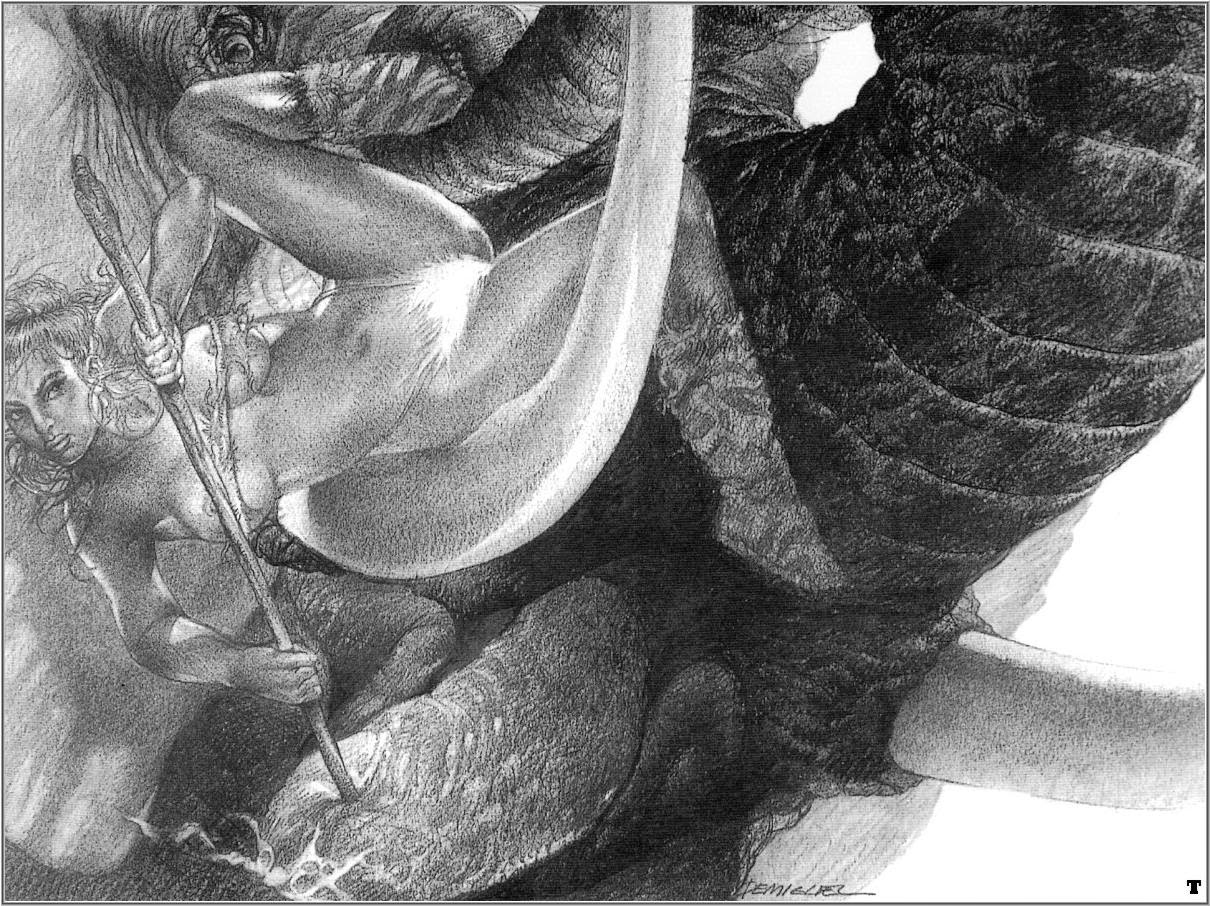
Siberian Tigers and Cave Girl?

High coverage genome from 45,000-year old Siberian (Ust'-Ishim)
We present the high-quality genome sequence of a ~45,000-year-old modern human male from Siberia. This individual derives from a population that lived before—or simultaneously with—the separation of the populations in western and eastern Eurasia and carries a similar amount of Neanderthal ancestry as present-day Eurasians. However, the genomic segments of Neanderthal ancestry are substantially longer than those observed in present-day individuals, indicating that Neanderthal gene flow into the ancestors of this individual occurred 7,000–13,000 years before he lived. . .
This fossil bears DNA affinity to modern Asian populations:
The finding that the Ust’-Ishim individual is equally closely related to present-day Asians and to 8,000- to 24,000-year-old individuals from western Eurasia, but not to present-day Europeans, is compatible with the hypothesis that present-day Europeans derive some of their ancestry from a population that did not participate in the initial dispersals of modern humans into Europe and Asia.
However, the next fossil, K14 from European Russia from 37,000 before present shows significantly more European traits: Genome of Kostenki-14, an Upper Paleolithic European 
A new paper in Science reports on the genome of Kostenki-14 (K14), an Upper Paleolithic European from Russia. This is now the third oldest Homo sapiens for which we have genetic data, after Ust'-Ishim (Siberia, 45 thousand years), Tianyuan (China, 40 thousand years), and now Kostenki (European part of Russia, 37 thousand years). Of these three genomes, the Ust'-Ishim is both the highest coverage and earliest (Siberia is the gift that keeps on givin'), Tianyuan only has its chromosome 21 known, and K14, a complete 2.42x coverage sequence (and, apparently, good teeth, after all these years; left).
 I don't have any really relevant Cave Girls so I'll have to illustrate with some only sort of relevant ones...
The publication of the Tianyuan genome showed that populations related to East Asians and Oceanians existed in the world 40 thousand years ago. So, models based on modern humans that put the split of East Asians from Europeans to a much more recent time period were basically wrong (more on this a little below). The Ust'-Ishim genome showed that populations basal to both East Asians and Europeans existed in the world 45 thousand years ago. So, either East Asians and Europeans hadn't gone along their different paths yet, or, if they had, Ust'-Ishim happened to be a side branch and not the major East Asian and European lineages.
So, by 45,000 BP and 37,000 BP, we have separate populations genetically related to modern Asians and Europeans respectively.  Moreover, both DNA profiles show an "injection" of Neandertal genes in the not too distant past, from their point of view (approximately 50,000 years BP). So these fossils are after, but relatively close to the time that Asians and Europeans separated far enough geographically, or perhaps culturally, to start to evolve apart biologically.

What does this mean? I wouldn't impute much to it except to point out how far back the basic racial natures of human beings originate. It certainly doesn't make one better than another, and we are still clearly members of the same species despite the long evolutionary separation.

Wombat-socho chose to hold Rule Five Sunday on Monday this week.

Tuesday, October 7, 2014

Seattle Swaps Columbus Day for Redskins' Day

I would have called it "Indigenous Peoples Day" in the title but it would have made it wrap.

Columbus Day will now be Indigenous Peoples' Day in Seattle
The Seattle City Council is replacing Columbus Day with Indigenous Peoples' Day in the city. The resolution that passed unanimously Monday celebrates the contributions and culture of Native Americans and the indigenous community in Seattle on the second Monday in October, the same day as the federally recognized Columbus Day.

Tribal members and other supporters say the move recognizes the rich history of people who have inhabited the area for centuries. "This action will allow us to bring into current present day our valuable and rich history, and it's there for future generations to learn," said Fawn Sharp, president of the Quinault Indian Nation on the Olympic Peninsula, who is also president of the Affiliated Tribes of Northwest Indians.

"Nobody discovered Seattle, Washington," she said to a round of applause.
Except maybe Kennewick Man, who seems to have traveled a long way south out of his way to end up dead in Washington State. Now, there may have been other indigenous people already there, but that doesn't diminish his achievement.
Several Italian-Americans and others objected to the change, saying Indigenous Peoples' Day honors one group while disregarding the Italian heritage of others.

Columbus Day is a federal holiday that commemorates the arrival of Christopher Columbus, who was Italian, in the Americas on Oct. 12, 1492. It's not a legal state holiday in Washington.

"We don't argue with the idea of Indigenous Peoples' Day. We do have a big problem of it coming at the expense of what essentially is Italian Heritage Day," said Ralph Fascitelli, an Italian-American who lives in Seattle, speaking outside the meeting.
Maybe it was just my elementary school, but I always thought of Columbus Day as celebrating his discovery of a few malarial islands off the the coast of the Americas and not his Italian descent, which is suspect in any event. If people want to celebrate the discovery of the Western Hemisphere by the Vikings, and the various waves immigrants from prehistoric Asia. The more holidays the better!

Found at Wombat-socho's "Live at Five: 10.07.14." Do you think I read Seattle news?

Thursday, August 28, 2014

Chesapeake Bay Spear Point Poses Puzzle

A 22,000-year-old mastodon skull and tool (a stone blade or spear point) dredged from the seafloor of the Chesapeake Bay by fishermen in 1974 is only now coming to light. The bottom of Chesapeake Bay hasn’t been dry since 14,000 years ago. The relics were found in a net, brought up from 230 feet down and 60 miles off Chesapeake Bay by a small wooden scallop trawler. The crew cut the tusk and teeth off and dropped the rest of the mastodon skull back into the Bay as it was too heavy to bring in. They split up the pieces as souvenirs and ended up donating some to the Gwynn’s Island Museum in Virginia. That’s where they were discovered by Darrin Lowery, a geologist at the University of Delaware, while he was doing his doctoral paper.
Solutream maid slays mammoth?
So it's not really the Chesapeake Bay, it's on the Atlantic Continental Shelf, through which once ran the Susquehanna River on it's way to the sea, during one of the glacial periods in which the Chesapeake Bay itself was high and dry.
Experts who back an East Coast habitation of North America by Solutreans say the time frame of the discovery backs their theories. The Solutrean culture was known to occupy a piece of Europe between present-day France and Spain. This theory says they came over and along the ice from Europe to America before the Bering Strait time frame. Their spear points were called “laurel leaf” and these experts say they pre-date the Clovis Culture and theorize the Solutreans could’ve become the Clovis Culture by creating the better hunting tools due to the large population of animals they encountered in North America. The Bering Strait theorists will have nothing to do with this, of course. They say there is no context for the discovery, as the only acceptable proof is if they were found in the same geological layer.

Clovis is one of those theories like the Sasquatch which seems to thrive on a smattering of vaguely favorable evidence every few years. It's a theory that would put Europeans in the New World before the ancestors of today's Indians. Unfortunately the only evidence for it is some stone tools which bear a resemblance to Solutrean tool culture of Europe. There's not a speck of genetic evidence that I've heard of.
The Solutrean backers point to other East Coast discoveries, such as those at Cactus Hill in Virginia and Meadowcroft Rockshelter in Pennsylvania. These sites may have been inhabited from 16,000 to 18,000 years ago, but of course that evidence has its own issues, say the Bering Straiters. The Monte Verde, Chile find dated at 14,800 years is the one that started off most of the debate and successive finds continue to push back dates and ignite professional arguments.
I think the evidence for pre-Clovis is pretty strong, but the evidence that they came from Europe via the sea or sea ice is non-existent. See the second story below:
The tusk was dated to 22,000 years old. The blade (a flaked blade made of a volcanic rock called rhyolite) was harder to test, but its Solutrean appearance put it at 17,000 to 22,000 years old. Glacial melting submerged the area 14,000 years ago, so the blade is at least that old. The weathered appearance of both shows open air, saltwater, then seawater exposure and matches the idea that they were on land and then submerged. Of course there’s no evidence tying the two relics together aside from being pulled up together. They could’ve come from hunting in a marsh area near the coast, or from different time frames as the sediment could’ve been mixed. Thousands of years of ocean currents means they could’ve come from anywhere.
Yes, and lightening could have struck in the middle of 8.5 Richter Scale earthquake, but it's not very probable. It's reasonable to assume that the spear point is somehow associated with the mastodon skull.

You know, with enough work, you should be able to find out where in the world that piece of rhyolite came from, using exact elemental composition.  If it was in the Old World, that would be a dynamite result. If it was New World, it would still be long way from home, as there are no volcanic rocks anywhere near the Chesapeake Bay.

And in more paleo-anthropological news, the Kennewick Man has been freed to help science:
. . .The mysterious Kennewick Man, who died 9,000 years ago in the Columbia River Valley, was a seal hunter who rambled far and wide with a projectile point lodged in his hip, five broken ribs that never healed properly, two small dents in his skull and a bum shoulder from the repetitive stress of throwing spears. He came from somewhere far away, far up the Pacific Northwest coast, possibly Alaska or the Aleutian Islands. He might even have come to North America all the way from Asia. That’s the argument of the editors of a new, 688-page, peer-reviewed book, “Kennewick Man: The Scientific Investigation of an Ancient American Skeleton,” that will be published this fall by Texas A&M University Press.
Either he wasn't a popular man at home, or he was a hell of a wanderer.
“Kennewick Man could not have been a longtime resident of the area where he was found, but instead lived most of his adult life somewhere along the Northwest and North Pacific coast where marine mammals were readily available,” the concluding chapter of the book states.  “He could have been an Asian,” said co-editor Richard Jantz, emeritus professor of anthropology at the University of Tennessee. “One of the things we always tend to do is underestimate the mobility of early people.”
One of the things to remember is that the people who came before us were hunter/gatherers for the most part. Following animal migrations over long distances was just part of the niche. It was only after agriculture that people could afford to set in one place and watch the grass grow.
The chemical analysis of the molecular isotopes in the bones and the clues they provide to Kennewick Man’s origin are likely to be among the most heavily debated findings. The analysis suggests that Kennewick Man lived off a diet of seals and other large marine mammals and drank glacier-melt water. His wide-set body is akin to what is generally seen in cold-adapted human populations. The book includes a vintage photograph of an Inuit seal hunter on an ice floe in Alaska — a suggested analog to Kennewick Man’s lifestyle.

The dimensions of Kennewick Man’s skull most closely match those of Polynesians, specifically the inhabitants of the Chatham Islands, near New Zealand, the scientists say. He wasn’t himself a Polynesian, however. Rather, according to the scientists, Kennewick Man and today’s Polynesians, as well as the prehistoric Jomon people and contemporary Ainu people of northern Japan, have a common ancestry among a coastal Asian population.

These were hunters of marine creatures and could have followed the edge of the ice around the northern rim of the Pacific Ocean, harvesting seals and using primitive watercraft to travel long distances, Owsley said.  “This is like a highway,” Owsley said of the coastal route of migration. “People are going from the Old World to the New World and back and forth.”

He said of Kennewick Man, “His morphology is what people look like in the Upper Paleolithic period along that whole circum-Pacific expanse.”
Just a regular guy who may have paddled from Siberia to Washington State.

When I read stories like this, I laugh a little about the worry that humanity might be at threat from warming that might (worst case) make Maryland as warm as Georgia. with a few feet of added sea level rise (it's already rising).  The people who came before us not only survived, but evolved to adapt to a world that went from heavily glaciated to the modern world with 300 ft sea level rise.

If another couple of degrees C and a few feet of sea level rise are going to make us extinct despite our new technological abilities, maybe we deserve it.

Wombat-socho has the grand "Rule 5 Sunday: Labor Day Weekend Lovelies", up at The Other McCain.