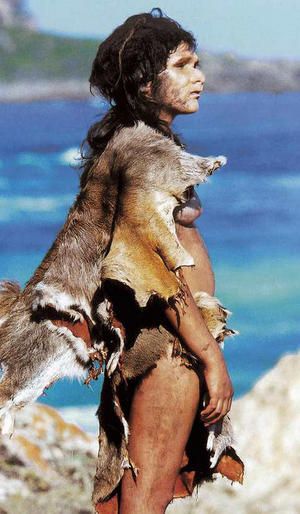
With only their feet to carry them, our distant ancestors didn’t move around much during their lives. Their skin adapted to subtle, seasonal changes in sunlight and UV conditions by producing more eumelanin and becoming darker in the summer and then losing some pigment in the fall and winter when the sun wasn’t so strong. Even for people with lightly pigmented skin, painful sunburns would have been exceedingly rare because there was never a sudden shock of strong sun exposure. Rather, as the sun strengthened during spring, the top layer of their skin would have gotten gradually thicker over weeks and months of sun exposure.
One day you wash up on the beach, wet and naked. Another day you wash back out. In between, the scenery changes constantly.
Thursday, July 3, 2025
Thursday Tanlines
Wednesday, September 18, 2024
Dogs, Man's Best Friend, but Not Neanderthal's
Nowadays, modern humans are the only game in town. There are still chimpanzees and bonobos, but all the other walking-upright primates have gone extinct. The last Neanderthal vanished about 40,000 years ago; the last Denisovan 50,000 years ago. These are just educated guesses, however. There’s some evidence that smaller, isolated pockets of Neanderthals survived until 25,000 years ago, and the Denisovans might’ve persevered in New Guinea until just 15,000 years ago — and are still remembered in folklore and oral traditions. We just don’t have enough physical evidence to prove it.
A third group, the Homo floresiensis, lasted in Indonesia until 50,000 years ago, and might’ve been a surviving group of an even older archaic species, the Homo erectus.
But why did they all go extinct? These species were extraordinarily successful for a very long time, yet they all went extinct around the same general timeframe. What happened?
Nobody knows.
All we know for certain is that we coexisted and mated. For about 2,600 to 5,400 years in Europe, Neanderthals and Humans interacted, intermingled and interbred. Even today, virtually all humans outside of sub-Saharan Africa have about 2% Neanderthal DNA. Among Melanesians (Papua New Guinea and Bougainville Islands), about 5% of their DNA is from Denisovans. Depending on how you look at it, perhaps the Neanderthals and Denisovans never went extinct at all; they’re still here, living within this strange, hybrid species known colloquially as a “modern human.”
We still know very little about the Denisovans and the Homo floresiensis. About the former, we don’t have any complete skeletons; just a few bone and teeth fragments that we can DNA test. The culture and lifestyle of both remain a near-total mystery. We only discovered Homo floresiensis fossils in 2003; Denisovans in 2010.
But we’ve already learned a great deal about the Neanderthals. We know they were stronger and more powerful than humans. They might’ve been smarter, too: Their brains are larger. Now, bigger brains don’t always correlate to higher intelligence, so it’s not a certainty that they could out-think and out-plan us. It does indicate that they required more caloric content to survive, since the brain is a very expensive organ to run. According to some estimates, Neanderthals needed 350 extra calories each day to feed their larger brains — not an insurmountable total, but enough to stress an ecosystem during times of famine. Paradoxically, their bigger brains could’ve been their downfall.
We also know Neanderthals were capable of art and music. Their caves are filled with gorgeous paintings, and we’ve discovered the remains of a bone that was converted into a flute. We’ve also uncovered the bones of Neanderthal men and women who had survived debilitating injuries during their youth and still made it to middle age, which indicates they were “humane” enough to care for the wounded. Numerous times, bodies have been buried with rare flowers, shells, and eagle feathers, which seems to demonstrate a sense of spirituality.
As far as we can tell, there’s no genetic reason why Neanderthals couldn’t prosper and be as successful as humans. They had the brains, the tools, and most of the same advantages we had.
But they weren’t successful: They’re all gone.
Weirdly, for hundreds of thousands of years, the Neanderthal lifestyle changed very little. Neanderthals lived in Europe for over 350,000 years, but when archeologists analyze settlements that are 200,000 years apart, they’re virtually identical. It was as if their culture disallowed progress and growth. In fact, it wasn’t until modern humans began arriving in Europe between 54,000 to 43,000 years ago that Neanderthal settlements began finally showing evidence of cultural improvements. We still don’t know why this is.
But for those invading humans to successfully supplant the entire Neanderthal population — exiling them from their homes, conquering their land, stealing their resources, and driving them to extinction — they needed some kind of advantage. A superweapon.
After all, the Neanderthals were bigger and stronger. They might’ve been smarter. They had homefield advantage and knew the terrain like the back of their hand: All the animals to hunt, all the best fishing spots, all the ways to survive winter. They evolved specifically for this environment; it was their home for 350,000 years!
And then, a few thousand years later, they all vanished from the earth. Whoosh!
One theory of what might’ve given humans the upper-hand is a helpful paw: The faithful dog.
We don’t know when dogs were first domesticated. Some experts believe it was only 15,000 years ago, but others put the timeline at 40,000 years ago, or even longer. The two oldest known dog skeletons were found in a Belgium cave and in the Altai Mountains of Siberia, dating back 33,000 years ago.
Either way, the bond between humans and wolves-turned-dogs predates agriculture and the invention of the wheel. It’s one of the oddest partnerships in Mother Nature: A symbiotic connection between two very different species — but one that allows both man and dog to overcome life-and-death adversity.
In the hands of a human, a domesticated dog would be tantamount to a superweapon — a technological breakthrough that equipped modern humans with night vision, an alarm system, a hunting partner, a warm body on a cold night, and even provided self-defense. Humans with spears fighting against Neanderthals with spears might be a close match, but when dogs are added to the mix, it’s a strategic mismatch.
A human settlement protected by guard dogs would be almost impossible for Neanderthal invaders to sneak-attack. But even if both populations were perfectly peaceful — which seems unlikely, knowing what we do about our history — a human hunting with a dog will outcompete a Neanderthal without one. And if Neanderthal brains also required more calories, this imbalance could have serious consequences.
It's an interesting theory, and I like it, but really, the only evidence for it is a convenient time line. A lot of changes happened during that time period.
The Wombat has Rule 5 Sunday: Moving Indoors up on time and under budget.
Saturday, July 13, 2024
A Long Long Time Ago
Once upon a time, our world was home to many giants. Actually, it wasn't so long ago. Once the dinosaurs had had their day, our planet was home to a whole new range of giant animals, from sloths that towered over humans, to wooly mammoths, to huge wombats and kangaroos, to the magnificent giga-goose.
Between around 50,000 and 10,000 years ago, nearly 200 of the world's largest animal species disappeared forever, leaving nothing but their humongous bones (and burrows). It's unclear what ultimately claimed these magnificent creatures.
During the time frame in which the megafauna disappeared, the world warmed and an ice age ended, suggesting one potential mechanism: climate change. Meanwhile, our own species was expanding into new lands, chasing the wealth of resources that came with the retreating ice. And so the debate over the roles of these two potential contributing factors has raged. Now a new study on the decline of giant herbivorous mammals – megaherbivores – points a finger at humanity.
Fossils show that, 50,000 years ago, there were at least 57 species of megaherbivore. Today, just 11 remain. They include notable behemoths such as hippos and giraffes, as well as several species of rhino and elephant, many of which continue to dwindle.
Such a dramatic decline, researchers say, is inconsistent with climate change as the sole cause. "The large and very selective loss of megafauna over the last 50,000 years is unique over the past 66 million years. Previous periods of climate change did not lead to large, selective extinctions, which argues against a major role for climate in the megafauna extinctions," says macroecologist Jens-Christian Svenning of Aarhus University in Denmark. "Another significant pattern that argues against a role for climate is that the recent megafauna extinctions hit just as hard in climatically stable areas as in unstable areas."
The new study consists of a comprehensive review of the available evidence since the extinction of the dinosaurs 66 million years ago. These include locations and timings of extinctions, habitat and food preferences, estimated population sizes, evidence of human hunting, human population movements, and climate and vegetation data going back millions of years.Loss of megafauna changed patterns of vegetation, which for example lead to denser forests in the Americas. (Svenning et al., Extinction, 2024)
We know that humans coexisted with megafauna, and we have evidence of some species being hunted to extinction. We know our ancestors were capable of hunting large animals effectively. "Early modern humans were effective hunters of even the largest animal species and clearly had the ability to reduce the populations of large animals," Svenning says. "These large animals were and are particularly vulnerable to overexploitation because they have long gestation periods, produce very few offspring at a time, and take many years to reach sexual maturity."
The new research shows that these human hunters were effective enough to significantly contribute to many extinctions. The megaherbivores, the team found, died out across a variety of climate scenarios, in which they had been able to effectively thrive even during times of change. Most of them would have adapted well to a warming environment, the researchers found.
It's all their fault for tasting good grilled.
Ever since the first Neanderthal bones were discovered in 1856, people have wondered about these ancient hominins. How are they different from us? How much are they like us? Did our ancestors get along with them? Fight them? Love them? The recent discovery of a group called Denisovans, a Neanderthal-like group who populated Asia and South Asia, added its own set of questions.
Now, an international team of geneticists and AI experts are adding whole new chapters to our shared hominin history. Under the leadership of Joshua Akey, a professor in Princeton's Lewis-Sigler Institute for Integrative Genomics, the researchers have found a history of genetic intermingling and exchange that suggests a much more intimate connection between these early human groups than previously believed.
"This is the first time that geneticists have identified multiple waves of modern human-Neanderthal admixture," said Liming Li, a professor in the Department of Medical Genetics and Developmental Biology at Southeast University in Nanjing, China, who performed this work as an associate research scholar in Akey's lab.
"We now know that for the vast majority of human history, we've had a history of contact between modern humans and Neanderthals," said Akey. The hominins who are our most direct ancestors split from the Neanderthal family tree about 600,000 years ago, then evolved our modern physical characteristics about 250,000 years ago.
"From then until the Neanderthals disappeared—that is, for about 200,000 years—modern humans have been interacting with Neanderthal populations," he said.
The results of their work appear in the current issue of the journal Science.
Li and Akey's key insight was to look for modern-human DNA in the genomes of the Neanderthals, instead of the other way around. "The vast majority of genetic work over the last decade has really focused on how mating with Neanderthals impacted modern human phenotypes and our evolutionary history—but these questions are relevant and interesting in the reverse case, too," said Akey.So, were Neanderthals stealing women and children to bolster their numbers?
They realized that the offspring of those first waves of Neanderthal-modern matings must have stayed with the Neanderthals, therefore leaving no record in living humans. "Because we can now incorporate the Neanderthal component into our genetic studies, we are seeing these earlier dispersals in ways that we weren't able to before," Akey said.
The final piece of the puzzle was discovering that the Neanderthal population was even smaller than previously believed.That's less people than live in my whole little town, spread over all of Europe and parts of the Middle east. I would guess that finding mates outside your family would be problem.
Genetic modeling has traditionally used variation—diversity—as a proxy for population size. The more diverse the genes, the larger the population. But using IBDmix, Akey's team showed that a significant amount of that apparent diversity came from DNA sequences that had been lifted from modern humans, with their much larger population.
As a result, the effective population of Neanderthals was revised down from about 3,400 breeding individuals down to about 2,400.
Put together, the new findings paint a picture of how the Neanderthals vanished from the record, some 30,000 years ago.
"I don't like to say 'extinction,' because I think Neanderthals were largely absorbed," said Akey. His idea is that Neanderthal populations slowly shrank until the last survivors were folded into modern human communities.
I don't subscribe to the naïve belief that early man was more pacific and moral than modern man. If you look around the world two things are almost universal when two different cultures meet, warfare, and interbreeding. Cannibalism is not out of the question either.
The Wombat makes up time with Rule 5 Sunday: Hangar Queen Double-Scoop Sunday!
Monday, May 20, 2024
A Pre-Clovis Site on Chesapeake Bay
“I was a weirdo kid,” he recalled. He trained as a geologist, and it was geology that initially attracted Lowery to study Parsons Island.
In 2010, he published an article in Quaternary Science Reviews describing layers of windblown silt deposited between 13,000 and 41,000 years ago at Miles Point in eastern Maryland. But the geological record is like reading the CliffsNotes version of a book, and he was frustrated by an “unconformity” in the sediment layers where thousands of years were missing, like someone had ripped out those chapters.
Lowery and a colleague were prowling around in a boat, looking for a spot that might fill in the blanks, when they spotted a black streak of sediment rising up out of the bay. They pulled up to Parsons Island and thought they had found “the Rosetta stone” to decode the geology.
Parsons is a 78-acre island less than a mile offshore that is privately owned by the Corckran family, which uses it as a family retreat. With the Corckrans’ permission, Lowery and colleagues began to visit regularly. The bluff layers preserved a remarkably intact geologic timeline going back more than 40,000 years.
Then, one morning in August 2013, the team discovered a leaf-shaped prehistoric stone tool jutting out of this crumbling wall. They knew from the work they’d already done that it was probably quite old.
On a recent visit to the island, geoarchaeologist Daniel Wagner demonstrated why. He stepped back to scan the cliff, then tapped a narrow spade into a light tan sediment layer just above his head. That, he said, is the geologic “chapter” where they’d expect to find Clovis artifacts. Lower layers were set down before Clovis.
The palm-size tool Lowery and his colleague found came out of the dark sediment layer near their knees.
The scientists used two methods to date the sediment around the artifact, both showing it was more than 20,000 years old. They scoured the beach on 93 visits and conducted a formal, top-down excavation, collecting the 286 artifacts. They sent out sediment to labs that specialize in studying ancient pollen and microfossils called phytoliths to help reconstruct the ecosystem at the time.
Back then, this region wouldn’t have been a coastline. The sediment the tools are embedded in dates to the “last glacial maximum” — the scientific term for the most recent coldest period of the Ice Age. In the final analysis, Lowery thinks the artifacts may have been transported downslope before they were buried, making them between 15,000 and 20,500 years old.
At the time of the last glacial maximum there would have been no Chesapeake Bay, merely the Susquehanna River running down what is now the main channel of Chesapeake, out across the continental shelf and into the Atlantic. Parsons Island, would have been a fair distance back from the river, although there would have likely been nearby streams.
“This was a swale, where water was collecting,” Lowery said, envisioning the ancient landscape. “You’ve got a dune. It’s got sedges and small trees on it that are windblown and all contorted, and then behind it you’ve got a little pond.”
That pond may have attracted prehistoric bison, musk oxen and llamas, whose fossilized molars he’s found scattered on the island shore. And it may have been what attracted the mysterious people who left behind a cache of stone tools.
The Clovis-first hypothesis has been pretty well busted for quite a while now, but evidence of a Pre-Clovis community in the Bay region certainly expands they're range. It's still an open question whether the Pre-Clovis population had much genetic contribution to the Native American population present when Europeans arrived. Did they suffer an extinction, or near extinction event at the Younger Dryas? We're they largely conquered and wiped out by the more recent Native Americans after they crossed the Bering Straight, or merely intermingled in the population?
Monday, January 15, 2024
I Blame the Chinese
Back in the 1930s, paleontologists discovered the fossilized remains of the largest ape known to have ever walked the earth. Standing as much as ten feet tall and weighing more than a quarter of a ton, they named the creature Gigantopithecus and it is only known to have lived in southern China. The ape is believed to have gone extinct between 200,000 and 300,000 years ago. This may seem like a rather odd story to be discussing here, but Gigantopithecus was back in the news this week in the journal Nature for a peculiar reason. A group of scientists has concluded that the monster ape was driven to extinction by climate change. Before all of our friends on the left start leaping to their feet and screaming ‘We told you so,’ we should look at the details of what these scientists are talking about. (Associated Press)
An ancient species of great ape was likely driven to extinction when climate change put their favorite fruits out of reach during dry seasons, scientists reported Wednesday.
The species Gigantopithecus blacki, which once lived in southern China, represents the largest great ape known to scientists — standing 10 feet tall and weighing up to 650 pounds.
But its size may also have been a weakness.
“It’s just a massive animal – just really, really big,” said Renaud Joannes-Boyau, a researcher at Australia’s Southern Cross University and co-author of the study published in the journal Nature.
So the mechanics of this extinction event come down to the Gigantopithecus being a victim of its own evolutionary success, assuming these scientists are correct. It evolved to become so large that it was unable to climb trees or explore alternate food sources during lean times. But they believe that its food supplies were wiped out by climate change. How did that happen?
What was causing climate change way back then? There were only a comparatively tiny number of human beings on the planet in those days and they were primarily poking around with sticks and living a hunter-gatherer lifestyle, not engaging in any sort of industrial activity. Did the giant apes have a fracking program that we haven’t found any evidence of yet?
That’s almost certainly not the explanation. In the end, this may prove to be yet another example of something that many grounded scientists have pointed out and we’ve discussed it here in the past. Analyses of ice core samples and other geologic records tell us that the planet and been going through cycles of heating and cooling for as long as it has existed. There are records of at least five ice ages where the world froze over almost entirely. In the intervening eras, Earth was often noticeably warmer on average than it is today. And all of this kept happening while there were no polluting, oil-drilling humans around to mess up the place.
Speaking of shifting temperatures, have the scientists looked into those types of changes when figuring out how Gigantopithecus went extinct? If you look at the graphic timeline in this report on glacial and interglacial periods of Earth’s history, you notice something that might have been a factor. As noted above, scientists believe that the giant ape may have gone extinct roughly 200,000 years ago. Perhaps it’s just a coincidence, but that period falls right at the end of one of the interglacial warming periods. Right after that, the temperatures plunged and didn’t rise again for the next 50,000 years. Could Gigantopithecus have been the victim of an ice age? That would certainly qualify as an extreme form of “climate change,” but it wasn’t driven by mankind.
200,000-300,000 years ago is quite a wide range for an extinction date. The earth is currently in an ice-age that oscillates between warm (like we're in now) and cold glacial advances on approximately a 100,000 year cycle (very approximate, it has been any where from 80ky to 120ky in the past few cycles). Not knowing when something went extinct by 100,000 years doesn't help very much to determine what might have caused it. Personally, I suspect the proto-Chinese ate them.
Curiously, people have suggested, probably tongue in cheek, that remnant populations of Gigantophithecus survived down the present in out of the way places, and gave rise to legends of Bigfoot, Yeti and other otherwise apparently mythical giants. I doubt it, but I sure hope so.
The Wombat has Rule 5 Monday: Happy Lee-Jackson Day! up at The Other McCain.
Wednesday, January 10, 2024
Vikings Into Dental Health
A new analysis of Viking-era teeth – dating back around a thousand years – has given us some interesting insight into the dentistry of the time, which looks to have been more advanced than previously thought.
Researchers from the University of Gothenburg and the Västergötlands Museum in Sweden looked at a total of 3,293 teeth from 171 of the Nordic marauders, including both kids and adults.
Modern-day dentistry assessments were carried out on the teeth, including the use of X-ray scans and dental probes, and it turns out that these Scandinavians didn't just leave their teeth to rot and decay. "There were several signs that the Vikings had modified their teeth, including evidence of using toothpicks, filing front teeth, and even dental treatment of teeth with infections," says Carolina Bertilsson, an odontologist from the University of Gothenburg.
The teeth date back to the 10–12th centuries CE and were collected from the well-known Varnhem archaeological dig in Sweden. The site is notable for soil conditions that favor the preservation of remains, including bones and teeth. Of the adult teeth analyzed, 13 percent were shown to be affected by caries or cavities, often on the surface of the roots. Tooth loss was common too, with adults having lost an average of 6 percent of their teeth, excluding the wisdom teeth.
However, teeth collected from children aged under 12 showed no signs of tooth decay.
Notably, evidence of dental treatment was also seen, including attempts to fill in the holes created by molars – most probably to provide some relief from the toothache that would come as a result of infection. "This is very exciting to see, and not unlike the dental treatments we carry out today when we drill into infected teeth," says Bertilsson. "The Vikings seem to have had knowledge about teeth, but we don't know whether they did these procedures themselves or had help."
As for the deliberate filing of front teeth found in one individual, the researchers think this might have been for the purposes of identifying the person for some reason. It's something that's been seen in other studies.
Teeth are made of strong stuff, which makes them more likely to be preserved in the ground, giving us fascinating clues about ancient people.
Another finding of note is that by the age of 40, tooth loss was a far bigger problem for the Varnhem Vikings than tooth decay – even with their toothpicks and rudimentary treatments. "This study provides new insights into Viking oral health, and indicates that teeth were important in Varnhem's Viking culture," says Bertilsson.
I suspect if you looked at almost any sort of early civilized culture, you'd find similar concern for dental health, and some occasionally helpful interventions.
The Wombat has Rule 5 Monday: Happy Lee-Jackson Day! up and at 'em at The Other McCain.
Friday, December 1, 2023
Let's Face It, Women are Just Better at Everything
Racism, sexism, and homophobia explain why White men are wrong about everything.
Despite being incompetent boobs who have never contributed a thing to the world, somehow, we get all the credit.
It is a miracle. The stupidest, least capable people somehow run the world with an iron fist.
People in the comments claiming this is untrue yet are willing to ignore the photographic evidence provided https://t.co/6Vkybj3SMf
— Godfrey Elfwick™ (@GodfreyElfwick) November 28, 2023
The latest example of how White men have twisted reality like a pretzel is the false belief that in prehistoric times, men were generally the hunters and women the gatherers and caretakers.
Nothing could be further from the truth. Science has proven this beyond doubt.
If you envisage a prehistoric hunter, a vision of a caveman might spring to mind.
But a new study claims that these cavemen paled in comparison to their female counterparts.
While women have long been seen as child-rearers and gatherers and men as hunters, researchers from the Univeristy of Notre Dame have debunked this theory.
“Debunked.” That’s a word that carries a lot of weight. Did they find a secret video that proves this theory or perhaps some other incontrovertible evidence? Clearly, there are no written records since, by definition, “prehistoric” is pre-writing.
No, their theory is based on hormones, which give women greater endurance than men–which is, in fact, true in general.
They need it. They take care of the kids. Usually more than one at a time. Let me try to run down a deer on foot anytime. The only reason men do all the hunting is to get away from the wife and kids, right?
Monday, August 28, 2023
Chinese Skull Suggests New Branch on Human Bush
|
|
Skull of the ancient hominin from China. (Wu et al., Journal of Human Evolution, 2023) |
An international team of scientists has described an ancient human fossil in China unlike any other hominin found before. It resembles neither the lineage that split to form Neanderthals, nor Denisovans, nor us, suggesting our current version of the human family tree needs another branch.
The jaw, skull, and leg bones belonging to this yet-to-be classified hominin, labeled HLD 6, were discovered in Hualongdong, in East Asia, in 2019. In the years since, experts at the Chinese Academy of Sciences (CAS) have struggled to match the remains to a known lineage.
The hominin's face is similarly structured to that of the modern human lineage, which split from Homo erectus as far back as 750,000 years ago. But the individual's lack of chin appears more like that of a Denisovan – an extinct species of ancient hominin in Asia that split from Neanderthals more than 400,000 years ago.
Working alongside researchers from China's Xi'an Jiaotong University, the UK's University of York, and Spain's National Research Center on Human Evolution, researchers at CAS think they have uncovered an entirely new lineage – a hybrid between the branch that gave us modern humans and the branch that gave us other ancient hominins in the region, like Denisovans.
Until proven otherwise, I will assume all prehistoric human lines had hot chicks.
At Eureka Alert!, A climate-orchestrated early human love storyTo unravel when and where human hybridization took place, scientists usually rely on paleo-genomic analysis of extremely rare fossil specimens and their even scarcer ancient DNA content. In the new Science paper, the team of climate experts and paleo-biologists from South Korea and Italy pursued a different approach. Using existing paleo-anthropological evidence, genetic data and supercomputer simulations of past climate, the team found that Neanderthals and Denisovans had different environmental preferences. More specifically, Denisovans were much more adapted to cold environments, characterized by boreal forests and even tundra, compared to their Neanderthal cousins who preferred temperate forests and grassland. “This means that their habitats of choice were separated geographically, with Neanderthals typically preferring southwestern Eurasia and Denisovans the northeast”, says Dr. Jiaoyang Ruan, postdoctoral researcher at the IBS Center for Climate Physics (ICCP), South Korea and lead author of the study.
However, according to their realistic computer simulations the scientists found that in warm interglacial periods, when Earth’s orbit around the Sun was more elliptic and northern hemisphere summer occurred closer to the Sun, the hominin habitats began to overlap geographically. “When Neanderthals and Denisovans shared a common habitat, there were more encounters and interactions among the groups, which would have increased the chance of interbreeding”, adds Prof. Axel Timmermann, corresponding author of the study and director of the ICCP and professor at Pusan National University.
But how did the climate warm without coal-fired power plants and SUVs?
And just for fun, 5 million-year-old fossils reveal 2 new species of saber-toothed cats in South Africa
Scientists have unearthed the remains of two never-before-seen species of saber-toothed cats that roamed Africa around 5.2 million years ago. The discoveries have changed what researchers previously knew about this group of extinct feline creatures, a new study shows.
The new findings could also shed light on the environmental changes happening at the time, which could help reveal why human ancestors started walking on two legs. researchers say.
The partial remains of the two newfound species, Dinofelis werdelini and Lokotunjailurus chimsamyae, were unearthed alongside the bones of two other known species, Adeilosmilus kabir and Yoshi obscura, near the town of Langebaanweg on the west coast of South Africa. The four species belong to the subfamily Machairodontinae — an extinct group of feline predators that included most species of saber-toothed cats. (The name Machairodontinae means "dagger-tooth.") Most members of this subfamily were equivalent in size to most big cats alive today.
In a new study, published July 20 in the journal iScience, researchers described the remains of all four species. The discovery of D. werdelini was not a surprise to the team, because species from this genus had previously been uncovered in the area and across the globe, including Europe, North America and China. However, the researchers were shocked to discover L. chimsamyae because, until now, members of this genus had only ever been found in Kenya and Chad.
I have seen in the past (don't make me Google) that sabre-tooth species were widespread down through prehistorical times, up until fairly recently, the end of the last glaciation. It's kind of a shame that none of the existing cat species show this trait.
The Wombat has Rule 5 Sunday: Salma Hayek up on time at The Other McCain.
Sunday, July 16, 2023
But How Did They Taste?
The date that humans arrived in South America has been pushed back to at least 25,000 years ago, based on an unlikely source: bones from an extinct giant ground sloth that were crafted into pendants by ancient people.
Discovered in the Santa Elina rock shelter in central Brazil, three sloth osteoderms — bony deposits that form a kind of protective armor over the skin of animals such as armadillos — found near stone tools sported tiny holes that only humans could have made.
The finding is among the earliest evidence for humans in the Americas, according to a paper published Wednesday (July 12) in the journal Proceedings of the Royal Society B.
The Santa Elina rock shelter, located in the Mato Grosso state in central Brazil, has been studied by archaeologists since 1985. Previous research at the site noted the presence of more than 1,000 individual figures and signs drawn on the walls, hundreds of stone tool artifacts, and thousands of sloth osteoderms, with three of the osteoderms showing evidence of human-created drill holes.
![]() |
| Ground Sloth osteoderm with drill hole |
The newly published study documents these sloth osteoderms in exquisite detail to show that it is extremely unlikely that the holes in the bones were made naturally, with the implication that these bones push back the date humans settled in Brazil to 25,000 to 27,000 years ago. These dates are significant because of the growing — but still controversial — evidence for very early human occupation in South America, such as a date of 22,000 years ago for the Toca da Tira Peia rock shelter in eastern Brazil.
Using a combination of microscopic and macroscopic visualization techniques, the team discovered that the osteoderms, and even their tiny holes, had been polished, and noted traces of stone tool incisions and scraping marks on the artifacts. Animal-made bite marks on all three osteoderms led them to exclude rodents as the creators of the holes.
"These observations show that these three osteoderms were modified by humans into artefacts, probably personal ornaments," the researchers wrote in their paper.
In an email to Live Science, study co-author Mírian Pacheco, a lecturer in paleontology at the Federal University of São Carlos, Brazil, noted that "it is virtually impossible to define the real meaning these artifacts had for the occupants of Santa Elina." However, the shape and large number of osteoderms "may have influenced the making of a specific type of artifact such as a pendant," she said.
The presence of human-modified sloth bones in association with stone tools from geological layers that date to 25,000 to 27,000 years ago is strong evidence that people arrived in South America far earlier than previously assumed.
"Our evidence reinforces the interpretation that our colleagues working on Santa Elina have been talking about for 30 years," Thaís Pansani, a paleontologist at the Federal University of São Carlos in Brazil, said in an email to Live Science — namely, that "humans were in Central Brazil at least 27,000 years ago."
The Clovis First Hypothesis is well and truly dead. Some of the 1st ice age humans who ventured into Americas came from China, DNA study suggests. Study suggests a migration of people from China to North America from 26 to 19 thousand years ago. If this is correct, they must have rushed right down to Brazil to get in on the Giant Sloth action.
The Wombat has Rule 5 Sunday: Communication Failure up at The Other McCain on time and under budget.
Sunday, March 5, 2023
Cache of Assault Weapons Discovered
A trove of nearly 600 obsidian handaxes, dating back at least 1.2 million years, has been unearthed in Ethiopia, indicating the presence of a prehistoric “knapping workshop”.They call them stone "tools," but you and I know that if people were making them in those quantities, they used them as weapons, at least some of the time. If you were to meet a hyena over a kill, would prefer to be bare fisted, or to be carrying one of these?
Knapping is the technique used to create handaxes, which are often referred to as humanity’s “first great invention.”
Made by chipping shards off a piece of stone to make a sharp edge, handaxes were not attached to handles, but held in the hand. They have a distinctive teardrop or pear shape. They were made out of flint or, later, obsidian – a type of volcanic glass.
The first handaxes in the palaeontological record date back to at least 1.5 million years ago and were found in Tanzania’s Olduvai Gorge. Handaxes are believed to have spread throughout Africa, south Asia, the Middle East and Europe around 500,000 years ago. They were still being made as recently as 40,000 years ago.
No other cultural artefact is known to have been made for such a long time.
Prior research has suggested that knapping workshops first cropped up in the prehistoric record in Europe several hundred thousand years ago – up to 774,000 years ago. The Ethiopian find nearly doubles the earlier estimates.
The researchers found 578 handaxes buried in sediment, all but three of which were made of obsidian. They were able to estimate the age of the tools by analysing the material around them.
The Wombat has Late Night With Rule 5 Sunday: Olivia Thirlby up on time an under budget at The Other McCain.
Saturday, January 14, 2023
Sailing, Sailing, Over the Ocean Blue
Archaic humans may have worked out how to sail across the sea to new lands as far back as nearly half a million years ago.
According to a new analysis of shorelines during the mid-Chibanian age, there's no other way these ancient hominins could have reached what we now call the Aegean Islands. Yet archaeologists have found ancient artifacts on the islands that pre-date the earliest known appearance of Homo sapiens.
This suggests that these ancient humans must have found a way to traverse large bodies of water. And if reliance on land bridges was not necessary for human migration, it may have implications for the way our ancestors and modern humans spread throughout the world.
The question of when hominins began sea-faring is difficult to answer. Boats throughout history tend to be made of wood, a material that doesn't often survive the ravages of time intact – and certainly not for tens of thousands, never mind hundreds of thousands of years. So there's no hope of a record of the first boats skimming across the oceans.
Instead, what we have is a record of artifacts and bones that have survived – stone tools that don't decay, for instance – and analysis tools that allow us to reconstruct the way the world has changed over many millennia. Led by geologist George Ferentinos of the University of Patras in Greece, this is how a team of researchers were able to conduct the new analysis.
The islands of the Aegean are, today, considered among the world's most beautiful places. They consist of hundreds of islands making up an archipelago scattered across the Aegean Sea between Turkey, Greece, and Crete. And they've been inhabited for a long time; artifacts have been dated to potentially as early as 476,000 years ago.
These ancient tools on Lesbos, Milos, and Naxos, moreover, have been linked to the Acheulean style developed some 1.76 million years ago, associated with Homo erectus across Africa and Asia. Several such tools have been found in Turkey, Greece, and Crete dating back to 1.2 million years ago, so their appearance in the nearby archipelago does make some sense.
Previous studies suggested that ancient humans crossed to the islands on foot during ice ages. When the world freezes, the sea level drops, and humans can make crossings that would be covered by water in more temperate times.
To determine whether this is a possibility, Ferentinos and his colleagues reconstructed the geography of the region, including a reconstruction of the shoreline around the Aegean Islands dating back to 450,000 years ago. For this, they used ancient river deltas, which can be used to infer sea level, and rates of subsidence driven by tectonic activity.
And they found that previous reconstructions were incorrect. At its lowest point over the last 450,000 years, the sea level was approximately 225 meters (738 feet) lower than it is today.
This means that, while some of the Aegean Islands were connected to each other when sea levels were lower, over the last 450,000 years, the islands have remained consistently insular from the surrounding land masses. At the sea level's lowest point, there still would have been several kilometers of open water to traverse to reach the nearest of the Aegean Islands.
Other evidence, the researchers point out, suggests that this was not the earliest sea crossing. Sometime between 700,000 and a million years ago, archaic humans were thought to have been traveling the sea around Indonesia and the Philippines.
These combined crossings suggest that sea travel was a skill developed not by Homo sapiens, but the human ancestors and relatives that came before.
"Furthermore, considering that the archaic hominins were able to cross the Aegean Sea, they would also have been capable of crossing the Gibraltar Straits," the researchers write in their paper.
So, do you reckon Homo erectus, Neanderthals and Denisovans had bow babes?
Thursday, December 1, 2022
AI Finds A Bird in the Bush
The human ancestral bush, An AI Found an Unknown 'Ghost' Ancestor in The Human Genome
Nobody knows who she was, just that she was different: A teenage girl from over 50,000 years ago of such odd uniqueness she appeared to be a 'hybrid' ancestor to modern humans that scientists hadn't seen before.
Only recently, researchers have uncovered evidence she wasn't alone. In a 2019 study analyzing the tangled mess of humanity's prehistory, scientists used artificial intelligence (AI) to identify an unknown human ancestor species that modern humans encountered – and shared dalliances with – on the long trek out of Africa millennia ago.
"About 80,000 years ago, the so-called Out of Africa occurred, when part of the human population, which already consisted of modern humans, abandoned the African continent and migrated to other continents, giving rise to all the current populations," explained evolutionary biologist Jaume Bertranpetit from the Universitat Pompeu Fabra in Spain.
As modern humans forged this path into the landmass of Eurasia, they forged some other things too – breeding with ancient and extinct hominids from other species.
Up until recently, these occasional sexual partners were thought to include Neanderthals and Denisovans, the latter of which were unknown until 2010.
But in this study, a third ex from long ago was isolated in Eurasian DNA, thanks to deep learning algorithms sifting through a complex mass of ancient and modern human genetic code.
Using a statistical technique called Bayesian inference, the researchers found evidence of what they call a "third introgression" – a 'ghost' archaic population that modern humans interbred with during the African exodus.
"This population is either related to the Neanderthal-Denisova clade or diverged early from the Denisova lineage," the researchers wrote in their paper, meaning that it's possible this third population in humanity's sexual history was possibly a mix themselves of Neanderthals and Denisovans.
In a sense, from the vantage point of deep learning, it's a hypothetical corroboration of sorts of the teenage girl 'hybrid fossil' identified in 2018; although there's still more work to be done, and the research projects themselves aren't directly linked.
"Our theory coincides with the hybrid specimen discovered recently in Denisova, although as yet we cannot rule out other possibilities," one of the team, genomicist Mayukh Mondal from the University of Tartu in Estonia, said in a press statement at the time of discovery.
That being said, the discoveries being made in this area of science are coming thick and fast.
Also in 2018, another team of researchers identified evidence of what they called a "definite third interbreeding event" alongside Denisovans and Neanderthals, and a pair of papers published in early 2019 traced the timeline of how those extinct species intersected and interbred in clearer detail than ever before.
. . .
"We thought we'd try to find these places of high divergence in the genome, see which are Neanderthal and which are Denisovan, and then see whether these explain the whole picture," Bertranpetit told Smithsonian.
"As it happens, if you subtract the Neanderthal and Denisovan parts, there is still something in the genome that is highly divergent."
Until proven otherwise, I assume all the Denisovan women, and the mysterious fourth subspecies were hot.
The Wombat has Rule 5 Monday: HMS Foxhound/HMCS Qu’Appelle out on time and under budget at The Other McCain.
Sunday, November 6, 2022
Neanderthal, Eat It, Fight It or F*ck It?
The species Homo sapiens (or “wise man”) began to evolve about 300,000 years ago, and eventually won out the evolutionary battle and became the only Homo species to reign on Earth about 40,000 years ago. During the early days of human life, another species named Homo neanderthalensis, or more commonly called Neanderthals, co-existed with Homo sapiens. In 2010, a ground-breaking analysis of a Neanderthal genome revealed that the two species could successfully interbreed.
It was once thought that war and violence caused the demise of the Neanderthals. However, a new study out this week in the journal PalaeoAnthropology adds to a growing body of research that proposes that Homo sapiens may have been responsible for the extinction of Neanderthals in a different manner—sex.
The researchers compared the genomes of Neanderthals and present day humans, and discovered that breeding in between the two species could have led to the eventual extinction of Neanderthals. When looking closer at the genomes of a Neanderthal with five modern humans, researchers discovered that Asians and Europeans share roughly one to four percent of their DNA with Neanderthals, while Africans don’t share any. This suggests that modern humans bred with Neanderthals after they left the African continent, but before they spread East to Asia and north towards Europe roughly 250,000 years ago.
However, there currently isn’t any evidence of Homo sapiens genetics in late Neanderthal genomes dating to between 40,000 to 60,000 years ago. Only 32 Neanderthal genomes have been sequenced, which makes it possible that a lack of Homo sapiens DNA within the Neanderthal genome is simply due to a low sampling.
It is also possible this is due to hybridization—where one species starts mating with another, creating offspring of a new variety. There are plenty of examples of hybrids in nature, such as the liger, which is the offspring of a male lion and a female tiger, or a mule, which is the offspring of a horse and donkey. For some species combinations, it makes a difference which parent is from which species, and often the offspring are infertile.
The lack of mitochondrial DNA (inherited from mother to child) from Neanderthals present in living humans might be evidence that only male Neanderthals and female Homo sapiens could successfully mate. If the researchers’ theory is correct, fewer Neanderthals may have been breeding with one another, opting for interspecies mating. This would decimate populations of the already existing small and scattered groups of Neanderthal families, eventually pushing them towards decline.
This is very counterintuitive to me. I would have expected Neanderthal genes found in human populations to be largely due to the capture (or perhaps barter) of Neanderthal women and their (and their offsprings) subsequent inclusion in human society (beggars can't be chosers). It wouldn't shock me at all if the reverse also happened, but at a much lesser rate because of the low population of Neanderthals compared to modern humans. Maybe there is some reason Neanderthal mitochondria in human cells is simply a no-go.
“We don’t know if the apparent one-way gene flow is because it simply wasn’t happening, that the breeding was taking place but was unsuccessful, or if the Neanderthal genomes we have are unrepresentative,” said Chris Stringer, the Research Leader in Human Evolution at London’s Natural History Museum and study author, in a statement. “As more Neanderthal genomes are sequenced, we should be able to see whether any nuclear DNA from Homo sapiens was passed on to Neanderthals and demonstrate whether or not this idea is accurate.”
“Our knowledge of the interaction between Homo sapiens and Neanderthals has got more complex in the last few years, but it’s still rare to see scientific discussion of how the interbreeding between the groups actually happened,” added Stringer. “We propose that this behavior could have led to the Neanderthals’ extinction if they were regularly breeding with Homo sapiens, which could have eroded their population until they disappeared.”
My instincts suggest the when modern humans came into contact with each other, a decision would need to be made by both parties; is the other similar enough to be "human", and engage in the usual ways humans engage with humans from another group, which include both fucking and fighting, or so dissimilar that the other would be considered valid table fare? So far, for the most part, the former seems to be winning out (although I'm sure that the odd meal here and there involved cross species "guests").