Which, as near as I can figure out translates to Chicken in Water from Thai. Is it a clever pun? I'd like to think so.

The Wombat has Rule 5 Sunday: Obligatory World Cup Post up on time and under budget at The Other McCain.
Which, as near as I can figure out translates to Chicken in Water from Thai. Is it a clever pun? I'd like to think so.

The Maryland Department of Natural Resources asks residents and visitors enjoying coastal and tidal waterways to remain alert for marine mammals and sea turtles into summer through early fall.
Dolphins, manatees, sea turtles, whales, and other marine wildlife are regular seasonal visitors to the Chesapeake Bay and its tidal tributaries, the Atlantic Ocean, and coastal bays. So far in 2025, Maryland has reported a higher-than-average number of strandings.
The five-year average (2020–2024) for marine mammal strandings in Maryland from January to May was 10 cases. As of June, the stranding program has responded to 29 animals.

Anyone who sees a marine mammal or sea turtle in Maryland waters is encouraged to report it via the Maryland Natural Resources Police Hotline, 800-628-9944, or use a simple online form to report deceased marine mammals or sea turtles. Anglers, boaters, and beachgoers should especially be on the lookout for stranded, dead, sick, injured, or entangled animals.
“Citizen reports allow us to have eyes on Maryland’s 3,190 miles of tidal coastline,” said Stranding Response Program Coordinator Amanda Weschler. “The data provided about each deceased animal and the select necropsies we perform contribute valuable information to the scientific understanding of the challenges protected species face in our waters.”

Since 1990, Maryland’s Marine Mammal and Sea Turtle Stranding Response Program ha s collected reports of more than 1,590 strandings.
One of the first cases the staff responded to in April was a West Indian manatee, reported by a private citizen kayaking on the Pocomoke River in Worcester County. DNR biologists determined that it likely stranded in late summer or early fall of 2024.
This was the first known stranded manatee in Maryland since November 2016. West Indian manatees (Trichechus manatus) are considered an “out-of-habitat” species in Maryland, making this sighting particularly rare.
Other animal strandings to which DNR has responded in 2025 are:
- 13 bottlenose dolphins (Tursiops truncatus)
- Two grey seals (Halichoerus grypus)
- One harbor porpoise (Phocoena phocoena)
- One humpback whale (Megaptera novaeangliae)
- Five loggerhead sea turtles (Caretta caretta)
- One minke whale (Balaenoptera acutorostrata)
- Five short-beaked common dolphins (Delphinus delphis)

Not all reported animals are viable for necropsy due to factors such as decomposition, resource availability, and the accessibility and safety of the stranding site. In cases where necropsy is not feasible, Stranding Program staff collect morphometric data, stranding location information, and take photographs. The deceased animal may be left at the stranding site to decompose naturally, benefiting the ecosystem. Alternate disposal methods include burial on-site or removal to designated disposal facilities, depending on the circumstances and local regulations. A list of relevant contacts for individuals seeking assistance with disposal is listed on the DNR website.
The department urges anyone who encounters a stranded animal, alive or dead, to maintain a safe and respectful distance and record details, including photos, to provide with a report.
I haven't found anything recently, but a few years ago, a dead dolphin washed up at Matoaka and a few years before that a sea turtle on Calvert Beach.
Maryland Department of Natural Resources Rolling out New Licensing System, MD Outdoors
The Maryland Department of Natural Resources will introduce its new online licensing system, MD Outdoors, on June 24. This centralized system replaces the current system, COMPASS.
MD Outdoors will continue to offer products for all outdoor activities, including all Maryland hunting and fishing licenses and associated stamps and permits, boat and off-road vehicle renewal registration, and other services that will be available in this one convenient location. The system is designed to streamline the process of renewing licenses and permits as well as make it easier and more simple for new and returning customers.
Current license-holders will retain their DNR ID number; the new website will provide clear instructions on creating a new username and password for MD Outdoors, where customers can retrieve their account information. The new system includes auto-renew options, an easier-to-navigate interface, and an app that stores your license information, and can help direct people to new hunting and fishing opportunities. Other benefits and capabilities will be added in the future.
Along with improvements in the user experience, Maryland for the first time is offering the purchase of durable license cards that demonstrate fishing and hunting license validity. These rugged, collectable cards feature various images of Maryland fish and wildlife.
That reminds me. My fishing license expires July 1. I might as well go over and check out the new site.
The Wombat has Rule 5 Sunday: Overall Beauty up more or less on time and under budget.

The Maryland Department of Natural Resources asks those visiting the Chesapeake Bay or Atlantic coast to be vigilant of sea turtles who exhibit signs of cold-stunning, a condition that causes animals to become debilitated and experience hypothermia-like symptoms due to prolonged exposure to cold temperatures.
Cold-stunning typically occurs in late autumn and early winter when water temperatures begin to fall or when temperatures drop rapidly in a 24-hour period. Lethargic and unresponsive animals can be a danger to themselves and potentially to boaters. Cold-stunning can ultimately be lethal to certain species.
Stranding Network members respond to thousands of cold-stunned sea turtles along the Atlantic Coast annually. During the cold-stunning season, Stranding Response Program staff remain informed through weekly updates provided by NOAA. As of December 12, a total of 858 sea turtles have been reported nationwide, with most of them (more than 700 sea turtles) stranding in Massachusetts.

While this condition typically affects sea turtles, West Indian Manatees are also susceptible and have occasionally been reported in Maryland during winter. The Maryland Department of Natural Resources Marine Mammal and Sea Turtle Stranding Response Program responded to a deceased, cold-stunned manatee in late November 2016, which was found stranded at the Dundalk Marine Terminal.
Anyone who sees a lethargic, floating, debilitated, or deceased sea turtle or marine mammal in Maryland waters or stranded onshore should maintain a safe distance and call the Maryland Natural Resources Police Hotline at 800-628-9944. The hotline is maintained 365 days a year, 24 hours a day.
Marine mammals are protected under the Marine Mammal Protection Act, and sea turtles are protected under the Endangered Species Act. The harassment, feeding, or collection of these species or their parts can result in fines, imprisonment, and/or the seizure of vessels and personal property.
As noted, sea turtles aren't very common, but not exceptionally rare in the Bay. Most of them manage to get back to the warmer ocean as the weather cools. Most. Manatees are indeed rare, but a few intrepid individuals do wander up from Florida most years and the ones that do are mostly immature males, by definition, not particularly particularly brilliant.
The long term forecast show our weather descending into a persistent cold spell, with temperatures near 0 F predicted. Turtles and Manatees beware.

Two manatees were spotted Thursday morning in the Hague, a relatively rare sight in the Ghent neighborhood of Norfolk.
The sea cows were spotted about 10 a.m. by a Daily Press/Virginian-Pilot staff photographer, who said they were about 6-8 feet long, from the Hague’s pedestrian bridge. A small group of people stopped to watch as the pair floated in the Hague. Just three weeks ago, a manatee surprised passengers coming back to the dock from a dolphin-watching excursion in Rudee Inlet.

The Hague has 25-30 large water outfalls entering it, according to the Elizabeth River Project. Because of that, pollution affects the water quality of the Y-shaped inlet. Still, there’s plenty of diversity in the water. From cownose rays to dolphins and seals, creatures often associated with the ocean can sometimes be spotted along the Elizabeth River.
Shrimp and oysters tend to thrive, as well.
Research suggests manatee populations — more often associated with Florida waters — will gradually double over the next 50 years, and sea cows will move north as water temperatures warm in South Florida. This is due to threats to seagrass (manatee food) and a rise in “red tide,” a toxic form of algae, according to a 2017 report from the U.S. Geological Survey.
A few Manatees, including a repeat offender nicknamed Chessie, seem to visit the Bay every year. It wouldn't be the worst thing in the world if a few more came up to visit, I know some very nice grass beds over on the other side that they could help keep mowed.
However, I don't recommend they stay long into Fall; our winters are far too severe.

A group of manatees made the most of last weekend’s storm when a few branches and palm tree fronds were blown into their water, giving them something to play with.
On Wednesday, Save the Manatees Club shared a video of the manatees playing at Florida’s Blue Spring State Park in Volusia County. The club said the debris entered the water on Sunday, Dec. 17.
I would think palm fronds would have low nutritional content and a lot of ruffage, but, hey, different tastes. During the year and a half we spent in Florida, back in the 80's, I recall seeing Manatees browse on the trees that overhung the ship channel at the place I worked, Harbor Branch Institution (later Harbor Branch Institute of Oceanography). IIRC, they mostly ate Brazilian Pepper, a somewhat toxic (to people at least) invasive species that was quite common there.
 |
| Probably not from Chesapeake Bay |
When a Florida manatee swims into the Chesapeake Bay, it makes waves.
Such was the case on Aug. 19, when one of the gentle giants was photographed munching on underwater grass in the St. Mary’s River in Maryland near where the Potomac River meets the Bay. Another followed on Aug. 27, when a group of paddleboarders spotted a manatee trapped in a pound net at the mouth of the Rappahannock River in Virginia. (It was freed, unhurt, by a marine patrolman within hours.)
Manatee sightings remain rare occurrences in Maryland and Virginia waters — rare enough that they generate a flurry of viral social media posts and news headlines. (Exhibit A: the manatee, nicknamed “Chessie,” that has captured the public’s imagination with its multiple visits to the Bay, beginning in the mid-1990s.)
Scientists don’t have enough data to say whether the whiskered marine mammals are visiting the region more frequently. But many believe it’s only a matter of time. “You can mark my words and come back to me if I’m wrong. I think you’ll see more before you see fewer,” said Ruth Carmichael, a marine ecologist with the Dauphin Island Sea Lab in Alabama. She has been collecting reports of manatee observations across the southeastern U.S. for more than 15 years. “We’re seeing the same patterns in Mississippi and Texas and going up to North Carolina.”
Scientists don’t conduct formal surveys of manatees’ presence the Chesapeake region. But one measure suggests that an average of at least one per year ventures into the estuary. Since the National Aquarium in Baltimore began keeping records in 1991, it has collected 39 manatee sightings in Maryland waters — either in the Chesapeake or the Atlantic Ocean. To qualify as an observation, the report must be accompanied by a photograph, said Kate Shaffer, who oversees the facility’s animal rescue program.
But there might be more in the future. Carmichael and other scientists point to a potential collision of three trends: a decades-long upswing in the species’ Atlantic population, a decline in water quality off Florida’s East Coast and warming waters tied to human-caused climate change.

The Florida manatee was one of the first creatures to receive protection from the federal Endangered Species Act after it went into effect in 1973. Efforts to shield the sea cows from boat collisions helped the population rebound from barely 1,000 individuals in the mid-1970s to more than 6,000 by 2017. That year, the U.S. Fish and Wildlife Service downlisted the species from endangered to threatened.
It’s only natural for manatees, especially males, to expand the boundaries of their range as their numbers increase, Carmichael said. Some have been tracked as far north as Cape Cod, MA, in recent years.
“Those animals have to go somewhere, and we know there’s the concept of carrying capacity,” she explained.
But that biological success story has hit a major snag. Since December 2020, about one-quarter of the species’ population has died during what federal wildlife officials have dubbed an “unusual mortality event” along the East Coast of Florida.

Worsening water quality appears to be at the center of the phenomenon, researchers say. Excessive nutrients spilling off lawns and farms are fueling the growth of a toxic form of algae, known as red tide, that is fatal to manatees. Such nutrients are also nourishing another type of algae bloom that has wiped out thousands of acres of seagrass, one of the manatee’s primary food sources. Many have starved.
Such pressures are likely to push manatees farther northward, research has suggested.
The Chesapeake Bay’s underwater grasses are proving to be an inviting refuge, said Jamie Testa, a dolphin researcher with the University of Maryland Center for Environmental Science and former marine mammal stranding coordinator for the Maryland Department of Natural Resources.
“We expect they find seagrass to eat in Chesapeake Bay and head back to the Southeast before water temperatures get too cold” around mid-October, she said.
Manatees begin showing signs of cold stress when water temperatures dip below around 68 degrees. So, with a typical thermometer reading of 48 degrees in February, the Chesapeake Bay is highly unlikely to become a year-round residence for sea cows, experts say.
“I don’t really see that yet,” said Dan Slone, a Florida-based manatee researcher for the U.S. Geological Survey. “Maybe in centuries.”
A remarkably balanced article for the Bay J. I would have expected more blame of climate change. I, for one, welcome the refugees from Florida.
The Wombat has Rule 5 Sunday: Best Wrench Wench And Gun Bunny Too? up at The Other McCain more or less on time.
 |
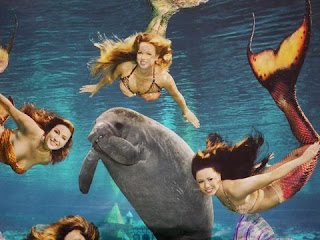
| In case you have trouble telling them apart Manatee on left, Mermaid on right |
No, that’s not a mermaid.
Environmental officials say a manatee has been spotted basking in the warm waters of the Chesapeake Bay. The Potomac Riverkeeper Network confirmed the sighting over the weekend on St. Mary’s River near where the Potomac and Chesapeake Bay converge.
Lower Potomac Riverkeeper Dean Naujoks said the river’s salinity this year has been unusually high, attracting dolphins, bullsharks, skate and crabs. He nearly forgot manatees have been known to pass through these waters, too.
“It’s an amazing area that’s part of the Chesapeake Bay,” Naujoks said. “It’s not surprising that we have abundant wildlife coming in and feeding and breeding and spending time in these waters.”
. . .
A young manatee named “Ilya” was spotted in 2009 in a marina near Havre de Grace, The Baltimore Sun reported at the time. Another Florida manatee named “Chessie” — after one of Maryland’s favorite cryptids — has enjoyed visiting the Chesapeake Bay since as far back as 1994. He is credited with helping the Maryland Department of Natural Resources develop the first federal set of protocols for northern-bound manatee strandings and rescues.

The Virginia Marine Police rescued a manatee stranded in a pound net on Sunday afternoon at the mouth of the Rappahannock River in the Chesapeake Bay.I still regret not seeing the Chessie when she made his visit to Flag Harbor back in 2011.
Paddleboarders reported seeing a manatee caught in a pound net near Windmill Point Marina on Aug. 27 around noon. Officer Neil Gunter of the Virginia Marine Police quickly responded and found the manatee swimming freely within the pound net without any signs of distress.
The manatee's health was assessed by Officer Gunter, who contacted the Virginia Stranding Team for assistance in devising a safe rescue plan for the animal. The officer secured his patrol vessel to the pound net and monitored the manatee's health and behavior. He also contacted the pound net owner during this time.
. . .
Officer Gunter and the pound net owner lowered the fishing gear at 2 p.m. The manatee swam out without harm and continued its journey out of the Chesapeake Bay.
A manatee was spotted enjoying the water near Windmill Point in a video posted on social media. It is unknown if this was the same manatee that was rescued from a net on Sunday.


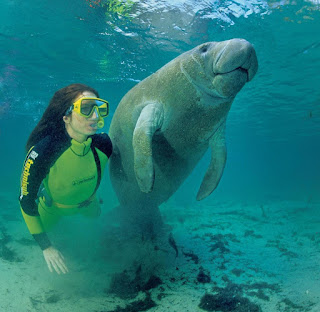
Chessie, the manatee that gained fame for making sporadic visits to the Chesapeake Bay over three decades, has made yet another reappearance, easing fears that a possible alligator attack last summer had done him in.
Chessie, a manatee who has occasionally visited the Chesapeake Bay, is scanned for a passive integrated transponder tag. PIT tags, commonly referred to as microchips, are about the size of a rice grain and are widely used by veterinarians to help identify lost pets and return them to their owners. Florida Fish and Wildlife Conservation Commission
When his satellite tag stopped transmitting last June in waters near Jacksonville, FL, scientists suspected that an alligator or a boat had damaged it. For more than six months, Chessie’s whereabouts were unknown.
 |
| Manatee swimming with Mermaids |
But on Tuesday, Jan. 25, an underwater microphone deployed by the Clearwater Marine Aquarium detected a separate — and apparently still-operative — tracking device attached to the 1,500-pound mammal. The sonic transmitter showed that Chessie was basking in the warm discharge from a power plant in Fort Lauderdale, more than 300 miles south of his last known location.
The aquarium’s staff hurried to the canal. They located the manatee and fastened a fresh satellite tag to him, according to the nonprofit’s press release. The tag allows researchers and the public to track Chessie’s movements remotely.
 |
| Chessie getting measured and photographed |
Scientists estimate the manatee to be at least 35 years old. His lifetime has been marked by a dramatic series of appearances and disappearances, beginning with his sighting in the Chesapeake Bay in 1994. That was the first time a manatee had been spotted in Maryland waters. He bypassed the Bay during his northward trek the following year but ventured as far north as Rhode Island, adding another first to his ledger.
He popped up in the Bay again in 2001 and 2011. But then he was off the grid until he was recovered in February 2021, emaciated and suffering from pneumonia. Unlike hundreds of Florida manatees that have died of starvation amid a recent mass die-off of seagrass, Chessie survived.
To my great regret, I missed Chessie when he stopped for a short visit in the local harbor in 2011.
The Wombat has Rule 5 Sunday: Evangeline Lilly at The Other McCain.
 |
| Nicole Spenc likes Alligators |
St. Mary’s County officials and a wildlife expert say they’re searching for an alligator that was reported in the area recently.
About a week and a half ago, officials in St. Mary’s County got a report of an eight-foot alligator roaming around.
According to county officials, they initially dismissed an alligator sighting in the area last year due to a lack of evidence.
A wildlife specialist, however, took an interest in the case, and recorded what they believe is credible video that could be showing an alligator.
 |
| So does Maria Meinke |
It’s not legal to own an alligator here, but officials believe it may have been someone’s pet and they released it back into the wild.
"The most important thing is that I don’t feel there’s a danger to the public. I think it’s fairly safe where it is. We’re not getting reports of pets missing or anything of that nature," said Steve Walker, Director of St. Mary’s County Emergency Services Department.
The county is working with a local wildlife group to capture the animal and take it to Florida.
 |
| And Amber Marchant |
"We think we’ve got a pretty good crew who’s doing it. There’s a local wildlife expert who is actually pursuing this and we are offering assistance to that person. He’s getting all the permitting for transporting the animal. We did provide some materials for him to build a trap," Walker said.
St. Mary’s County officials say they have never had a report of an alligator sighting in the area before so this is a first.
I'm not worried about 'gators, but its interesting to me that we've had two recent reports in our area. Most of the trafficked crocodilians are Caiman from South American, which fare poorly in our cold climate. But our native gators do survive the occasional frost in their native habitat, so what would prevent them from making a go of it here? Furthermore, I wouldn't be shocked to learn that these were not accidental or deliberate releases, but rather "rogue" animals that decided to wander away from southern climes, like Chessie the Manatee and found a northern home suitable. They're unlikely to get a breeding population together, but, given warmer temperatures, it could happen. I'd accept them in exchange for Bonefish and Tarpon.
The Wombat has both Rule 5 Sunday: Rabbit Season! posted at The Other McCain on time and under budget.


CAPE WASHINGTON (IMO: 7826178) is a Vehicles Carrier that was built in 1982 (39 years ago) and is sailing under the flag of USA. It’s carrying capacity is 32386 t DWT and her current draught is reported to be 7.8 meters. Her length overall (LOA) is 212.44 meters and her width is 32.24 meters.


A record number of manatees has perished in Florida this year in what experts are calling an unprecedented die-off. Marine scientists say most of the 890 deaths, as tabulated through July 30, are linked to a massive decline in seagrass on the state’s East Coast that has robbed the gentle mammals of their primary food source.
But in this case, rescuers soon realized they had just saved an icon. A decade after his last confirmed sighting anywhere, Chessie the manatee — famous for his northerly treks to the Chesapeake Bay — was still alive.
The distinctive scars on his back betrayed his identity as the manatee that stunned the scientific world in 1994 with his first foray into the Chesapeake, for which he was named. At the time, he was the first documented manatee to be spotted in Maryland.
His renown was heightened by two more confirmed sightings in the Bay in 2001 and 2011.

Was this to be the end of Chessie’s far-wandering ways? Not quite. In fact, not long after his release into the wild last May, the manatee, who is believed to be at least 35 years old, showed he has quite a bit of life left in him.
“He very quickly made tracks north,” said Monica Ross, a senior research scientist at the Clearwater Marine Aquarium, which had attached a satellite tag to the manatee to track his whereabouts. The public could also follow his movements on a website operated by the aquarium.

Chessie, now tipping the scales at 1,500 pounds, was released May 12 just north of West Palm Beach, FL. By May 23, he had trekked to the mouth of the St. Johns River near Jacksonville, about 300 miles up the coast. Over the next month, the satellite tracker showed him swimming several miles up the river as well as farther north along the coast to within a few hundred yards of the Florida-Georgia state line.
But after the tag sent up a signal near Blount Island in the St. Johns on June 27, there were no more pings. The tag was connected to a float ring that towed behind the large, gray animal. Because the signal was lost in the early evening near a shoreline, Ross said she is “100% convinced” the tag was bitten by an alligator.
“It’s something in the water column and they’re looking for food, so they will bite our tags,” she said.
Where and when Chessie will pop up again is anyone’s guess now. Ross urged anyone who spots a belt-wearing manatee to report the sighting to their state’s wildlife agency.
Alligator? I'm guessing a boat prop is more likely.
Linked at the Other McCain in the Wombat's Rule 5 Sunday: One From The Vaults.

The manatee arrived in the triage unit at SeaWorld Orlando like so many this year, emaciated, its skin clinging too tightly to its skull, ribs showing.
It had a brand telling of a previous rescue and release, but no tracking chip.
Still, the scars on the 1,100-pound male — like fingerprints — quickly identified his celebrity.
Chessie the manatee, whose nickname stuck after a 1994 rescue from the Chesapeake Bay, is a star of children’s books for his journeys as far north as Rhode Island. He is notorious for ditching tracking devices, made headlines in 2001 and 2011 when he reappeared in Mid-Atlantic waters, and flew on a C-130 Hercules on an escorted trip back to Florida.
Chessie the manatee made his name in Baltimore waters in the 1990s.

“There was a little added pressure,” said Senior SeaWorld Veterinarian Dr. Lydia Staggs about treating the ailing luminary.
Chessie went to SeaWorld after a Feb. 5 rescue in Riviera Beach by Florida Fish and Wildlife Conservation Commission officers who saw him floating on his side — an obvious sign of distress.
On Tuesday, a nearly 1,500-pound Chessie was released at Anchorage Park in North Palm Beach.
He is wizened — possibly upwards of 40 years old — but still the same scamp who evaded rescuers for eight days in October 1994 after being spotted in a sewage outfall near Queenstown, Md., in the Chesapeake Bay.
I missed Chessie when he visited our harbor in 2011.
Best of luck, Chessie. I suggest moving no farther north than the Carolinas in the future.
Wildlife officials are poised to move manatees off the endangered species list and upgrade their status to threatened, the U.S. Fish and Wildlife Commission announced Thursday. 2
"We believe the manatee is no longer in danger of extinction," said Michael Edgar with the FWC.
The designation acknowledges the success of conservation efforts in Florida over the past 25 years. They've included boat speed restrictions and manatee protection areas which helped ensure the animals wouldn't be bothered by humans.
. . .
The proposal to downlist will not affect federal protections currently in place by the ESA.
 So no Manatee roasts (I hear it's excellent; almost as good as mermaid).
It's good news. I remember swimming with Manatees in the shallow waters near the Fort Pierce Inlet along with my young son, Corwin, and seeing them come into the ship channel at Harbor Branch Institution (now Harbor Branch Oceanographic Institution), where I did my post-doc.
“The manatee’s recovery is incredibly encouraging and a great testament to the conservation actions of many,” said Cindy Dohner, the Service’s Southeast Regional Director in conjunction with an event at the Miami Seaquarium to announce the Service’s proposal. “Today’s proposal is not only about recognizing this progress, but it’s also about recommitting ourselves to ensuring the manatee’s long-term success and recovery. (Photo: S. Whitcraft, USFWS) http://1.usa.gov/1OdsrRG

Delaware wildlife officials are warning boaters to keep a lookout for a manatee that was spotted in the Chesapeake and Delaware Canal.We recently saw that one was spotted in the lower Potomac River. I doubt they are the same individual, as that would be a quick swim at the usual speed of Manatee
Cpl. John McDerby of the Division of Fish and Wildlife Natural Resources Police says a 7-foot manatee was spotted at the Summit North Marina in Bear on Thursday afternoon.
McDerby says it's rare for the creature, a native of Florida, to travel this far north.
McDerby says boaters who spot a manatee should slow down their vessel and keep a safe distance away from the manatee.
Earlier this month a manatee was spotted near Ocean City, Md., and in the Chesapeake Bay. Officials say they are not sure if each sighting is of the same manatee, or if there are several of them in the area.
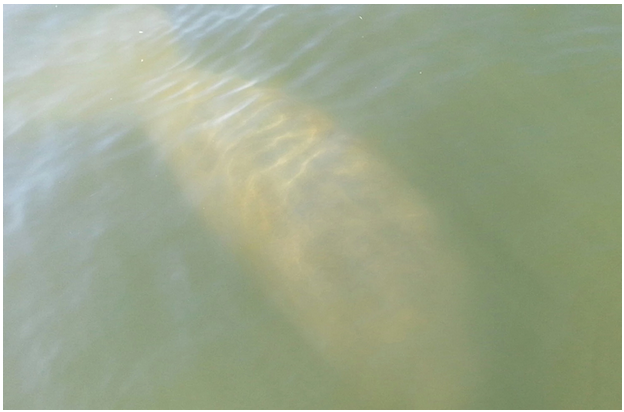
Officials with the National Aquarium said in a blog they run that the manatee was seen in St. George Creek in the Waldorf area.It seems like every year, a Manatee or two infected with wanderlust find themselves up the Bay during summer.
It actually isn’t that odd to see manatees in the area. Manatees usually travel from Florida up the East Coast, the aquarium said. Sea grass — their main choice for food — is abundant in the Chesapeake Bay.
And like others who seek warmer temperatures when it starts to get chilly in the D.C. area, the manatees “will begin to head back to the warmer waters” along the southern Atlantic coast, authorities said.


