
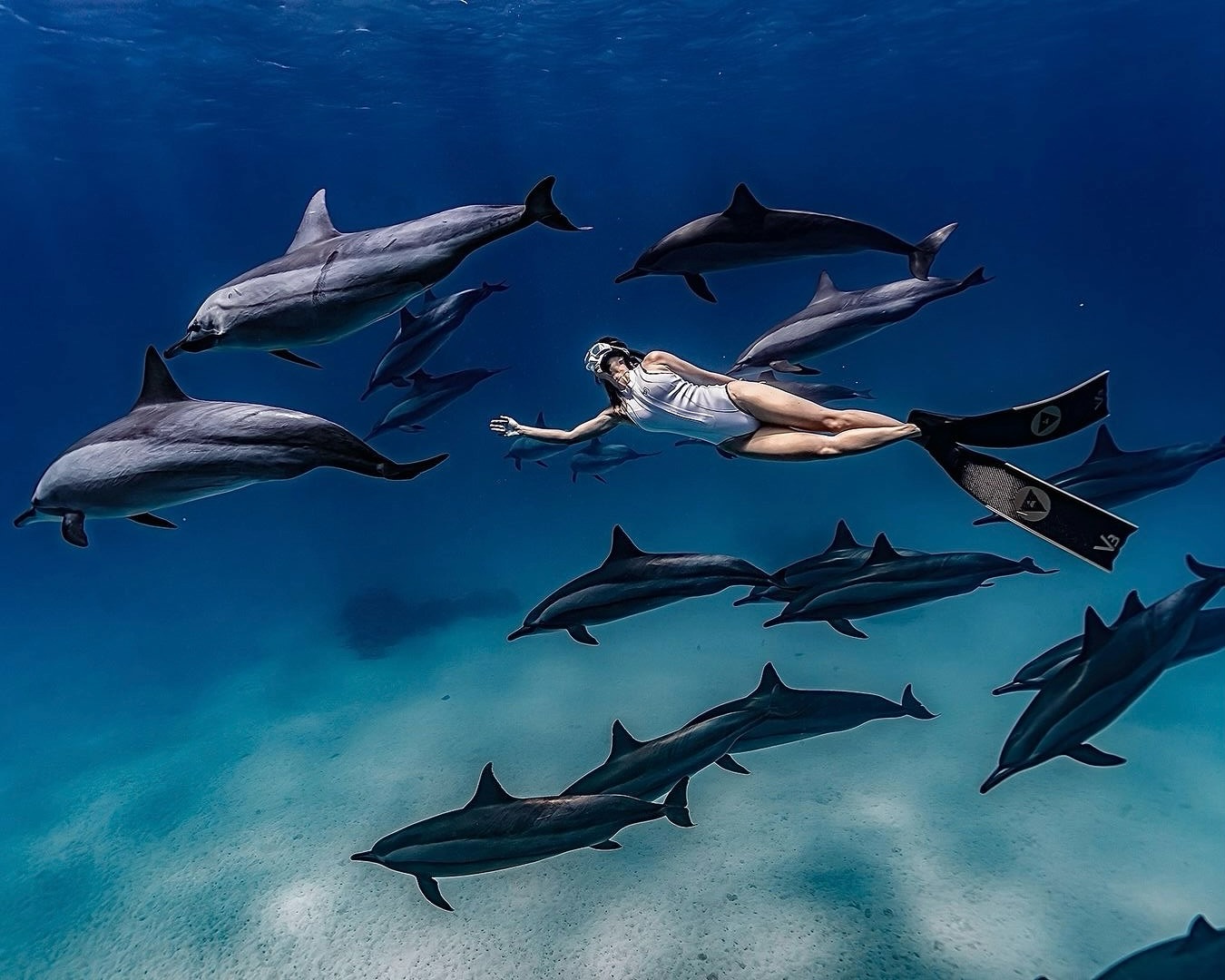
Kari Nautique@kari.nautique Entrepreneur 📸 Sober Supermodel & Producer
🏋️♀️ Fitness & Freediving 🧜♀️🏡 Recovery Residences ✝️ JESUS is Lord 🙏
The Wombat has Rule 5 Sunday: Terrain Features up on time and under budget.

The Maryland Department of Natural Resources asks residents and visitors enjoying coastal and tidal waterways to remain alert for marine mammals and sea turtles into summer through early fall.
Dolphins, manatees, sea turtles, whales, and other marine wildlife are regular seasonal visitors to the Chesapeake Bay and its tidal tributaries, the Atlantic Ocean, and coastal bays. So far in 2025, Maryland has reported a higher-than-average number of strandings.
The five-year average (2020–2024) for marine mammal strandings in Maryland from January to May was 10 cases. As of June, the stranding program has responded to 29 animals.

Anyone who sees a marine mammal or sea turtle in Maryland waters is encouraged to report it via the Maryland Natural Resources Police Hotline, 800-628-9944, or use a simple online form to report deceased marine mammals or sea turtles. Anglers, boaters, and beachgoers should especially be on the lookout for stranded, dead, sick, injured, or entangled animals.
“Citizen reports allow us to have eyes on Maryland’s 3,190 miles of tidal coastline,” said Stranding Response Program Coordinator Amanda Weschler. “The data provided about each deceased animal and the select necropsies we perform contribute valuable information to the scientific understanding of the challenges protected species face in our waters.”

Since 1990, Maryland’s Marine Mammal and Sea Turtle Stranding Response Program ha s collected reports of more than 1,590 strandings.
One of the first cases the staff responded to in April was a West Indian manatee, reported by a private citizen kayaking on the Pocomoke River in Worcester County. DNR biologists determined that it likely stranded in late summer or early fall of 2024.
This was the first known stranded manatee in Maryland since November 2016. West Indian manatees (Trichechus manatus) are considered an “out-of-habitat” species in Maryland, making this sighting particularly rare.
Other animal strandings to which DNR has responded in 2025 are:
- 13 bottlenose dolphins (Tursiops truncatus)
- Two grey seals (Halichoerus grypus)
- One harbor porpoise (Phocoena phocoena)
- One humpback whale (Megaptera novaeangliae)
- Five loggerhead sea turtles (Caretta caretta)
- One minke whale (Balaenoptera acutorostrata)
- Five short-beaked common dolphins (Delphinus delphis)

Not all reported animals are viable for necropsy due to factors such as decomposition, resource availability, and the accessibility and safety of the stranding site. In cases where necropsy is not feasible, Stranding Program staff collect morphometric data, stranding location information, and take photographs. The deceased animal may be left at the stranding site to decompose naturally, benefiting the ecosystem. Alternate disposal methods include burial on-site or removal to designated disposal facilities, depending on the circumstances and local regulations. A list of relevant contacts for individuals seeking assistance with disposal is listed on the DNR website.
The department urges anyone who encounters a stranded animal, alive or dead, to maintain a safe and respectful distance and record details, including photos, to provide with a report.
I haven't found anything recently, but a few years ago, a dead dolphin washed up at Matoaka and a few years before that a sea turtle on Calvert Beach.
Maryland Department of Natural Resources Rolling out New Licensing System, MD Outdoors
The Maryland Department of Natural Resources will introduce its new online licensing system, MD Outdoors, on June 24. This centralized system replaces the current system, COMPASS.
MD Outdoors will continue to offer products for all outdoor activities, including all Maryland hunting and fishing licenses and associated stamps and permits, boat and off-road vehicle renewal registration, and other services that will be available in this one convenient location. The system is designed to streamline the process of renewing licenses and permits as well as make it easier and more simple for new and returning customers.
Current license-holders will retain their DNR ID number; the new website will provide clear instructions on creating a new username and password for MD Outdoors, where customers can retrieve their account information. The new system includes auto-renew options, an easier-to-navigate interface, and an app that stores your license information, and can help direct people to new hunting and fishing opportunities. Other benefits and capabilities will be added in the future.
Along with improvements in the user experience, Maryland for the first time is offering the purchase of durable license cards that demonstrate fishing and hunting license validity. These rugged, collectable cards feature various images of Maryland fish and wildlife.
That reminds me. My fishing license expires July 1. I might as well go over and check out the new site.
The Wombat has Rule 5 Sunday: Overall Beauty up more or less on time and under budget.

A new app helps people track dolphin sightings in the Chesapeake Bay. You can find out where dolphins are and even upload videos of your own sightings. "This time of year is a great time to see dolphins," said Jamie Testa, project coordinator for Chesapeake Dolphin Watch.
Ocean City isn't the only place where you can see Atlantic bottlenose dolphins. From Havre de Grace to Virginia Beach, you can keep track with an app called Chesapeake Dolphin Watch. "They are all from opportunistic sightings. They are just out, enjoying their day on or near the water, they happen to see dolphins and they report them to us," Testa said.
The easy-to-use app was launched in 2017 from the University of Maryland Center for Environmental Science Chesapeake Biological Laboratory. "If you're not fortunate enough to see bottlenose dolphins, you could use the app to explore other people's sightings," Testa said. "You can browse around, look at where the sightings are on the map, as well as images."
Testa said the information is more than just fun to have, it's used to study dolphin movement and behavior. "We're looking at where they go, how far upriver, how far downstream, which creeks they're checking out," Testa said. "Some of the behaviors that we get from the sightings, like it appears that they were feeding, or sometimes we see video footage showing mating behavior."
The app is free — all you need is a name, email and password to register.
I'll report dolphins if I see them, but I'll be damned if I put a new app on my phone to do it.
The Wombat has Rule 5 Sunday: The Almost Perfect Picture ready and willing to collect clicks.

Sightings of bottlenose dolphins in the Chesapeake Bay are on the rise…experts say that means good things for the Chesapeake Bay.
As reported by Maryland Matters, a dolphin expert at the University of Maryland’s Center for Environmental Science said that while dolphins in the Bay are an annual occurrence, dolphins being sighted deeper into the Bay – as far north as Baltimore – is a trend that seems to be increasing.“It’s a wonderful sign that our beloved bottlenose dolphins are coming into the Bay. They are feeding. They are bringing their young. It signals really good things about our fisheries and that they can find a diversity of food here,” Testa said. “It points to a sign of things improving and things being hospitable for them.”

Researchers divide the Bay into thirds when monitoring dolphins: from the mouth of the Atlantic Ocean to the VA/MD state line; north from that point to the Bay Bridge; and then from the bridge into Baltimore.
The National Oceanic and Atmospheric Administration notes that bottlenose dolphins are highly intelligent and can live up to 60 years. Though they are usually found in tropical seawater, it’s not uncommon to see them in brackish water during the summer months. Experts warn that keeping a 50-yard distance when viewing dolphins is the safest method.
You can follow where bottlenose dolphins have been spotted at Chesapeake Dolphin Watch’s website. Or, read the full article from Maryland Matters for more details.
It's only been in the last ten years or so that dolphin sightings in the bay have become fairly common. Meanwhile, the improvement in the conditions of the Bay have been, to say the least, underwhelming. Maybe they were enough to encourage dolphins, but I rather suspect a more mundane reason, expanding dolphin populations on the Atlantic seaboard.
The Wombat has Rule 5 Sunday: In & Out up at The Other McCain.


A bit of an odd year. 4337 teeth, including sharks, dolphins and crocodiles and a couple of boar's tusks, which is a first (I think, we're really not sure what might be buried back in some past years) for an average of 11.8 teeth per day. We found only 1 Megalodon, and it was Georgia's tiny Hubble Meg (in front of the jar, left) and even the bigger teeth weren't really standouts. One arrowhead (front of the jar right). Total tooth weight was 2' 15 1/8 oz or 1332 grams, averaging a smaller than normal 0.31 g average. No really big outstanding bones, other than the whale ear bone (periotic) in the upper left.


-EDIT.jpg)


A New Year, and time to clean off the kitchen window sill, count the shark's teeth and try to find a place to store it all:


A lot of unexpected things have turned up in the Baltimore Harbor, but it’s not every day a dolphin turns up along the urban waterfront.
A Harbor Point employee sent a photo of a dolphin just off its campus to the folks who run Mr. Trash Wheel, the city’s solar-powered trash interceptor. The photo, shared on Facebook, is getting a lot of attention.
The National Aquarium in Baltimore is keeping an eye on the situation, but has had no other reports about this dolphin yet, says Kate Shaffer, stranding response and triage manager.
 |
| Not Baltimore Harbor |
DolphinWatch, the citizen science dolphin research program run by the University of Maryland Center for Environmental Science (UMCES) is aware of the report and photo. Project Coordinator Jamie Testa tells Bay Bulletin that dolphin sightings in the Patapsco River have become increasingly more common over the past two years.
Testa says, “Several have been downriver from the tunnel and/or in creeks to the south like Stoney Creek and Rock Creek and most of the sightings were from July.”
Indeed, DolphinWatch told us earlier this summer that there were more dolphins being spotted further north than usual in 2022 and the first part of 2023.

We asked both Testa and Shaffer whether it’s possible the dolphin could have wandered up to the Inner Harbor as a result of Tropical Storm Ophelia, which brought gusty winds, inches of rain and storm surge to the Chesapeake region.
(Last week we reported on flamingos that wandered far afield of their southern habitat in the wake of Hurricane Idalia. A pair was even found in the Potomac rivershed in Pennsylvania!)
As for the dolphin sighting, Shaffer says, “It is possible that increased water levels could allow animals to access areas they would otherwise not be able to access.”
Testa says dolphins tend to generally “do OK during storms”, so the storm may have been only one of several contributing factors.
It’s not the only dolphin sighting at the Baltimore Harbor in the past few years. You may remember in 2019 that a couple of Port of Baltimore employees captured video of a dolphin calf in Canton. That turned out to be a young Risso’s dolphin, an unexpected visitor to the harbor. According to the National Aquarium, Risso’s dolphins, also called gray dolphins, prefer deeper offshore waters.
Could it have been related to the storm? It's possible, I suppose, but I doubt it. There are just more dolphins in the Bay in the past few years, and they poke into all kinds of different habitats to see if there's something there they want, mainly food. I suspect this one was disappointed and headed out past the bridges pretty quickly.
I wonder if the photos have enough detail to identify the dolphin should it return in future years. I would be kind of neat to have a dolphin returning to Baltimore year after year, the way Chessie the Manatee returns to the Bay repeatedly.


 |
| Skull as initially found |
On Saturday night, Calvert Marine Museum volunteer Emily Bzdyk was collecting fossils at Calvert Cliffs in Maryland when she made a discovery that could help write history books on marine life from long ago: In the beach, the water and surf uncovered a 15-million-year-old dolphin skull.
“Rarely are they in this good of condition,” said Stephen Groff with the Calvert County Marine Museum.
 |
| Emily with skull in place |
It is not uncommon to find fossils from marine mammals. Dolphin skulls are typically found twice a year in southern Maryland. But this find, according to Groff, stands to be the most intact of the finds. It could also turn out to be a species that was previously not known about.
Bzdyk’s discovery led to Groff and others joining her on Sunday for a dig at the beach to unearth the skull. It is a process that takes patience and precision to not damage the fossil. Once removed from the sand, the skull was taken by boat to the museum.
 |
| Skull being excavated for removal |
Now, it is in the process of being dried. When wet, glues and other material used to preserve fossils cannot be used. Next, work to carefully remove remaining sediment will take place.
Bzdyk will be in charge of that process.
“It’ll probably take her a few months, takes several dozen hours to completely clean one of these skulls because we have to be very careful that we don’t break anything or cause any damage,” Groff said.
While work is done, museum visitors will be able to see Bzdyk conduct the work in the coming weeks.

Groff said one misconception is that all fossils found in the area are found in the cliffs. But some are found in the beach like this one was.
During the Miocene period, when the marine mammal swam the earth, the sea level was much higher, according to Groff. What is the beach now was once the ocean floor. Now, as the ocean is eroding away part of the beach, more fossils are being uncovered.
 |
| Skull wrapped in plaster for removal |
Groff said while the term dolphin is used, the species of marine mammals didn’t look like bottled nose dolphins.
“You can kind of think of them like a modern swordfish, or sailfish,” Groff said. “They have a long snout, they probably use it to club fish just like modern a billfish do, or to maybe probe around in the mud on the seafloor to stir up fish,” said Groff.
Groff said there is a good chance this isn’t a new species, but only a full exam of the fossil will tell. That said, he does suspect there are more species that have yet to be discovered, since it is believed during that time that 40 toothed marine mammals lived in the area.
 |
| Tee Smith carrying skull to boat |
Groff said it is discoveries like this that has him looking forward to coming to work each day.
“To be able to go out in the field and, you know, recover and preserve a piece of our local natural history, it’s just wonderful. I can’t describe how exciting it is,” he said.
Emily (as well as most of the people involved in recovering this specimen) are regulars on the Facebook page Calvert Fossils and Trip Reports where I go to brag, and ask the pros about my finds.
Good job, Emily!

