Showing posts with label moths. Show all posts

Friday, March 4, 2022

Science Eliminates Gypsy Moth

Gypsy Moth
That was simple, just rename it, Etymological Society of America, 'Spongy Moth' Adopted as New Common Name for Lymantria dispar

Annapolis, MD; March 2, 2022—"Spongy moth" has been formally adopted as the new common name for the moth species Lymantria dispar by the Entomological Society of America.

The ESA Governing Board voted unanimously last week to approve the addition of "spongy moth" to ESA's Common Names of Insects and Related Organisms List, completing a process started in July 2021 when the previous name, "gypsy moth," was removed due to its use of a derogatory term for the Romani people. The change is the first undertaken by ESA's Better Common Names Project.

The name—derived from the common name used in France and French-speaking Canada, "spongieuse"—refers to the moth's sponge-like egg masses.

"Lymantria dispar is a damaging pest in North American forests, and public awareness is critical in slowing its spread. 'Spongy moth' gives entomologists and foresters a name for this species that reinforces an important feature of the moth's biology and moves away from the out-dated term that was previously used," says ESA President Jessica Ware, Ph.D. "We are grateful to the diverse community of people and organizations who have been involved in this renaming process and have committed to adopting 'spongy moth' as well."

The spongy moth is an invasive pest of North American forests that can defoliate hundreds of tree and shrub species. Native to Europe, Asia, and North Africa, it was introduced in Massachusetts in the 1800s and is now widespread in the northeastern United States and eastern Canada and costs hundreds of millions of dollars each year in damage and prevention and control efforts. A primary way the spongy moth spreads is via these egg masses when transported on firewood, outdoor equipment, and vehicles. Public awareness of the L. dispar egg mass and its sponge-like appearance is important in controlling the pest, as the insect spends most of its life cycle (10 months) in the egg stage.

Through its addition to the ESA Common Names List, "spongy moth" will now be adopted for use in articles published in ESA's scientific journals and in presentations and posters at ESA conferences, as well as in ESA's website, social media, and public policy documents.

I hope the Romani are happy not having a destructive moth named in their honor. 

The Wombat has a double stuffed Rule 5 Double Scoop Sunday: W*ng D*ng Sw**t P**nt*ng running at The Other McCain.

Thursday, August 27, 2020

A Walk Around the Neighborhood and in the Garden

Georgia, Skye and I decided to take a short walk around the neighborhood in lieu of a beach walk because it was bloody hot and humid out. Unfortunately, along the way, Skye ducked under vine, which unhitched her collar from the leash, and I had to go off and chase her while Georgia went home to wait for a call from the number on her collar. It was a relatively short chase; two streets up the hill she made the mistake of going onto someone's deck with only one way off, and I managed to corner her. On the way back, we met a young friend.
 Later, Georgia caught this female Ruby-Throated Hummingbird taking a heat bath on the deck rail under the feeder.
 After a while, I went out to see what kind of butterfly life was out in the garden. Zebra Swallowtails, although not as abundant as some years, are at least still fairly common.
And the Eastern Tiger Swallowtails still visit the Butterfly Bush
 As did this Clear Wing Hummingbird Moth.
 A bumble bee in Georgia's Cosmos.
And a Zabulon Skipper, another regular. 

Monday, August 12, 2019

From Today's Walk to the Beach

Some butterflies on the way to the beach. An Eastern Tiger Swallowtail male (compare to the female from yesterday).
A black morph female on the next stalk over. Too bad Skye wouldn't let me wait for a shot at the upper side.
 Still lots of butteflies puddling.
 Something different on a lot under the cliff.
Polyphemus moth  - Antheraea polyphemus
Caterpillar Hosts: A wide variety of trees and shrubs including oak (Quercus), willow (Salix), maple (Acer), and birch (Betula).
Adult Food: Adults do not feed.
Habitat: Deciduous hardwood forests, urban areas, orchards, and wetlands.
Range: Locally common in its broad range; in Canada in province except Newfoundland and Prince Edward Island; in the United States, every state except Arizona and Nevada; and Mexico.
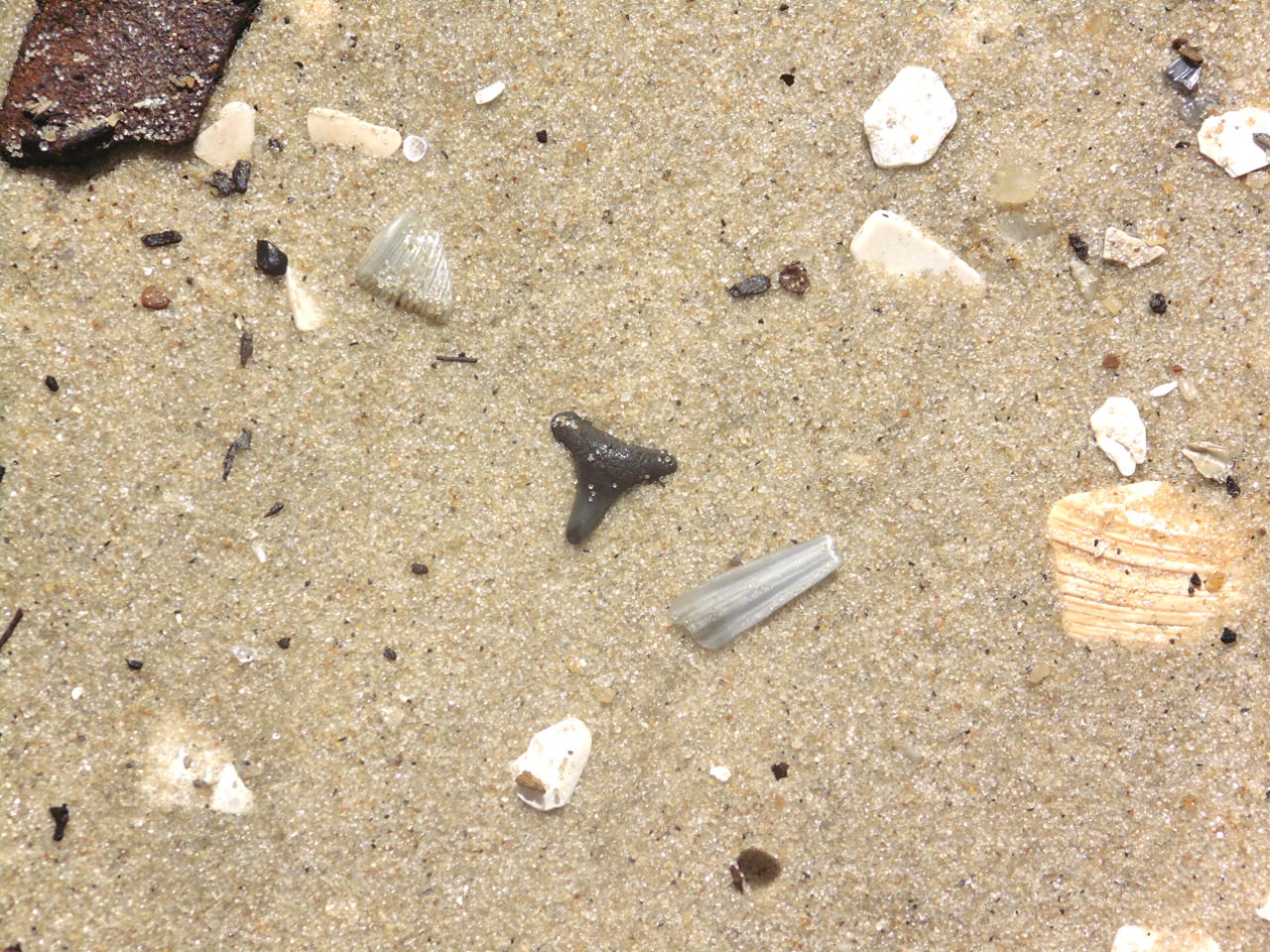
We got a lot of shark's teeth today, but mostly small. The chevron on the right is a Bonnet Ray mouth plate, in better shape than most, with an unusual color and texture. Instead of black and opaque, it was brown and somewhat translucent. 

Tuesday, August 7, 2018

Eagles and Moths at the Beach

 I'll start off this beach report with a Bald Eagle sighting.  They've been a little scarcer this year than they have in past years, so this was a little unusual.
It's hot here. 85 in the shade on the beach, although the home thermometer claims 90. There was a 10 kt south wind at the beach, which help considerably. Still warm for a snow loving dog, and we stopped in the shade a few times.
We're experiencing bout of red or mahogany tide. It's thick enough that you can actually smell it.
 A Luna Moth that blundered into the yucky water.
 Let's hurry back to the air conditioned car!
The red tide can really gather in the lee of the jetty thick enough that you can swirls in it.

Tuesday, August 1, 2017

A Visit to the Beach and a Visitor

 It was 85, sunny, and all but windless when Skye demanded her afternoon stroll. She and I walked down to the beach, and Georgia met us there with the car, which saved us the hot walk home.
I found this tooth pretty quickly. A nice Lemon Shark, maybe.
Georgia found this one within a few seconds. A little smaller and more worn.
Then I found this Snaggletooth. We had to quit with the pictures pretty quickly; we found 30 teeth.
Once home from the beach, I tried to get some butterfly pictures in the garden while Georgia tried to give Skye a good cleaning. The Butterfly Bushes were swarming. There were at least two Monarchs.
Not a butterfly, but a Hummingbird Moth, probably a Snowberry Clearwing.
A Zebra Swallowtail. I saw cerveral other varieties, and would have taken more photos, but I turned around and saw . . .
 A six point buck (I'll use eastern count, since I'm in the east) standing behind me in the back yard. I watched and took shots for a few minutes, and he barely moved, even when Georgia came over with Skye on the leash.
After a while he went back down, but then I came back around the house, and he was headed back up. It looks like he had an encounter with something. There was a big scraped on his side that didn't look like a wound, but had most of the hair off.
As you can see, his antlers were still in velvet.

Saturday, July 23, 2016

A Hot Day for the Butterflies

The heat brought out the butterflies today. An American Lady against the sky on the Butterfly Bush. I couldn't get a shot that showed the top of the wings. You can tell it from the very similar Painted Lady by the two big eyespots on the hind wing (top or bottom) or the little white spot surrounded by orange on the fore wing (top or bottom).
A giant female Eastern Tiger Swallowtail. The wide blue markings at the bottom distinguish it from the males.
A Zebra Swallowtail. I saw one laying eggs on a Paw Paw a few days ago, and I'm hoping to catch a caterpillar of one and grow it up.
 A Spicebush Swallowtail. One of several black swallowtails in the area. The cloudy green markings identify this one as male (the females are much bluer). Supposedly a mimic of the poisonous Pipevine Swallowtail, but it seems much more common to me.
 Not a butterfly at all, but a day flying moth that imitates hummingbirds or bumblebees, the Snowberry Clearwing.
One of the little orange skippers. I think it's a Sachem.
Oh, and a frog.

Sunday, September 13, 2015

Southern Refugees Reach Britain

Conservationists are calling on Britons to record sightings of a massive continental moth whose tongue is longer than its body.

The palm-sized Convolvulus Hawk-moth migrates from southern Europe to Britain in early autumn and has already been sighted widely across the UK in recent weeks, with a record number expected this year.

The Convolvulus, which is one of the largest moths in Europe, drinks nectar from tobacco plant flowers using its 7.5cm-long proboscis and also feasts on wine.

Every year, several hundred of the moths are spotted and numbers are believed to be increasing, with some seen as far north as North Yorkshire and Shetland.

Remarkably similar to the White Lined Sphinx Moth which we occasionally see around here:


Maybe I should put out some wine.

They also have some cool photos of other migrants at the link.


Saturday, May 2, 2015

Things in the Garden

In another post, I said I would update if a female Rose-Breasted Grosbeak showed up. I lied, I'm going with a whole new post because I have a lot of garden pictures to share.

We've had male Grosbeaks off and on since the first sighting, but today was the first time a female showed up too. I can't really tell if the males are all the same or if it's new one flying through, although I suspect the later.
Another visitor? A Myrtle or Yellow Rumped Warbler. Way out in the back among the trees, at the far end of my zoom's capabilities.


The first Silver-Spotted Skipper for the year. They'll be common later, if the past two years are any guide. This is a rare open wing shot.
Mostly they hold their wings erect over the body, displaying the silver spot that gives them their name.

In addition to this, I also saw a couple of Zebra Swallowtails flit by, but not stop
A clear wing hummingbird moth of some sort, most likely a Snowberry Clearwing.


Sunday, August 17, 2014

Back in the Garden

This afternoon we got back into the garden. The lawn was shaggy after more than a week without mowing, and some of the pots needed some watering.  After mowing the lawn, I went to check out the butterfly garden to see if there were any new visitors.  Well, no, but did find this pair of Zabulon Skippers courting.
 The Zabulons are very common, at least this year and last year, and unlike many skippers, they are very sexually dimorphic.  The males are typical orange skippers, while the females are much darker, with the violet markings on their wings. There were at least two males fighting over this female.
A Snowberry Clear Wing Hummingbird Moth buzzed by, but wasn't impressed by the offerings and didn't stay long.
 A tattered Red Admiral stopped by a couple of times for a sip.
Red Admirals prefer sap flows on trees, fermenting fruit, and bird droppings; visiting flowers only when these are not available. Then they will nectar at common milkweed, red clover, aster, and alfalfa, among others.
And Butterfly Bush, apparently
And a Robber Fly lurks around looking for somebody to grab.