Showing posts with label physics. Show all posts

Wednesday, September 2, 2026

New Light on Dark Matter?

From New Scientist, The first signs of dark matter particles may finally have been spotted
Researchers may have spotted the first signs of a dark matter particle. If the result is confirmed, it could be one of the most monumental discoveries in the history of physics. Dark matter makes up about 85 per cent of the universe, but for decades physicists have been unable to determine what it itself is made of. Hypotheses have ranged from different sorts of particles and forces to strangely behaving gravity and everything in between – but the leading idea has always been that of the weakly interacting massive particle, or WIMP. As we have built more and more powerful detectors to search for WIMPs, though, their failure to show up has led many to doubt their existence and move on to more exotic ideas.

That doubt may soon come to an end. A new analysis of data from the LUX-ZEPLIN (LZ) experiment in South Dakota has revealed a single particle that may be the first WIMP ever detected. “This result is certainly an exciting one, because it provides some potential positive hint for what dark matter could be, not just what dark matter could not be,” says JiJi Fan at Brown University in Rhode Island, who wasn’t part of the analysis.

LZ looks for dark matter using a 7-tonne tank of liquid xenon, surrounded by several layers of shielding and buried more than a kilometre down to keep out other types of particles. When an outside particle hits a xenon atom, it creates a tiny burst of light that is measured by sensitive detectors surrounding the tank. Researchers can then use that light to reconstruct the path of the incoming particle and the energy level of the interaction.

In the search for WIMPs, we generally look for events with energies below about 30 kiloelectronvolts (keV), says LZ spokesperson Richard Gaitskell, also at Brown University. That assumes the simplest sort of interaction, in which the WIMP is essentially bouncing off an individual nucleon in the xenon nucleus. Having not found any hints of WIMPs in that energy range, the LZ team decided to reanalyse the first 220 days of data from the detector, searching for events with higher energies. That is where they found their dark matter particle candidate, at about 248 keV. “You must never make an assumption that nature is going to do something the easy way,” says Gaitskell. “Nobody can accuse our universe of making the simplest and most natural-seeming choices.”
A WIMP Detector
In particle physics, the statistical threshold for a finding to go from an intriguing hint to a solid discovery is a number called 5 sigma, which means there is about a 1-in-3.5 million chance that a signal like this would show up as a fluke rather than a true sign of dark matter. Right now, this detection from LZ sits at 2.6 sigma, which means that there is about a 1-in-200 chance it could appear as a fluke.

That might still seem fairly secure, but in the search for dark matter it is far from enough. “In science we sit down and we do so many damned experiments, I’m afraid you come across a 1-in-100 event fairly often,” says Gaitskell.

Back in my biology days we were pretty happy with a 2.5 sigma result, provided you had done adequate correction for multiple tests. Still, basing the result on the alleged detection of a single WIMP seems a little sketchy. Your not going to get very good statistics with n=1. That is certainly a weakly interacting particle.

Wednesday, November 27, 2024

I Have Seen the Light

At Earth.com, Precise shape of a single photon revealed for the first time

For the first time, researchers have defined the precise shape of a single photon, a huge leap forward in quantum physics and material science.

Dr. Benjamin Yuen from the University of Birmingham led the groundbreaking research that delves deep into the quantum level of light and matter interaction.

His team’s findings, published in Physical Review Letters, provide a visual representation of a photon while enhancing our understanding of how photons are emitted and shaped by their environment.

The interaction between photons and their environment leads to endless possibilities for how light exists and travels.

This limitless potential makes modeling these interactions exceptionally challenging — a puzzle that quantum physicists have been trying to solve for decades.

“Our calculations enabled us to convert a seemingly unsolvable problem into something that can be computed,” Dr. Yuen explained.

“And, almost as a byproduct of the model, we were able to produce this image of a photon, something that hasn’t been seen before in physics.”
The idea of constructing an image of a particle that represents the absolute smallest element of an image seemed a bit grandiose, so I did something dangerous. I went off to the original paper to check. The math was far above my recollections from P-Chem, but I did not find a picture of a photon there. I did, however, see something akin to the picture above, which seems to be a representation of the probable energy distribution within a particular photon. I presume that changes depending on the energy (wavelength) of that photon, and seeing that represented would have been interesting. But I guess they have to save that for the next paper. 

Thursday, July 11, 2024

Weird Science!

 At Da Blaze, CRAZY: Scientists invent 'anti-gravity' device that could revolutionize transportation

Ascientist by the name of Charles Buhler claims that he and a group of scientists and engineers have developed a device that defies the laws of physics in that it can propel itself without a propellant.

Buhler, who’s the co-founder of Exodus Propulsion Technologies and a NASA electrostatics expert, says that his team has been exploring “propellantless propulsion” for many years.

Their work, which began in 2016, has now culminated with the development of a device that has the potential to revolutionize transportation as we know it.

I've got a lot of time and energy invested in learning the natural laws, but I would welcome a modification that would allow this. On the other hand, if I had a revolutionary idea that would overturn much of physics, somehow, I don't see Glenn Beck's Blaze as the place tout it. 

The video doesn't say much about the power requirements of the the proposed system. Does it require electrical energy inputs on the order of rockets to lift a body into space? That's going to be a long, thick extension cable...

As issues of climate change and energy security are becoming increasingly salient, the promise of an apparently "clean", "abundant" and "safe" energy source, such as fusion, is ever more appealing. 

In response, the fusion industry is growing rapidly and the trope that fusion is "30 years away and always will be" is beginning to lose credibility as the technology moves beyond its experimental stage.

But it's too easy to generate hype around a seemingly ideal solution to societal challenges – and I would argue that the realisation of fusion energy may come into tension with the issues it proposes to solve.

Contextualising this hype and exploring areas where these tensions may arise is critical to ensuring the technology develops in an ethically sound way and can provide net societal benefit if it proves viable.

In short, the environment, women and minorities hurt worse: 

But these benefits may mask deeper ethical questions around the development of the technology and some potentially detrimental impacts. Perhaps one of the clearest instances of such a tension arises over environmental sustainability. This applies particularly to the association with climate change mitigation and the reduction of greenhouse gas emissions.

Climate change is an issue that lends itself to the "techno-fix" approach – in other words, it can be tempting to avoid making important changes to our behaviour because we think we can depend on technology to fix everything. This is known as the "mitigation obstruction" argument.

Squaring greenhouse gas emissions with energy demand also raises questions of justice and equity. Energy demand is growing in certain regions, primarily the global south, that have contributed the least to the current climate crisis. Yet fusion programmes are overwhelmingly based in the global north. So if fusion proves viable, those with access to such a transformative technology are not necessarily those who will need it most.
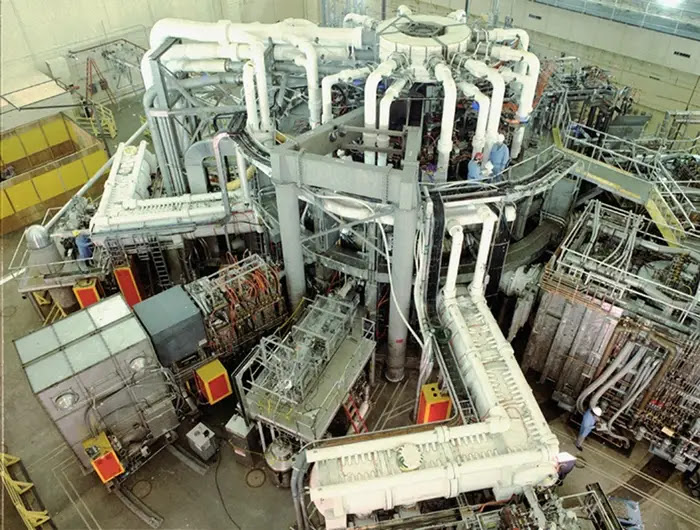
 ST40 compact spherical tokamak
Similar concerns can be found in the materials used for fusion energy. These include critical minerals, including lithium, tungsten and cobalt. Extraction and processing of these minerals emits greenhouse gases. In some cases, extraction operations are located on or near the lands of indigenous peoples. And the supply chains for these materials are embedded in geopolitical tensions, with alliances, collaboration, competition and the potential for monopolies forming.

Mercury, for example, is used in the processing of lithium for fusion reactors. Not only is the element environmentally damaging and toxic but depends largely on Chinese production.

The accelerating pace of fusion energy increases the risk of overlooking these potential hazards along the way. However, I would say this is not a case where we need to apply moral brakes, but rather shift gear. Approaching these potential ethical tensions requires systematic thought throughout the development process, from thinking about the implications of design decisions and materials choices, through to equitable deployment strategies and knowledge sharing.

Is it any wonder fusion is the fuel of the future, forever?

The Wombat has Rule 5 Sunday: Outstanding In Her Field garnering clicks at The Other McCain.

Friday, April 12, 2024

RIP: Peter Higgs, OJ Simpson

One man gave us mass, the other was a mass murderer, maybe. At The Guardian, Peter Higgs, physicist who proposed Higgs boson, dies aged 94

Peter Higgs, the Nobel prize-winning physicist who proposed a new particle known as the Higgs boson, has died.

Higgs, 94, who was awarded the Nobel prize for physics in 2013 for his work in 1964 showing how the boson helped bind the universe together by giving particles their mass, died at home in Edinburgh on Monday.

After a series of experiments, which began in earnest in 2008, his theory was proven by physicists working at the Large Hadron Collider at Cern in Switzerland in 2012; the Nobel prize was shared with François Englert, a Belgian theoretical physicist whose work in 1964 also contributed directly to the discovery.
. . .
The Royal Swedish Academy of Sciences, which awards the Nobel, said at the time the standard model of physics which underpins the scientific understanding of the universe “rests on the existence of a special kind of particle: the Higgs particle. This particle originates from an invisible field that fills up all space.

“Even when the universe seems empty this field is there. Without it, we would not exist, because it is from contact with the field that particles acquire mass. The theory proposed by Englert and Higgs describes this process.”

Sound a bit like the old idea of the "aether,"  the imaginary filler of the universe through which light waves were originally thought to propagate. 

OJ. I don't intend to relitigate the trial of Orenthal James Simpson for the murder of Nicole Brown Simpson and Dan Goldman in Brentwood back in 1994. I suspect he was guilty, but I'm not totally convinced. Call it unreasonable doubt. There was enough evidence of police misconduct to a least take what they assert with a grain of salt. I've also heard (I forget where) a somewhat plausible version the events where one of Simpson's sons from a previous marriage committed the crime, but OJ stepped in to cover it up, explaining the forensic evidence.

I did have a personal encounter with OJ, prior to fame, in the late 1960s.  Back when he was a football player at USC, before the Heisman, a guy I worked with,  a black athlete from UCLA, occasionally hosted an unofficial poker game at the tropical fish store we both worked at. Yeah, it was that kind of place. Anyway, OJ Simpson was there one evening. Not a big deal, and it didn't make a big impression at the time, only later, after he got the Heisman, became a professional football player, actor, and all round celebrity. 

For a contrary view consult Stacy McCain at America Cries Out in Agony: ‘If Only Norm Macdonald Were Still Alive Today!’

Saturday, April 22, 2023

I Hate It When That Happens

 At ScienceAlert, Shock Boson Result Upending Physics Was a Miscalculation, Scientists Say

Last year a new finding in particle physics stunned scientists: a fundamental particle responsible for one of the Universe's four fundamental forces was heavier than predicted.


The discovery of a discrepancy between the W boson's theorized and experimental masses promised new insights beyond the Standard Model, the theoretical blueprint that describes how matter behaves.

Now scientists have run the same numbers again using an updated technique, this time discovering the particle's mass is a close fit with the Standard Model's predictions after all.

While this means we may not need a revolutionary rethink of our current theory of particle physics, we can't but help be a little disappointed. The Standard Model of particle physics remains a hypothetical interpretation of the Universe around us, but so far it has held up well to the battery of tests that we've managed to put it through. At the same time we know there are unexplained gaps: the Standard Model doesn't account for dark matter, for example, or even gravity.
. . .
"While the understanding of the detector as well as the effects of contributions from electroweak and top quark background processes have not changed, significant progress has been made in the statistical framework on the extraction of the W boson mass from the data," write the researchers.
. . .
"Due to an undetected neutrino in the particle's decay, the W mass measurement is among the most challenging precision measurements performed at hadron colliders," says particle physicist Andreas Hoecker from the ATLAS team at the CERN lab.
Well, I'm glad that's settled. I can sleep easily tonight. Oh, wait . . . 
It's worth bearing in mind that this is only a preliminary finding right now. Further tests are now underway on more recent data. If it turns out that the Standard Model has got the W boson mass wrong, that would hint at some as-yet-undiscovered particles and forces at play. For now though, it seems the reputation of this fundamental hypothesis is safe.

Darn it; back to insomnia it is. 

Saturday, December 3, 2022

Welfare for Physicists?

  The Guardian, No one in physics dares say so, but the race to invent new particles is pointless

Imagine you go to a zoology conference. The first speaker talks about her 3D model of a 12-legged purple spider that lives in the Arctic. There’s no evidence it exists, she admits, but it’s a testable hypothesis, and she argues that a mission should be sent off to search the Arctic for spiders.

The second speaker has a model for a flying earthworm, but it flies only in caves. There’s no evidence for that either, but he petitions to search the world’s caves. The third one has a model for octopuses on Mars. It’s testable, he stresses.

Kudos to zoologists, I’ve never heard of such a conference. But almost every particle physics conference has sessions just like this, except they do it with more maths. It has become common among physicists to invent new particles for which there is no evidence, publish papers about them, write more papers about these particles’ properties, and demand the hypothesis be experimentally tested. Many of these tests have actually been done, and more are being commissioned as we speak. It is wasting time and money.

Since the 1980s, physicists have invented an entire particle zoo, whose inhabitants carry names like preons, sfermions, dyons, magnetic monopoles, simps, wimps, wimpzillas, axions, flaxions, erebons, accelerons, cornucopions, giant magnons, maximons, macros, wisps, fips, branons, skyrmions, chameleons, cuscutons, planckons and sterile neutrinos, to mention just a few. We even had a (luckily short-lived) fad of “unparticles”.

All experiments looking for those particles have come back empty-handed, in particular those that have looked for particles that make up dark matter, a type of matter that supposedly fills the universe and makes itself noticeable by its gravitational pull. However, we do not know that dark matter is indeed made of particles; and even if it is, to explain astrophysical observations one does not need to know details of the particles’ behaviour. The Large Hadron Collider (LHC) hasn’t seen any of those particles either, even though, before its launch, many theoretical physicists were confident it would see at least a few.

Talk to particle physicists in private, and many of them will admit they do not actually believe those particles exist. They justify their work by claiming that it is good practice, or that every once in a while one of them accidentally comes up with an idea that is useful for something else. An army of typewriting monkeys may also sometimes produce a useful sentence. But is this a good strategy?

Experimental particle physicists know of the problem, and try to distance themselves from what their colleagues in theory development do. At the same time, they profit from it, because all those hypothetical particles are used in grant proposals to justify experiments. And so the experimentalists keep their mouths shut, too. This leaves people like me, who have left the field – I now work in astrophysics – as the only ones able and willing to criticise the situation.

There are many factors that have contributed to this sad decline of particle physics. Partly the problem is social: most people who work in the field (I used to be one of them) genuinely believe that inventing particles is good procedure because it’s what they have learned, and what all their colleagues are doing.

But I believe the biggest contributor to this trend is a misunderstanding of Karl Popper’s philosophy of science, which, to make a long story short, demands that a good scientific idea has to be falsifiable. Particle physicists seem to have misconstrued this to mean that any falsifiable idea is also good science.

In the past, predictions for new particles were correct only when adding them solved a problem with the existing theories. For example, the currently accepted theory of elementary particles – the Standard Model – doesn’t require new particles; it works just fine the way it is. The Higgs boson, on the other hand, was required to solve a problem. The antiparticles that Paul Dirac predicted were likewise necessary to solve a problem, and so were the neutrinos that were predicted by Wolfgang Pauli. The modern new particles don’t solve any problems.

In some cases, the new particles’ task is to make a theory more aesthetically appealing, but in many cases their purpose is to fit statistical anomalies. Each time an anomaly is reported, particle physicists will quickly write hundreds of papers about how new particles allegedly explain the observation. This behaviour is so common they even have a name for it: “ambulance-chasing”, after the anecdotal strategy of lawyers to follow ambulances in the hope of finding new clients.

Ambulance-chasing is a good strategy to further one’s career in particle physics. Most of those papers pass peer review and get published because they are not technically wrong. And since ambulance-chasers cite each other’s papers, they can each rack up hundreds of citations quickly. But it’s a bad strategy for scientific progress. After the anomaly has disappeared, those papers will become irrelevant.

This procedure of inventing particles and then ruling them out has been going on so long that there are thousands of tenured professors with research groups who make a living from this. It has become generally accepted practice in the physics community. No one even questions whether it makes sense. At least not in public.

Good work, if you can do the math. It's a sign that grad school programs in physics need to cut back on the number of graduate students in the field, maybe keep the top ten percent of those who would get in now. It wouldn't make the particles they invent any more real, but at least they'd be more imaginative.  

Saturday, June 11, 2022

It's Always the Last Place You Look

Livescience, Physicists discover never-before seen particle sitting on a tabletop. "This newly-discovered particle could account for dark matter."

Researchers have discovered a new particle that is a magnetic relative of the Higgs boson. Whereas the discovery of the Higgs boson required the tremendous particle-accelerating power of the Large Hadron Collider (LHC), this never-before-seen particle  —  dubbed the axial Higgs boson — was found using an experiment that would fit on a small kitchen countertop.

As well as being a first in its own right, this magnetic cousin of the Higgs boson  —  the particle responsible for granting other particles their mass  —  could be a candidate for dark matter, which accounts for 85%t of the total mass of the universe but only reveals itself through gravity.

"When my student showed me the data I thought she must be wrong," Kenneth Burch, a professor of physics at Boston College and lead researcher of the team that made the discovery, told Live Science. "It’s not every day you find a new particle sitting on your tabletop."

The axial Higgs boson differs from the Higgs boson, which was first detected by the ATLAS and CMS detectors at the LHC a decade ago in 2012 ,  because it has a magnetic moment, a magnetic strength or orientation that creates a magnetic field. As such, it requires a more complex theory to describe it than its non-magnetic mass-granting cousin.

In the Standard Model of particle physics, particles emerge from different fields that permeate the universe, and some of these particles shape the universe’s fundamental forces. For example photons mediate electromagnetism, and hefty particles known as W and Z bosons mediate the weak nuclear force, which governs nuclear decay at subatomic levels. When the universe was young and hot, however, electromagnetism and weak force were one thing and all of these particles were nearly identical. As the universe cooled, the electroweak force split, causing the W and Z bosons to gain mass and to behave very differently from photons, a process physicists have called "symmetry breaking." But how exactly did these weak-force-mediating particles get so heavy?

It turns out that these particles interacted with a separate field, known as the Higgs field. Perturbations in that field gave rise to the Higgs boson and lent the W and Z bosons their heft.

It seems odd to me that a particle that could be detected with a simple tabletop experiment was discovered after the Higgs boson, which required massive experiment using the CERNs Large Hadron Collider. Shouldn't science seek the lower hanging fruit first, and then build up to the hard stuff?

Thursday, December 16, 2021

Warp Nine, Scotty!

The Debrief: DARPA Funded Researchers Accidentally Discover The World's First Warp Bubble 

Warp drive pioneer and former NASA warp drive specialist Dr. Harold G “Sonny” White has reported the discovery of an actual, real-world “Warp Bubble.” And, according to White, this first of its kind breakthrough by his Limitless Space Institute (LSI) team sets a new starting point for those trying to manufacture a full-sized, warp-capable spacecraft.

In an interview, White added that “our detailed numerical analysis of our custom Casimir cavities helped us identify a real and manufacturable nano/microstructure that is predicted to generate a negative vacuum energy density such that it would manifest a real nanoscale warp bubble, not an analog, but the real thing.” In other words, a warp bubble structure will manifest under these specific conditions. White cautioned that this does not mean we are near building a fully functioning warp drive, as much more science needs to be done.

“To be clear, our finding is not a warp bubble analog, it is a real, albeit humble and tiny, warp bubble,” White told The Debrief, “hence the significance.”

 . . .

“While conducting analysis related to a DARPA-funded project to evaluate possible structure of the energy density present in a Casimir cavity as predicted by the dynamic vacuum model,” reads the actual findings published in the peer-reviewed European Physical Journal, “a micro/nano-scale structure has been discovered that predicts negative energy density distribution that closely matches requirements for the Alcubierre metric.”

Or put more simply, as White did in a recent email to The Debrief, “To my knowledge, this is the first paper in the peer-reviewed literature that proposes a realizable nano-structure that is predicted to manifest a real, albeit humble, warp bubble.”

This fortuitous finding, says White, not only confirms the predicted “toroidal” structure and negative energy aspects of a warp bubble, but also resulted in potential pathways he and other researchers can follow when trying to design, and one day actually construct, a real-world warp-capable spacecraft.

“This is a potential structure we can propose to the community that one could build that will generate a negative vacuum energy density distribution that is very similar to what’s required for an Alcubierre space warp,” explained White.
Proposed Design of Nano-Scale Warp craft. 

And the plans for a first test are small, but not that small:

To further evaluate his groundbreaking results and move the research forward, White and his team have come up with a proposed design for a testable, nano-scale “warp drive craft.”

“Specifically,” said White during the AIAA presentation, “a toy model consisting of a 1-micron diameter sphere centrally located in a 4-micron diameter cylinder was analyzed to show a three-dimensional Casimir energy density that correlates well with the Alcubierre warp metric requirements.”

“This qualitative correlation,” he adds, “would suggest that chip-scale experiments might be explored to attempt to measure tiny signatures illustrative of the presence of the conjectured phenomenon: a real, albeit humble, warp bubble.”

White expanded further on that idea in yet another email to The Debrief.

“This is a potential structure we can propose to the community that one could build that will generate a negative vacuum energy density distribution that is very similar to what’s required for an Alcubierre space warp.”
4 microns is small on a human scale, but pretty large by molecular standards; there are whole eukaryotic organisms smaller than 4 microns

Can the green girls be far behind?


The Wombat has Rule Five Sunday: Nadezhda Zhukova up and running.

Tuesday, April 6, 2021

So Much for Impulse Power

I've posted previously on NASA's  highly experimental EM drive, the electronic drive system that purports to generate thrust (albeit miniscule amounts) by bouncing microwaves around in an asymmetrical metal chamber, thus violating the Newton's Second Law (conservation of momentum) without a throwing out a reaction mass. If It's Too Good to Be True . . ., well, it probably isn't true.

Science Alert: In a Comprehensive Test, The 'Impossible' EM Drive Has Failed to Produce Thrust… Again

But in the spirit of scientific replication, a team at the Dresden University of Technology led by Professor Martin Tajmar rebuilt the Eagleworks experimental setup.

And they found squat.

Reporting their results in the Proceedings of Space Propulsion Conference 2020, Professor Tajmar said:

"We found out that the cause of the 'thrust' was a thermal effect. For our tests, we used NASAs EM Drive configuration from White et al. (which was used at the Eagleworks laboratories, because it is best documented and the results were published in the Journal of Propulsion and Power.)

With the aid of a new measuring scale structure and different suspension points of the same engine, we were able to reproduce apparent thrust forces similar to those measured by the NASA team, but also to make them disappear by means of a point suspension."

In essence, the Eagleworks EM Drive apparent thrust came from a heating of the scale they used to measure the thrust, not from any movement of the drive itself.

"When power flows into the EM Drive, the engine warms up. This also causes the fastening elements on the scale to warp, causing the scale to move to a new zero point. We were able to prevent that in an improved structure," Professor Tajmar continued.

His conclusion puts the final nail in the coffin for EM Drive dreams: "Our measurements refute all EM Drive claims by at least three orders of magnitude."

Well, darn. Much like the Nessy and Bigfoot, I was rooting for it, without much hope. 


Tuesday, January 28, 2020

Cool Stuff!

I don't really want to do posts on each of these separately, but these came across the bow, and they seemed pretty interesting. Science marches on (even if I'm not playing).

Pliny the Elder
Remains Found by Pompeii Really Are Pliny the Elder, New Tests Indicate
A team of Italian researchers have strengthened the case that at least the cranium found near Pompeii 100 years ago really does belong to Pliny the Elder, a Roman military leader and polymath who perished while leading a rescue mission following the eruption of Mt. Vesuvius in 79 C.E. However, a jawbone that had been found with the skull evidently belonged to somebody else.

Over the last couple of years the experts, including anthropologists and geneticists, conducted a host of scientific tests on the skull and lower mandible that had been found a century ago on the shore near Pompeii, which have since been at the center of a scholarly debate as to whether they should be attributed to Pliny.
. . .
In a letter to the Roman historian Tacitus, the younger Pliny recounts that his uncle ordered his fleet to set sail for the Vesuvius area, both to investigate the phenomenon and to help “the many people who lived on that beautiful coast."

According to Pliny the Younger, the fleet and its commander disembarked at Stabiae, a town on the shore near Pompeii. But as he was leading a group of survivors to safety, Pliny the Elder was overtaken by a cloud of poisonous gas, and suffocated to death on the beach at age 56.
. . .
So, to sum up this century-old forensic mystery: we have a skull of a high-ranking Roman official who died at the time, place and circumstances in which ancient sources say this occurred; his DNA and skull are compatible with the age and ancestry of the ‘hero of Pompeii.’  . . . 


Mysterious particles spewing from Antarctica defy physics. I think they covered this one in Star Gate, the series, you know, the one starring Morena Baccarin. Hint, it was aliens!
Our best model of particle physics is bursting at the seams as it struggles to contain all the weirdness in the universe. Now, it seems more likely than ever that it might pop, thanks to a series of strange events in Antarctica.

The death of this reigning physics paradigm, the Standard Model, has been predicted for decades. There are hints of its problems in the physics we already have. Strange results from laboratory experiments suggest flickers of ghostly new species of neutrinos beyond the three described in the Standard Model. And the universe seems full of dark matter that no particle in the Standard Model can explain.

But recent tantalizing evidence might one day tie those vague strands of data together: Three times since 2016, ultra-high-energy particles have blasted up through the ice of Antarctica, setting off detectors in the Antarctic Impulsive Transient Antenna (ANITA) experiment, a machine dangling from a NASA balloon far above the frozen surface.
. . .
ANITA picks up only the most extreme high-energy neutrinos, Barbano said, and if the upward-flying particles were cosmic-accelerator-boosted neutrinos from the Standard Model — most likely tau neutrinos — then the beam should have come with a shower of lower-energy particles that would have tripped IceCube's lower-energy detectors.

"We looked for events in seven years of IceCube data," Barbano said — events that matched the angle and length of the ANITA detections, which you'd expect to find if there were a significant battery of cosmic neutrino guns out there firing at Earth to produce these up-going particles. But none turned up.

Their results don't completely eliminate the possibility of an accelerator source out there. But they do "severely constrain" the range of possibilities, eliminating all of the most plausible scenarios involving cosmic accelerators and many less-plausible ones.

"The message we want to convey to the public is that a Standard Model astrophysical explanation does not work no matter how you slice it," Barbano said.
Newly discovered underwater volcanic range is teeming with bizarre, tiny fanged fish
While on a recent mission to map the sea floor in their new ocean explorer, RV Investigator, researchers with the Commonwealth Scientific and Industrial Research Organisation (CSIRO) made a startling discovery just off the coast from Sydney, Australia: An extinct volcanic range teeming with nightmarish fish, reports CSIRO News.

One of the fish found lurking in this undersea range is the creature pictured above, a tiny, jet black, fanged, scaleless creature. Chief scientist for the voyage, UNSW marine biologist professor Iain Suthers, said he was amazed by how many of these little creatures could be found so far out to sea. The discovery could change how researchers study juvenile fish.

"We had thought fish only developed in coastal estuaries, and that once larvae were swept out to sea, that was end of them," explained Suthers. "But in fact, these eddies are nursery grounds for commercial fisheries along the east coast of Australia."

The features of the sea floor, such as with the underwater volcanic range discovered on this voyage, can create eddies that provide ideal places for life to flourish. The scaleless black fish is not the only strange creature discovered. Also lurking were eel-like idiacanthidae and the ever-frightening chauliodontidae . . . 
The science is not settled. And that's a good thing.

Wednesday, March 14, 2018

RIP: Stephen Hawking

A famous physicist, and bit player on "The Big Bang Theory" Stephen Hawking unlocked a 'universe of possibilities,' NASA says
Tributes are pouring in for famed physicist Stephen Hawking, who died early Wednesday. He was 76 years of age.

In a tweet, NASA praised Hawking’s huge contribution to science. “His theories unlocked a universe of possibilities that we & the world are exploring. May you keep flying like superman in microgravity, as you said to astronauts on @Space_Station in 2014,” it wrote. A video accompanying the tweet showed Hawking talking to astronauts Rick Mastracchio and Koichi Wakata aboard the International Space Station in 2014.

Famed for his work on cosmology, black holes, and the basic laws of the universe, Hawking was among the most recognizable faces in science. His 1991 work “A Brief History of Time” became a global best seller.

Hawking owed part of his fame to his triumph over amyotrophic lateral sclerosis, or ALS, a degenerative disease that eats away at the nervous system. When he was diagnosed aged only 21, he was given only a few years to live.

Also known as Lou Gehrig's disease after the New York Yankee star who died of it, ALS usually kills within three to five years.
An amazing scientist who overcame amazing odds, Hawking was not above the common scientists failing in thinking that his expertise in one area carried over into arenas where he was just another commoner. His political views were those of a conventional liberal academic (anti-Brexit, pro-government funded health care) and in later years he became a bit of a crank regarding the possibility of finding alien life (he was worried that aliens would almost certainly wish us harm):
In 2010, Hawking worried what that answer would bring, describing the dangers of first contact with aliens in a Discovery Channel documentary. “If aliens visit us, the outcome would be much as when Columbus landed in America, which didn’t turn out well for the Native Americans,” Hawking says. “We only have to look at ourselves to see how intelligent life might develop into something we wouldn’t want to meet.”


He was also reported to be a bit of a dirty old man. Not that there was anything wrong with that.


Hawking became a regular at Stringfellows strip club in London, and the proprietor recalls a hilarious run-in with the professor one night.

“I went and introduced myself and said, ‘Mr. Hawking, it’s an honor to meet you. If you could spare a minute or two, I’d love to chat with you about the universe,’” Stringfellow recalled.

“Then I paused for a bit and joked, ‘Or would you rather look at the girls?’

“There was silence for a moment, and then he answered, ‘The Girls.’”

Hawking has also reportedly been spotted numerous times getting lap dances at the California strip club Devore, and was even said to have frequented Freedom Acres, a swinger’s club in California.

“I have seen Stephen Hawking at the club more than a handful of times,” a member said, according to the Huffington Post. “He arrives with an entourage of nurses and assistants. Last time I saw him, he was in the back ‘play area’ lying on a bed fully clothed with two naked women gyrating all over him.”
Wombat-socho has "Rule 5 Sunday: Gal Gadot" up and open for business. 

Monday, December 5, 2016

Using Dark Matter to Explore the Stars?

Continuing the strange story of the mysterious EMdrive, which appears to defy Newtons Law, and produce thrust without reactions mass: Could Dark Matter Be Powering The EMdrive?
For every action, there's an equal and opposite reaction. This formulation of Newton's third law has two very important modern consequences: one, that there's a physical quantity that's always conserved in the Universe (momentum), and two, that the laws of physics are the same irrespective of your position in space. This has a huge slew of implications, including that if you want to power a device to change its motion, you need to push against something. This could be exhaust from a rocket, tires pushing against a road, train wheels on a rail-line or even photons reflected off a sail. The one thing that's forbidden is a reactionless drive: an action without a reaction. That's exactly what the EMdrive -- the "impossible" space engine just verified by a NASA test -- claims to be. If it truly works as advertised, it violates the laws of physics. But there's a possible loophole: perhaps there is a reaction, and we just don't detect it. Perhaps the reaction occurs, but it's occurring due to dark matter.
EMdrive in action?
According to the standard model of cosmology, the majority of the matter in the Universe isn't in the form of atoms, or of any known particle. Rather, the overwhelming majority of mass -- by a 5-to-1 margin -- is in the form of dark matter. Dark matter doesn't collide, annihilate or otherwise interact with either itself or other, normal matter under any known circumstances, but rather interacts only gravitationally. After 13.8 billion years like this, it forms a vast, diffuse cosmic network of gravitational structure, and forms huge spherical haloes more than a million light years in diameter that contain galaxies like our own. This means, all told, that dark matter permeates every square centimeter of our galaxy, including existing -- albeit in small densities -- inside every object on Earth, including our own bodies.

How would it work? At any point in time, there are dark matter particles passing through all regions of space, undeterred by the presence of matter or other Standard Model particles. Inside the electromagnetic cavity, photons of a particular frequency bounce around in all directions, conserving momentum and generating no thrust. But if photons moving in a particular direction -- towards the "back" of the cavity, for example -- are likely to strike a dark matter particle, three things ensue:

  • The photon changes momentum, and moves "less backwards" and "more forwards" than before it struck the dark matter particle.
  • The photon strikes the inside wall of the cavity, reflecting off of it and imparting its momentum in the forward direction to the cavity itself.
  • The struck dark matter particle gains momentum as well in the opposite direction: backwards.

Momentum is conserved because the dark matter carries it away, equal and opposite in magnitude to what the cavity absorbs.

If this is what's truly going on, it would be revolutionary. Because dark matter is everywhere, it means that we'd only need a power source -- not fuel -- to travel anywhere in the galaxy we wanted, because every location in the galaxy contains substantial amounts of dark matter. It means that we'll have a method for detecting dark matter that was stumbled upon accidentally, and that dark matter is verified to exist. And most importantly, it means that the laws of physics aren't broken after all; momentum is still conserved.
I really like this. It preserves Newton's Law, which has held up pretty well until now, shows a way forward to detecting dark matter directly, and offers a way to get to the stars (without throwing everything away as reaction mass). It does, however, have some drawbacks. Even if dark matter outweighs "our matter" 5 to 1, its spread rather thing (ours, by contrast, is quite lumpy), and the amount of thrust must ultimately be limited by the amount of dark matter the engine "runs through", although I doubt the engine as now contructed is anywhere near optimal.

Hmm, does this mean it speeds up like a ram jet as it accelerates? I'll leave that question to the real physicists.

Wombt-socho has "Rule 5 Sunday: Maid of Meat" up and running at The Other McCain.

Thursday, July 21, 2016

WIMPS Escape Detection

No, not a post on the Democrats: World's most sensitive dark matter detector completes search
The Large Underground Xenon (LUX) dark matter experiment, which operates beneath a mile of rock at the Sanford Underground Research Facility in the Black Hills of South Dakota, has completed its silent search for the missing matter of the universe.

Today at an international dark matter conference (IDM 2016) in Sheffield, U.K., LUX scientific collaborators presented the results from the detector's final 20-month run from October 2014 to May 2016. The new research result is also described with further details on the LUX Collaboration's website.

LUX's sensitivity far exceeded the goals for the project, collaboration scientists said, but yielded no trace of a dark matter particle. LUX's extreme sensitivity makes the team confident that if dark matter particles had interacted with the LUX's xenon target, the detector would almost certainly have seen it. That enables scientists to confidently eliminate many potential models for dark matter particles, offering critical guidance for the next generation of dark matter experiments.

"LUX has delivered the world's best search sensitivity since its first run in 2013," said Rick Gaitskell, professor of physics at Brown University and co-spokesperson for the LUX experiment. "With this final result from the 2014 to 2016 search, the scientists of the LUX Collaboration have pushed the sensitivity of the instrument to a final performance level that is four times better than the original project goals. It would have been marvelous if the improved sensitivity had also delivered a clear dark matter signal. However, what we have observed is consistent with background alone."

Dark matter is thought to account for more than four-fifths of the mass in the universe. Scientists are confident of its existence because the effects of its gravity can be seen in the rotation of galaxies and in the way light bends as it travels through the universe, but experiments have yet to make direct contact with a dark matter particle. The LUX experiment was designed to look for weakly interacting massive particles, or WIMPs, the leading theoretical candidate for a dark matter particle. If the WIMP idea is correct, billions of these particles pass through your hand every second, and also through the Earth and everything on it. But because WIMPs interact so weakly with ordinary matter, this ghostly traverse goes entirely unnoticed.
Well, they're called "weakly interacting" for a reason. If they exist.

Wednesday, May 4, 2016

French Attempt to Debunk Jewish Physics

Also on board the Soyuz will be Microscope, designed to test a key component in the theory of general relativity published by Albert Einstein 100 years ago. (READ: Space probe set to test Einstein's relativity theory)

The 130-million-euro satellite will probe – with 100 times more accuracy than has been possible on Earth – the so-called "equivalence principle," which says that a feather in a vacuum should fall at the same speed as a lead ball.
More specifically, the equivalence principle states that  "the gravitational "force" as experienced locally while standing on a massive body (such as the Earth) is actually the same as the pseudo-force experienced by an observer in a non-inertial (accelerated) frame of reference", or that there is no way to distinguish between gravity and acceleration without outside knowledge. Einstein was never able to prove it, but their numerical equivalency is the basis of general relativity.
The experiment will compare the motion of two different objects "in almost perfect and permanent free fall" aboard the orbiting satellite, according to France's CNES space agency, which financed 90% of the project.

If any difference in motion is observed, the equivalence principle would collapse – "an event that would shake the foundations of physics," it states on its website.

Such a result would suggest that Einstein's relativity theory may be flawed. This would be a great relief to physicists who have long struggled to explain why the theory cannot be reconciled with quantum physics, the other pillar of modern physics.

"We shall then know that Einstein's theory of general relativity is not the whole story of gravity – that there are other forces contributing to it," French physicist Thibault Damour told reporters in Paris last week.

"It will not mean that Einstein's theory is completely wrong – just incomplete," he added.
I'm betting on Einstein. So far, it's been a pretty good bet.

Friday, April 22, 2016

Star Trek "Impulse" Drive Comes Closer to Reality

Bring on the Green Girls! The Curious Link Between the Fly-By Anomaly and the “Impossible” EmDrive Thruster
About 10 years ago, a little-known aerospace engineer called Roger Shawyer made an extraordinary claim. Take a truncated cone, he said, bounce microwaves back and forth inside it and the result will be a thrust toward the narrow end of the cone. Voila … a revolutionary thruster capable of sending spacecraft to the planets and beyond. Shawyer called it the EmDrive.
Just catch a few rays on your solar/stellar panels, send the electricity to the EmDrive, and voila, propulsion without wasting reaction mass. But there's a pesky little problem with one of Newton's Laws.
Shawyer’s announcement was hugely controversial. The system converts one type of energy into kinetic energy, and there are plenty of other systems that do something similar. In that respect it is unremarkable.

The conceptual problems arise with momentum. The system’s total momentum increases as it begins to move. But where does this momentum come from? Shawyer had no convincing explanation, and critics said this was an obvious violation of the law of conservation of momentum.

Shawyer countered with experimental results showing the device worked as he claimed. But his critics were unimpressed. The EmDrive, they said, was equivalent to generating a thrust by standing inside a box and pushing on the sides. In other words, it was snake oil.
If I only had $5  for every proposal for a perpetual motion machine; but I digress.
Since then, something interesting has happened. Various teams around the world have begun to build their own versions of the EmDrive and put them through their paces. And to everyone’s surprise, they’ve begun to reproduce Shawyer’s results. The EmDrive, it seems, really does produce thrust. . . And last year, NASA conducted its own tests in a vacuum to rule out movement of air as the origin of the force. NASA, too, confirmed that the EmDrive produces a thrust. In total, six independent experiments have backed Shawyer’s original claims.
So put one in space with some solar panels, a little machinery to navigate with, and see if it flies!
That leaves an important puzzle—how to explain the seeming violation of conservation of momentum.

The answer is that they don't really know yet, but theories they have will challenge physics as we know it.

Today we get an answer of sorts thanks to the work of Mike McCulloch at Plymouth University in the U.K. McCulloch’s explanation is based on a new theory of inertia that makes startling predictions about the way objects move under very small accelerations.

First some background. Inertia is the resistance of all massive objects to changes in motion or accelerations. In modern physics, inertia is treated as a fundamental property of massive objects subjected to an acceleration. Indeed, mass can be thought of as a measure of inertia. But why inertia exists at all has puzzled scientists for centuries.

McCulloch’s idea is that inertia arises from an effect predicted by general relativity called Unruh radiation. This is the notion that an accelerating object experiences black body radiation. In other words, the universe warms up when you accelerate.

According to McCulloch, inertia is simply the pressure the Unruh radiation exerts on an accelerating body.
Something here doesn't link, at least to me. Does the universe push back against hot objects? Not that I've heard of.
That’s hard to test at the accelerations we normally observe on Earth. But things get interesting when the accelerations involved are smaller and the wavelength of Unruh radiation gets larger.

At very small accelerations, the wavelengths become so large they can no longer fit in the observable universe. When this happens, inertia can take only certain whole-wavelength values and so jumps from one value to the next. In other words, inertia must quantized at small accelerations.

McCulloch says there is observational evidence for this in the form of the famous fly by anomalies. These are the strange jumps in momentum observed in some spacecraft as they fly past Earth toward other planets. That’s exactly what his theory predicts.

Testing this effect more carefully on Earth is hard because the accelerations involved are so small. But one way to make it easier would be to reduce the size of allowed wavelengths of Unruh radiation. “This is what the EmDrive may be doing,” says McCulloch.
If this is true, the rules of physics are stranger than we've imagined
McCulloch’s theory could help to change that, although it is hardly a mainstream idea. It makes two challenging assumptions. The first is that photons have inertial mass. The second is that the speed of light must change within the cavity. That won’t be easy for many theorists to stomach.

But as more experimental confirmations of Shawyer’s EmDrive emerge, theorists are being forced into a difficult position. If not McCulloch’s explanation, then what?
Proving Newton's Laws wrong is one thing, Einstein did that a century ago now, at least at the margins.  But the constancy of the speed of light in integral to Einstein's theories of Relativity. They've been trying for years, and no one has proved Einstein wrong yet.


Wombat-socho has the giant "Rule 5 Sunday: Blue Shirt Double-Dip Edition" ready at The Other McCain.

Friday, April 8, 2016

Another Cold Fusion Fail

E-Cat crumbles: “Industrial Heat has worked for over three years to substantiate the results … without success.”
The long running Rossi E-CAT cold fusion saga may be about to collapse in a heap of lawsuits, with accusations flying, of intellectual property theft and fraudulent energy technology claims. The dispute appears to centre around the non-payment of an $89 million licensing fee, upon successful completion of a $11 million e-cat test. Industrial Heat claims E-cat does not work, and they are therefore refusing to pay any additional money.
RESEARCH TRIANGLE, N.C., April 7, 2016 /PRNewswire/ — We are aware of the lawsuit filed by Andrea Rossi and Leonardo Corporation against Industrial Heat. Industrial Heat rejects the claims in the suit. They are without merit and we are prepared to vigorously defend ourselves against this action. Industrial Heat has worked for over three years to substantiate the results claimed by Mr. Rossi from the E-Cat technology – all without success. Leonardo Corporation and Mr. Rossi also have repeatedly breached their agreements. At the conclusion of these proceedings we are confident that the claims of Mr. Rossi and Leonardo Corporation will be rejected.
Industrial Heat continues to be focused on a scientifically rigorous approach that includes thorough, robust and accurate testing of promising LENR technologies. Our goal remains to deliver clean, safe and affordable energy.
. . .
New Energy Times, a news outlet dedicated to low energy fusion news, is scathing in its criticism of Rossi and his E-Cat.
Andrea Rossi, a convicted white-collar criminal with a string of failed energy ventures, is suing Thomas Darden, JT Vaughn, and their affiliated companies Cherokee Investment Partners LLC, Industrial Heat LLC, and IPH International B.V. for fraud. Rossi is accusing them of stealing his intellectual property.
Judging by all available facts known to New Energy Times, although Rossi and his Leonardo Corp. may have some patents and patent applications, there is no evidence that he has any working system that can produce commercially relevant amounts of excess heat based on what is contained in Rossi’s published intellectual property.
According to the complaint, Industrial Heat had paid Rossi $11 million for a license to what he calls his Energy Catalyzer, or E-Cat, an assembly of copper pipes that he says can produce 1 megawatt of commercially useful excess heat from low-energy nuclear reactions (LENRs). Attorney John Annesser, with the Silver Law Group in Islamorada, Florida, is representing Rossi. Annesser has been licensed for four years. Before that, he worked as a general contractor.
According to the license agreement, Industrial Heat was supposed to pay Rossi another $89 million after the successful completion of a one-year operating test in February 2016. Some of the accusations in the complaint, filed in U.S. District Court for the Southern District of Florida, appear suspicious.
Read more: http://news.newenergytimes.net/2016/04/06/convicted-fraudster-rossi-accuses-licensee-industrial-heat-of-fraud/
The full text of Rossi’s lawsuit is here (courtesy of New Energy Times).

The original Fleischmann cold fusion efforts were an attempt to produce conventional nuclear fusion reactions in an unconventional way – to use an electrically stressedplatinum Palladium lattice to create the extreme compression required to ignite a nuclear fusion reaction.
I have about the same love for cold fusion as I do for Sasquatch, and only a little more hope.

Monday, March 14, 2016

Mildly Warm Girl Explains Cool Thing


Cool. I wouldn't have guessed they were connected like that.

Wombat-socho has "Rule 5 Sunday: St. Patrick’s Day Post-Mortem"  ready at the Other McCain.

Thursday, July 2, 2015

The End of the World as We Know It

End of the universe really: Claim: Universe to end with a ‘big rip’ where ‘atoms are ripped apart’
. . . Most dark energy theories to date have not taken cosmic viscosity into account, despite the fact that it has a repulsive effect strikingly similar to that of dark energy. “It is possible, but not very likely, that viscosity could account for all the acceleration that has been attributed to dark energy,” said Disconzi. “It is more likely that a significant fraction of the acceleration could be due to this more prosaic cause. As a result, viscosity may act as an important constraint on the properties of dark energy.”

Another interesting result involves the ultimate fate of the universe. Since the discovery of the universe’s run-away expansion, cosmologists have come up with a number of dramatic scenarios of what it could mean for the future.

One scenario, dubbed the “Big Freeze,” predicts that after 100 trillion years or so the universe will have grown so vast that the supplies of gas will become too thin for stars to form. As a result, existing stars will gradually burn out, leaving only black holes which, in turn, slowly evaporate away as space itself gets colder and colder.

An even more radical scenario is the “Big Rip.” It is predicated on a type of “phantom” dark energy that gets stronger over time. In this case, the expansion rate of the universe becomes so great that in 22 billion years or so material objects begin to fall apart and individual atoms disassemble themselves into unbound elementary particles and radiation.
The key value involved in this scenario is the ratio between dark energy’s pressure and density, what is called its equation of state parameter. If this value drops below -1 then the universe will eventually be pulled apart. Cosmologists have called this the “phantom barrier.” In previous models with viscosity the universe could not evolve beyond this limit.

In the Desconzi-Kephart-Scherrer formulation, however, this barrier does not exist. Instead, it provides a natural way for the equation of state parameter to fall below -1.

“In previous models with viscosity the Big Rip was not possible,” said Scherrer. “In this new model, viscosity actually drives the universe toward this extreme end state.”
So the universe ends in a giant fart?

Friday, May 1, 2015

NASA Test of Star Drive a Success?

New Test Supports NASA's Controversial EM Drive
Last year, NASA's advanced propulsion research wing made headlines by announcing the successful test of a physics-defying electromagnetic drive, or EM drive. Now, this futuristic engine, which could in theory propel objects to near-relativistic speeds, has been shown to work inside a space-like vacuum. NASA Eagleworks made the announcement quite unassumingly via NASASpaceFlight.com. The EM drive is controversial in that it appears to violate conventional physics and the law of conservation of momentum; the engine, invented by British scientist Roger Sawyer, converts electric power to thrust without the need for any propellant by bouncing microwaves within a closed container. So, with no expulsion of propellant, there’s nothing to balance the change in the spacecraft’s momentum during acceleration.
In addition to violating the laws of physics as we know them (maybe they aren't so much laws as guidelines), such a drive would open up the possibility of interstellar travel using energy captured from space.

But so far, the Newton's Laws, with Einstein's corrections have worked pretty well, and I'm fairly confident that this will turn out to be experimental error, and that when tried in true space, the drive doesn't work as advertised.

But just like Nessie, Chessie, Yeti and Bigfoot, I'm rooting for it.