Showing posts with label rockets. Show all posts

Thursday, July 11, 2024

Weird Science!

 At Da Blaze, CRAZY: Scientists invent 'anti-gravity' device that could revolutionize transportation

Ascientist by the name of Charles Buhler claims that he and a group of scientists and engineers have developed a device that defies the laws of physics in that it can propel itself without a propellant.

Buhler, who’s the co-founder of Exodus Propulsion Technologies and a NASA electrostatics expert, says that his team has been exploring “propellantless propulsion” for many years.

Their work, which began in 2016, has now culminated with the development of a device that has the potential to revolutionize transportation as we know it.

I've got a lot of time and energy invested in learning the natural laws, but I would welcome a modification that would allow this. On the other hand, if I had a revolutionary idea that would overturn much of physics, somehow, I don't see Glenn Beck's Blaze as the place tout it. 

The video doesn't say much about the power requirements of the the proposed system. Does it require electrical energy inputs on the order of rockets to lift a body into space? That's going to be a long, thick extension cable...
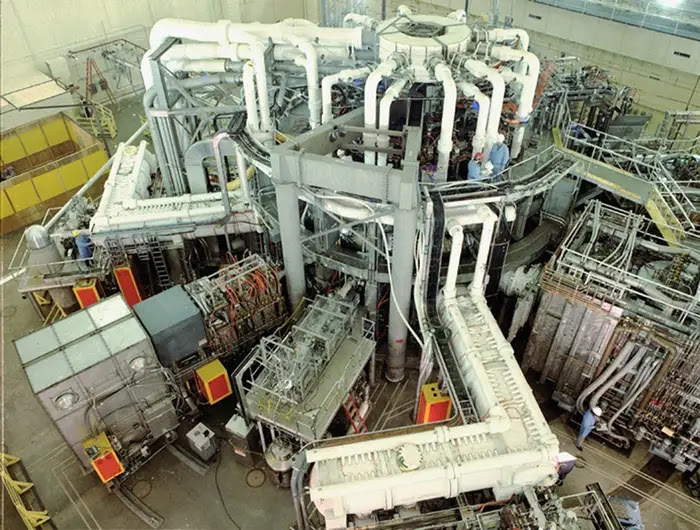
As issues of climate change and energy security are becoming increasingly salient, the promise of an apparently "clean", "abundant" and "safe" energy source, such as fusion, is ever more appealing. 

In response, the fusion industry is growing rapidly and the trope that fusion is "30 years away and always will be" is beginning to lose credibility as the technology moves beyond its experimental stage.

But it's too easy to generate hype around a seemingly ideal solution to societal challenges – and I would argue that the realisation of fusion energy may come into tension with the issues it proposes to solve.

Contextualising this hype and exploring areas where these tensions may arise is critical to ensuring the technology develops in an ethically sound way and can provide net societal benefit if it proves viable.

In short, the environment, women and minorities hurt worse: 

But these benefits may mask deeper ethical questions around the development of the technology and some potentially detrimental impacts. Perhaps one of the clearest instances of such a tension arises over environmental sustainability. This applies particularly to the association with climate change mitigation and the reduction of greenhouse gas emissions.

Climate change is an issue that lends itself to the "techno-fix" approach – in other words, it can be tempting to avoid making important changes to our behaviour because we think we can depend on technology to fix everything. This is known as the "mitigation obstruction" argument.

Squaring greenhouse gas emissions with energy demand also raises questions of justice and equity. Energy demand is growing in certain regions, primarily the global south, that have contributed the least to the current climate crisis. Yet fusion programmes are overwhelmingly based in the global north. So if fusion proves viable, those with access to such a transformative technology are not necessarily those who will need it most.
 ST40 compact spherical tokamak
Similar concerns can be found in the materials used for fusion energy. These include critical minerals, including lithium, tungsten and cobalt. Extraction and processing of these minerals emits greenhouse gases. In some cases, extraction operations are located on or near the lands of indigenous peoples. And the supply chains for these materials are embedded in geopolitical tensions, with alliances, collaboration, competition and the potential for monopolies forming.

Mercury, for example, is used in the processing of lithium for fusion reactors. Not only is the element environmentally damaging and toxic but depends largely on Chinese production.

The accelerating pace of fusion energy increases the risk of overlooking these potential hazards along the way. However, I would say this is not a case where we need to apply moral brakes, but rather shift gear. Approaching these potential ethical tensions requires systematic thought throughout the development process, from thinking about the implications of design decisions and materials choices, through to equitable deployment strategies and knowledge sharing.

Is it any wonder fusion is the fuel of the future, forever?

The Wombat has Rule 5 Sunday: Outstanding In Her Field garnering clicks at The Other McCain.

Thursday, January 4, 2018

Ooopsy!

North Korea Appears To Have Bombed Itself In Botched Missile Test
North Korea appears to have accidentally sent a missile crashing down into a city during a test that went awry last April, a new open source intelligence report revealed Wednesday.

North Korea tested a new intermediate-range ballistic missile six times last year. The first three tests ended in failure, with one test sending a ballistic missile into a town not too far from the test site.

North Korea conducted its third test of the previously-unseen Hwasong-12 IRBM, an impressive weapon that served as a stepping stone in the development of a longer-range missile able to range the U.S. mainland, on April 28, 2017. The missile fell out of the sky over North Korean territory after its first-stage engines failed after about a minute of powered flight, The Diplomat reports, citing U.S. government sources with knowledge of the North’s weapons programs.

Relying on photographs released by North Korea during a concert held in July, Dave Schmerler, a geolocation specialist and research associate at the James Martin Center for Nonproliferation Studies at the Middlebury Institute of International Studies at Monterey, and Ankit Panda, a foreign affairs expert and the senior editor at The Diplomat, were able to use satellite images to identify both the launch site and the impact point for the April 28 missile test.

The missile was fired out of Pukchang Airfield, and it landed on what appears to be either an agricultural or industrial complex in the North Korean city of Tokchon. As the liquid-fueled missile did not, according to U.S. government sources, explode in flight, there is reason to believe that the missile exploded when it slammed into the earth, causing considerable damage.

The full extent of the damage is unknown, but satellite images show clear differences between the immediate before and after pictures of the facility believed to have been hit by the failed missile.
Sure sucks to be North Korean.

Monday, June 12, 2017

So Let's Try Again Tonight!

So, about 9:15 PM I went out to watch the Southern sky, to see the pretty colored rocket launch promised from Wallops Island. It was a clear sky, with no storms so I expected a launch. No go! What happened? Sounding rocket launch scrubbed due to boats in hazard area, NASA says
Sunday's launch of a Terrier-Improved Malemute sounding rocket scheduled from NASA's Wallops Flight Facility was postponed due to boats in the launch range hazard area, NASA officials say.
Stupid boaters! It would be a shame to get hit by a falling piece of astro-trash.  But they're going to try again tonight
The launch has been rescheduled for Monday, June 12 with a launch window between 9:04 p.m. and 9:19 p.m. EDT. 
Maybe we'll go down to the beach for a better view.

Sunday, June 11, 2017

Set Your Alarms!

Colorful clouds to dot East Coast skies after NASA rocket launch on Sunday
Red, blue and green clouds will dot skies across the East Coast on Sunday evening following a NASA rocket launch in Virginia.

Between 9:04 and 9:19 p.m., a sounding rocket will take off from the Wallops Flight Facility releasing colorful vapor clouds roughly 100 miles above the earth.

Known as “vapor tracers”, the harmless clouds are formed by an interaction between barium, strontium and cupric-oxide.

Cast out between six and 12 miles, the clouds will help NASA scientists on the ground to track particle motions in space.

If the weather-dependent launch goes ahead, sky gazers living from New York to North Carolina will be able to spot the colorful clouds.

Friday, November 7, 2014

Wednesday, October 29, 2014

Did You See That Rocket Explode?


Uff da!

Now about those government Ebola policies; what could go wrong? It's not rocket science. It's a lot more complicated.