Showing posts with label fusion. Show all posts

Saturday, September 13, 2025

Fusion, the Fuel of the Future Forever!

 Real Clear Energy, Are We on the Threshold of Commercial Fusion?

For how many years have we been told that nuclear fusion energy is just 20 or 30 years down the road? It is for the average guy hard to imagine human technology has advanced to the point that we are ready to generate the energy of the Sun and stars in much smaller doses – and control that energy without burning us in eternal fire.

But the ultimate alchemy (turning lead to gold is chicken feed by comparison) is, according to multiple private companies, much closer to reality than the timeline espoused by the myriad of international nuclear scientists building Europe’s ITER or even China’s artificial sun.

As Tim DeChan reports, three key technological advances have turned the dream (or, to some, the nightmare) of fusion energy from science fiction to planned operational status before the end of President Trump’s second term. Tbe trio? More powerful computer chips, more sophisticated artificial intelligence (AI), and powerful high-temperature superconducting magnets.

The first reported breakthrough came in late 2022 when 192 lasers at the National Ignition Facility at Lawrence Livermore National Laboratory converged on a small gold cylinder that contained a tiny bead of fuel composed of isotopes of hydrogen, deuterium, and tritium.

The pellet ignited to produce a sustained fusion reaction that released about 50% more energy than was imparted by the lasers – which had heated the pellet to about 150 million degrees Celsius and compressed it with a pressure over twice that found at the center of the Sun.

While the experiment generated 50% more output than input energy, LLNL director Kim Budil was hardly effusive, stating that commercial fusion remained “probably decades away,” and that a few decades more of research might put us in the realm of a commercial power plant.

Commercial fusion remains “probably decades away,” she said. “Not six or five as we used to say, but moving into the foreground. A few decades of research into the underlying technologies could put us in the realm of a commercial power plant.” Or, shall we say, “30 years away” was still the prevailing mantra just three years ago.
CFS fusion reactor


CFS, whose investors include Bill Gates and his Breakthrough Energy Ventures, already has an agreement with Google to purchase half the output of its planned Arc commercial power plant, to be built near Richmond, VA. The successful launch of the 400 MW facility would justify the heavy investment with 200 MW of clean energy, theoretically at a greatly reduced cost, with very little radioactive waste to dispose of.

Can CFS really reach commercial fusion for Google (and lots of smaller customers) within the next decade – or sooner? Will its Sparc reactor be efficient enough to justify startup of the Arc? Stay tuned. But another fusion startup plans to beat CFS to the finish line.

With support from such notables as Reid Hoffman, Sam Altman, BlackRock, KKR, and Peter Thiel, Helion, based in Everett, WA, has raised $1.03 billion, bolstered by a $425 million infusion after its Polaris prototype field-reversed reactor made its debut. Now the firm is promising Microsoft, its primary customer, electricity from its reactor in 2028.

That’s three years from now – not thirty. If. It. Happens.

I first read about the possibility of fusion power when I was in elementary school (what can I say, I'm a science nerd).  Here we are 60+ years later, and we're still a ways away. I have hopes of seeing commercial fusion power, but they're fair faint.

Monday, February 10, 2025

Fusion is Still the Fuel of the Future Forever

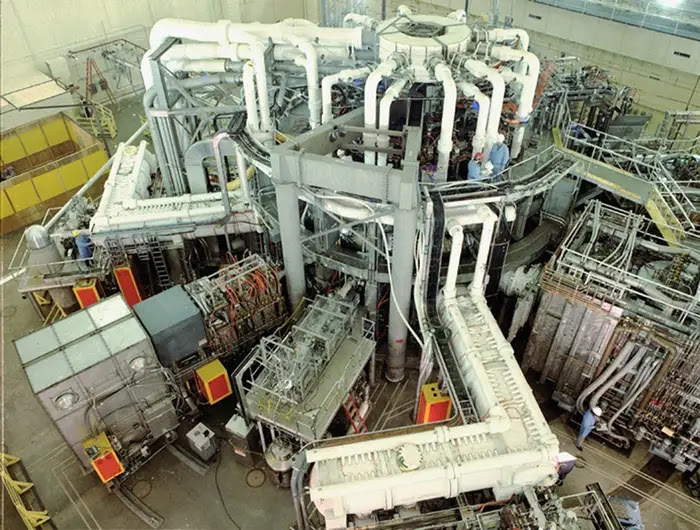
A research scale fusion reactor
 Bay Journal, Virginia joins the nuclear fusion race as region shifts to clean energy

Virginia Gov. Glenn Youngkin announced on Dec. 17 that Commonwealth Fusion Systems (CFS) plans to build a commercial fusion power plant in Chesterfield County, VA. If the company succeeds, it could power about 150,000 homes by the early 2030s.

“It is probably the global race of our century, and for Virginia to be leading it is pretty cool,” Glenn Davis, director of the Virginia Department of Energy, said.

Nuclear plants have been generating electrical power around the world since the 1950s — though they’ve fallen out of favor in the wake of Three Mile Island, Chernobyl and Fukushima, to name only the most infamous accidents. But, given the increasingly urgent push for clean energy sources, nuclear is getting a fresh look, if not a universally popular one, by the energy sector and regulatory agencies.

So far, the only practical atomic technology for power generation has been nuclear fission. The proposed Virginia plant will attempt to harness nuclear fusion — a long-sought but elusive alternative to fission.

Fission and fusion both produce massive amounts of energy from the nucleus of atoms. Fission happens when a neutron (a neutrally charged particle from an atom’s nucleus) slams into a larger nucleus and forces it to split. As the atom splits into two light nuclei, energy is released. Fusion does the opposite. It happens when two light nuclei slam together to form a single, heavier nucleus. The reaction has two byproducts: a spare neutron … and energy.

Fission is carbon-free, but it generates nuclear waste that remains radioactive for millions of years. Fusion reactions, on the other hand, produce waste that decays quickly without the need for long-term storage. This means the waste could decay over decades, a vast improvement over the long-lasting waste products associated with other forms of power generation. Another advantage of fusion is that it doesn’t rely on a chain reaction, as fission does, so it isn’t subject to potential meltdowns.

That is, if the company can deliver.

The problem that has long stymied scientists, until very recently, is that no fusion process had been able to generate more energy than what is needed to create the reaction in the first place. To do so, scientists must convert hydrogen into helium, much like the Sun does. But protons (positively charged particles in these atoms) want to repel each other. The Sun has immense pressure, heat and density, which overrides this phenomenon. After that, the strong nuclear force glues the new atom together while releasing energy.

Commercial fusion power has been touted as being 10 years away since I was old enough to be interested in science (5th grade, IIRC), so long that it's a standing joke. I hope they're right this time, but I'm skeptical. 

Friday, December 20, 2024

Fusion, the Fuel of the Future Forever

Fusion power has been 10 years in the future ever since I was a young budding scientist memorizing my periodic table. That means I've been disappointed for more than 60 years. But is it finally happening? At CNN, ‘World’s first’ grid-scale nuclear fusion power plant announced in the US.

If all goes to plan, Virginia will be the site of the world’s first grid-scale nuclear fusion power plant, able to harness this futuristic clean power and generate electricity from it by the early 2030s, according to an announcement Tuesday by the startup Commonwealth Fusion Systems.

CFS, one of the largest and most-hyped nuclear fusion companies, will make a multibillion-dollar investment into building the facility near Richmond. When operational, the plant will be able to plug into the grid and produce 400 megawatts, enough to power around 150,000 homes, said its CEO Bob Mumgaard.

Alcator C-Mod Tokamak at MIT
Early 30s? So, less than ten years? 

“This will mark the first time fusion power will be made available in the world at grid scale,” Mumgaard said. Virginia Gov. Glenn Youngkin welcomed the announcement, calling it “an historic moment for Virginia and the world at large.” 

The plant would represent a new stage in the quest to commercialize nuclear fusion, the process which powers the stars. But the path toward it is unlikely to be smooth, not least because the technology has not yet been proved viable.

The world is desperate for a clean, abundant source of energy that can replace fossil fuels as an always-available baseload power: nuclear fusion promises to be just that.

It’s something CFS acknowledges. “Nothing occurs overnight in fusion,” Mumgaard said. But the startup, which was spun out of MIT in 2018 and has raised more than $2 billion so far, says it is moving at pace.

It is “deep into” building a tokamak able to demonstrate net fusion energy: meaning a reaction that produces more energy than it consumes. It hopes to produce its first plasma – the superheated cloud of charged gas in which fusion reactions happen – in 2026 and achieve net fusion energy shortly afterward.

Building, owning and operating a power plant to plug fusion power into the grid is its “next act,” Mumgaard said.

The startup looked at more than 100 locations around the world for the power plant before choosing the James River Industrial Center in Virginia. The site is owned by Dominion Energy, which will lease it to CFS and provide technical assistance. The construction process is set to be long and CFS says it is still seeking permits. 

The location was chosen for its growing economy, skilled workforce, clean energy focus and the ability it offered to connect into the grid after the retirement of a coal plant, CFS said. “In the early 2030s, all eyes will be on the Richmond region … as the birthplace of commercial fusion energy,” Mumgaard said.

Virginia is also the world’s largest data center market, a sector that requires huge and growing amounts of energy. Data center electricity consumption in the US is expected to triple by 2030, equivalent to the amount needed to power around 40 million US homes, according to a Boston Consulting Group analysis.

Good news, but I'm not holding my breath.

Thursday, July 11, 2024

Weird Science!

 At Da Blaze, CRAZY: Scientists invent 'anti-gravity' device that could revolutionize transportation

Ascientist by the name of Charles Buhler claims that he and a group of scientists and engineers have developed a device that defies the laws of physics in that it can propel itself without a propellant.

Buhler, who’s the co-founder of Exodus Propulsion Technologies and a NASA electrostatics expert, says that his team has been exploring “propellantless propulsion” for many years.

Their work, which began in 2016, has now culminated with the development of a device that has the potential to revolutionize transportation as we know it.

I've got a lot of time and energy invested in learning the natural laws, but I would welcome a modification that would allow this. On the other hand, if I had a revolutionary idea that would overturn much of physics, somehow, I don't see Glenn Beck's Blaze as the place tout it. 

The video doesn't say much about the power requirements of the the proposed system. Does it require electrical energy inputs on the order of rockets to lift a body into space? That's going to be a long, thick extension cable...

As issues of climate change and energy security are becoming increasingly salient, the promise of an apparently "clean", "abundant" and "safe" energy source, such as fusion, is ever more appealing. 

In response, the fusion industry is growing rapidly and the trope that fusion is "30 years away and always will be" is beginning to lose credibility as the technology moves beyond its experimental stage.

But it's too easy to generate hype around a seemingly ideal solution to societal challenges – and I would argue that the realisation of fusion energy may come into tension with the issues it proposes to solve.

Contextualising this hype and exploring areas where these tensions may arise is critical to ensuring the technology develops in an ethically sound way and can provide net societal benefit if it proves viable.

In short, the environment, women and minorities hurt worse: 

But these benefits may mask deeper ethical questions around the development of the technology and some potentially detrimental impacts. Perhaps one of the clearest instances of such a tension arises over environmental sustainability. This applies particularly to the association with climate change mitigation and the reduction of greenhouse gas emissions.

Climate change is an issue that lends itself to the "techno-fix" approach – in other words, it can be tempting to avoid making important changes to our behaviour because we think we can depend on technology to fix everything. This is known as the "mitigation obstruction" argument.

Squaring greenhouse gas emissions with energy demand also raises questions of justice and equity. Energy demand is growing in certain regions, primarily the global south, that have contributed the least to the current climate crisis. Yet fusion programmes are overwhelmingly based in the global north. So if fusion proves viable, those with access to such a transformative technology are not necessarily those who will need it most.
 ST40 compact spherical tokamak
Similar concerns can be found in the materials used for fusion energy. These include critical minerals, including lithium, tungsten and cobalt. Extraction and processing of these minerals emits greenhouse gases. In some cases, extraction operations are located on or near the lands of indigenous peoples. And the supply chains for these materials are embedded in geopolitical tensions, with alliances, collaboration, competition and the potential for monopolies forming.

Mercury, for example, is used in the processing of lithium for fusion reactors. Not only is the element environmentally damaging and toxic but depends largely on Chinese production.

The accelerating pace of fusion energy increases the risk of overlooking these potential hazards along the way. However, I would say this is not a case where we need to apply moral brakes, but rather shift gear. Approaching these potential ethical tensions requires systematic thought throughout the development process, from thinking about the implications of design decisions and materials choices, through to equitable deployment strategies and knowledge sharing.

Is it any wonder fusion is the fuel of the future, forever?

The Wombat has Rule 5 Sunday: Outstanding In Her Field garnering clicks at The Other McCain.

Tuesday, August 16, 2022

Fusion, The Energy of the Future Forever

By which I mean, it always seems to recede into the future: Jazz Shaw at Haut Hair, Breakthrough: Ignition confirmed at California fusion reactor

Without bogging us down in too many technical details, suffice it to say that this is a big deal. Or at least it might be at some point. Scientists and engineers have been working on a way to build a workable fusion reactor for decades. A fusion reactor is quite different than the fission nuclear reactors you see around the world today. But there are enormous challenges involved in taking the fusion process from the hypothetical realm and creating a functional reactor capable of producing electricity for our energy grid. One problem is the fact that early experimental models required more energy to operate than they would be capable of producing. The other great challenge involved getting the tritium that fuels the fusion reaction to initially ignite and create a sustainable reaction. (Tritium or hydrogen-3 is a rare and radioactive isotope of hydrogen.) That latter hurdle has now officially been achieved. It actually happened a little more than a year ago, but it’s now been confirmed. The Lawrence Livermore National Laboratory National Ignition Facility in California successfully ignited the hydrogen fusion reaction last August. (Newsweek)
A major breakthrough in nuclear fusion has been confirmed a year after it was achieved at a laboratory in California.

Researchers at Lawrence Livermore National Laboratory’s (LLNL’s) National Ignition Facility (NIF) recorded the first case of ignition on August 8, 2021, the results of which have now been published in three peer-reviewed papers.

Nuclear fusion is the process that powers the Sun and other stars: heavy hydrogen atoms collide with enough force that they fuse together to form a helium atom, releasing large amounts of energy as a by-product. Once the hydrogen plasma “ignites”, the fusion reaction becomes self-sustaining, with the fusions themselves producing enough power to maintain the temperature without external heating.
If we can get this technology working on a large scale, most of the current debates over energy policy will go out the window in a generation.

It seems to me that we've been told that fusion power was 20 years away since I was in elementary school, (hint, a very long time ago). I'm glad to hear they made progress, but I've heard this (or something very much like it) several times before.

In a somewhat related story, John Sexton (also at Haut Hair) reports that, showing a lick of sense for a change, Gov. Newsom proposes keeping Diablo Canyon nuclear plant open until 2035.

Wednesday, September 1, 2021

Close is Good Enough for Hand Grenades and H-Bombs

But not for commercial nuclear fusion: WUWT, Lawrence Livermore Claims a Near Break Even Nuclear Fusion Burn

Inertial confinement fusion researchers have claimed a near break even experimental nuclear fusion burn, in which energy produced by the fusion reaction was comparable to the energy injected to initiate the burn.
National Ignition Facility experiment puts researchers at threshold of fusion ignition

On Aug. 8, 2021, an experiment at Lawrence Livermore National Laboratory’s (LLNL’s) National Ignition Facility (NIF) made a significant step toward ignition, achieving a yield of more than 1.3 megajoules (MJ). This advancement puts researchers at the threshold of fusion ignition, an important goal of the NIF, and opens access to a new experimental regime.

The experiment was enabled by focusing laser light from NIF — the size of three football fields — onto a target the size of a BB that produces a hot-spot the diameter of a human hair, generating more than 10 quadrillion watts of fusion power for 100 trillionths of a second.

“These extraordinary results from NIF advance the science that NNSA depends on to modernize our nuclear weapons and production as well as open new avenues of research,” said Jill Hruby, DOE under secretary for Nuclear Security and NNSA administrator.

The central mission of NIF is to provide experimental insight and data for NNSA’s science-based Stockpile Stewardship Program. Experiments in pursuit of fusion ignition are an important part of this effort. They provide data in an important experimental regime that is extremely difficult to access, furthering our understanding of the fundamental processes of fusion ignition and burn and enhancing our simulation tools to support stockpile stewardship. Fusion ignition is also an important gateway to enable access to high fusion yields in the future.

“This result is a historic step forward for inertial confinement fusion research, opening a fundamentally new regime for exploration and the advancement of our critical national security missions. It is also a testament to the innovation, ingenuity, commitment and grit of this team and the many researchers in this field over the decades who have steadfastly pursued this goal,” said LLNL Director Kim Budil. “For me it demonstrates one of the most important roles of the national labs – our relentless commitment to tackling the biggest and most important scientific grand challenges and finding solutions where others might be dissuaded by the obstacles.”

While a full scientific interpretation of these results will occur through the peer-reviewed journal/conference process, initial analysis shows an 8X improvement over experiments conducted in spring 2021 and a 25X increase over NIF’s 2018 record yield.

“Gaining experimental access to thermonuclear burn in the laboratory is the culmination of decades of scientific and technological work stretching across nearly 50 years,” said Los Alamos National Laboratory Director Thomas Mason. “This enables experiments that will check theory and simulation in the high energy density regime more rigorously than ever possible before and will enable fundamental achievements in applied science and engineering.”

The experiment built on several advances gained from insights developed over the last several years by the NIF team including new diagnostics; target fabrication improvements in the hohlraum, capsule shell and fill tube; improved laser precision; and design changes to increase the energy coupled to the implosion and the compression of the implosion.

“This significant advance was only made possible by the sustained support, dedication and hard work of a very large team over many decades, including those who have supported the effort at LLNL, industry and academic partners and our collaborators at Los Alamos National Laboratory and Sandia National Laboratories, the University of Rochester’s Laboratory for Laser Energetics and General Atomics,” said Mark Herrmann, LLNL’s deputy program director for Fundamental Weapons Physics. “This result builds on the work and successes of the entire team, including the people who pursued inertial confinement fusion from the earliest days of our Laboratory. They should also share in the excitement of this success.”

Looking ahead, access to this new experimental regime will inspire new avenues for research and provide the opportunity to benchmark modeling used to understand the proximity to ignition. Plans for repeat experiments are well underway, although it will take several months for them to be executed.Source: https://www.llnl.gov/news/national-ignition-facility-experiment-puts-researchers-threshold-fusion-ignition
I find inertial confinement fusion exciting, because in principle, unlike magnetic confinement fusion, it might be possible to scale inertial confinement down to an affordable size.

I've been waiting for the promise of commercial fusion power reactors literally since I was a child and interested in science. It always seems scientists are inching closer, but never getting quite with in sight.  

A pretty good racket for the scientists. Always getting funded, and never having to produce anything beyond a slightly bigger bang. 

Monday, April 2, 2018

Fusion, the Fuel of the Future, Forever

Could it be real this time? I've almost given up hope of seeing viable fusion power in my lifetime: Lockheed Martin Now Has a Patent For Its Potentially World Changing Fusion Reactor
Lockheed Martin has quietly obtained a patent associated with its design for a potentially revolutionary compact fusion reactor, or CFR. If this project has been progressing on schedule, the company could debut a prototype system that size of shipping container, but capable of powering a Nimitz-class aircraft carrier or 80,000 homes, sometime in the next year or so.

The patent, for a portion of the confinement system, or embodiment, is dated Feb. 15, 2018. The Maryland-headquartered defense contractor had filed a provisional claim on April 3, 2013 and a formal application nearly a year later. Our good friend Stephen Trimble, chief of Flightglobal's Americas Bureau, subsequently spotted it and Tweeted out its basic details.

In 2014, the company also made a splash by announcing they were working on the device at all and that it was the responsibility of its Skunk Works advanced projects office in Palmdale, California. At the time, Dr. Thomas McGuire, head of the Skunk Works’ Compact Fusion Project, said the goal was to have a working reactor in five years and production worthy design within 10.


"I still have to find a new job after this is done" I like it.

If you think environmentalists are resistant to fossil fuels or nuclear (fission) energy, just wait until effectively unlimited fusion power becomes available.

And in further fusion news, how about a starship? Pulsed Fission-Fusion (PuFF) Propulsion Concept gets Phase 2 NIAC funding
The pulsed fission fusion propulsion (PuFF) system envisions using a pulsed z-pinch to compress a fission-fusion target. The resulting deflagration expands against a magnetic nozzle to produce thrust and generate recharge energy for the next pulse. A z-Pinch is a device that is commonly used to compress laboratory plasmas to high pressures (~1 Mbar) for very short timescales (~100 ns). An electrical discharge produces a high axial current along the outer surface of a column of plasma; this current in turn generates a very strong toroidal magnetic field. This self-generated magnetic field interacts with the axial current via the Lorentz force and radially compresses the plasma column, bringing it to very high densities and temperatures. This team is exploring a modified Z-pinch geometry as a propulsion system by encasing the fission- fusion target in a sheath of liquid lithium, providing a current return path. Numerical results have been promising, the level of compression is sufficient to reach fission criticality. The fission energy boosts the fusion reaction rate, generating more neutrons which boost the fission process. This concept will potentially reach specific impulses of 30,000 sec with thrust levels sufficient to travel to Mars in a month and to interstellar space in a few decades.

Wednesday, October 15, 2014

Lockheed Claims Fusion Power Breakthrough

I once joked that fusion was the fuel of the future, forever, meaning it would never come to pass. The possibility of obtaining viable energy out of nuclear fusion has been held out as the "wholly grail" since I was a little kid reading Isaac Asimov and George Gamow, with the promised breakthrough only 20 years away (usually beyond the expected career life of the scientist making the claim).

This may be more substantial. The "Skunk Works" at Lockheed Martin claims to believe that they will have a working prototype design in 5 years, and commercially available reactors in 10.

Lockheed Martin aims to develop compact reactor prototype in five years, production unit in 10

Hidden away in the secret depths of the Skunk Works, a Lockheed Martin research team has been working quietly on a nuclear energy concept they believe has the potential to meet, if not eventually decrease, the world’s insatiable demand for power.

Dubbed the compact fusion reactor (CFR), the device is conceptually safer, cleaner and more powerful than much larger, current nuclear systems that rely on fission, the process of splitting atoms to release energy. Crucially, by being “compact,” Lockheed believes its scalable concept will also be small and practical enough for applications ranging from interplanetary spacecraft and commercial ships to city power stations. It may even revive the concept of large, nuclear-powered aircraft that virtually never require refueling—ideas of which were largely abandoned more than 50 years ago because of the dangers and complexities involved with nuclear fission reactors.
I would be more skeptical, but the group who designed and first flew the SR-71 back in 1964 deserves to be taken seriously.


Can you imagine, no more fighting over coal power, or global warming? How long before the NRDC is lobbying the EPA to shut down the Skunk Works?

Saturday, April 27, 2013

Fusion Power on the Horizon

The horizon being a place you can never reach.  However, the Europeans are still working at it, and announced plans to spend another $20 billion (with a "b")  to get there.

£13bn Iter project makes breakthrough in the quest for nuclear fusion, a solution to climate change and an age of clean, cheap energy
The international nuclear fusion project – known as Iter, meaning “the way” in Latin – is designed to demonstrate a new kind of nuclear reactor capable of producing unlimited supplies of cheap, clean, safe and sustainable electricity from atomic fusion.

If Iter demonstrates that it is possible to build commercially-viable fusion reactors then it could become the experiment that saved the world in a century threatened by climate change and an expected three-fold increase in global energy demand.

This week the project gained final approval for the design of the most technically challenging component – the fusion reactor’s “blanket” that will handle the super-heated nuclear fuel.
"If" being the key waffle word in this passage.
“It is the largest scientific collaboration in the world. In fact, the project is so complex we even had to invent our own currency – known as the Iter Unit of Account – to decide how each country pays its share,” says Carlos Alejaldre, Iter’s deputy director responsible for safety.
 Because the Euro has worked out so well...
“We’ve passed from the design stage to being a construction project. We will have to show it is safe. If we cannot convince the public that this is safe, I don’t think nuclear fusion will be developed anywhere in the world,” Dr Alejaldre said. “A Fukushima-like accident is impossible at Iter because the fusion reaction is fundamentally safe. Any disturbance from ideal conditions and the reaction will stop. A runaway nuclear reaction and a core meltdown are simply not possible,” he said.
That is one advantage to fusion for sure, but with lots of neutrons whizzing around, I'm sure there's lots of neutron activation and creation of radioactive materials in the unit itself, much the way there is in a fission reactor. And remind me again how many people died at Fukushima from radiation?  Oh, zero you say? 
Several experimental tokamak reactors around the world, including one at the Culham Centre for Fusion Energy in Oxfordshire, have shown nuclear fusion is theoretically possible, but the giant tokamak at Iter will be the first to generate more power than it needs to attain the very high temperatures required for nuclear fusion...It is the first experimental fusion reactor to receive a nuclear operating licence because of its power-generating capacity. For every 50 megawatts of electricity it uses, it should generate up to 500mw of power output in the form of heat.
Will be, being the key words.  So they haven't yet achieved break even yet.

Fusion has been the "energy of the future" since before since before I was born.  This time line is sobering:
1929: Scientists use Einstein’s equation E=mc² to predict release of large amounts of energy by fusing atomic nuclei together.
1939: German-born physicist Hans Bethe, pictured, demonstrates that nuclear fusion powers stars.
1950: Andrei Sakharov and Igor Tamm in the USSR propose a “tokamak” fusion reactor.
Note that I was born in 1951.  So, literally they have been talking about fusion power since I was born.
1956: Tokamak programme begins in strict secrecy.
1969: Tokamak results declassified, astounding Western scientists.
1973: Design work begins on Joint European Torus (Jet), a tokamak-type reactor in Europe.
1983: Jet completed at Culham, Oxfordshire, on time and to budget.
1985: USSR proposes an international fusion-energy project.
1988: Design work begins for International Thermonuclear Experimental Reactor, later known as simply Iter. 1992: Design phase begins for Iter.
1997: Jet produces 16 megawatts of fusion power, the current world record.
2005: Cadarache, France, chosen as Iter site.
2021-22: “First plasma” scheduled, when ionised gases will be injected into the Iter tokamak.
2027-28: Iter “goes nuclear” with injection of tritium.
2030s: First demonstration fusion reactor to produce electricity for grid.
2050s onwards: First commercial nuclear fusion power plants.
2051: Sierra Club holds protests at first commercial fusion plant
I may have added that last one.

It must be wonderful working on a science project where the ultimate proof of concept is generations away.  You never have to show any actual progress.

I'm certainly looking forward to cooking my first cup of Raman Noodles using fusion power...  Faster, please. Literally.

I really do want fusion power to succeed.  To say I'm frustrated with the slow pace would be an understatement.