Showing posts with label drought. Show all posts

Wednesday, July 22, 2026

The Wednesday Wetness

There is some encouraging news for Maryland lawns this week.

After several weeks dominated by drought concerns, the latest U.S. Drought Monitor shows additional improvement across portions of the Mid-Atlantic. While Moderate to Severe Drought remains across much of Central Maryland and Extreme Drought continues on parts of the Eastern Shore, recent rainfall has helped replenish soil moisture and slow the progression of drought in many locations.

This week’s Lawn Health Index remains at 48 out of 100 (Fair). Conditions continue to improve, but long-term rainfall deficits and summer stress are preventing a more significant jump.
Our grass greened up considerably after a few storms a week or two back, but it's starting to look a crispy again in spots. 


Wednesday, November 12, 2025

Some Wednesday Wetness

Iran - especially its capital, Tehran - is facing an unprecedented drought this autumn, with rainfall at record lows and reservoirs nearly empty. Officials are pleading with citizens to conserve water as the crisis deepens.

President Masoud Pezeshkian has warned that if there is not enough rainfall soon, Tehran's water supply could be rationed. But he said that even rationing might not be enough to prevent a disaster.

"If rationing doesn't work," Pezeshkian said, "we may have to evacuate Tehran."
Inshallah!

The Wombat has Rule 5 Sunday: It’s Always Warm & Sunny Somewhereup and garnering clicks at The Other McCain.

Wednesday, November 20, 2024

The Wednesday Wetness

State environmental officials are urging Marylanders and businesses to reduce water use when possible as the department has expanded drought watches and warnings across the state. The Maryland Department of the Environment made the announcement Monday, noting there have been six months of below-average rainfall and "virtually no rain this autumn."

With 0.57 inches of rain, the Hagerstown area just had its fourth driest October dating back to 1898, according to local weather observer Greg Keefer's website at https://i4weather.net. November also has been dry, with another 0.57 inches as of Sunday.

The state has not issued any mandatory water restrictions, though the Town of Oakland in Garrett County in far Western Maryland announced earlier this month some restrictions on water use. The Maryland Department of Natural Resources also continues to have a statewide burn ban in effect.
It's been dry here. Fortunately our water supply doesn't depend on rain.

The Wombat has Rule 5 Sunday: Nothing’s Fishy ready at The Other McCain on time and under budget.


Friday, July 19, 2024

Oregon, My Oregon

 At WUWT, No, OPB, Climate Change is Not Taking a Toll on Oregon Farmers

The news site OPB [Oregon Public Broadcasting] posted an article titled “Climate change increasingly taking a toll on Oregon farmers, ranchers,” which claims that climate change is having such a serious impact on Oregon agriculture that farmers need special climate grief counseling to cope. This is false. OPB claims that droughts, wildfires, and heat waves are all getting worse with climate change, however data show that this is not true for Oregon.

OPB claims that farmers and ranchers in the state are “increasingly dealing with severe droughts, wildfires, sweltering heat waves and pests that can all-together decimate entire fields.”

Later in the article OPB says “more precipitation is falling as rain rather than snow in many areas of the Pacific Northwest,” and “there’s less snow and it melts earlier, which means less water will last long enough through winter and spring to feed streams and reservoirs for agricultural irrigators.” It is also claimed that summers are trending hotter, and extreme heat waves are more frequent.

Beginning with drought, Oregon has not been suffering from more severe droughts over time. According to data from the U.S. Drought Monitor, there is no indication that droughts in Oregon are worse today than they were 100+ years of warming ago.

 National trends suggest that snowfall is decreasing slightly in late spring, but this doesn’t seem to be the case for Oregon as of yet, looking at data from the US Department of Agriculture National Water and Climate Center. (See figure below)
In fact, according to USDA data, which extends back to 1981, Oregon set its record for April snow-water equivalent in 2022, and second highest year was recorded in 2023.

Regarding wildfires, again, as Climate Realism has covered many times, U.S. wildfires are not getting worse, nor are they getting worse in Oregon.

According to the Oregon Department of Forestry data, except for two exceptional years in 2020 and 2021, when there was a drought, Oregon has not seen an increase in the acres burned in wildfires. (See figure below)
Heatwaves are likewise not getting worse in Oregon, at least not consistently. The NCEIS reports that, while the number of extremely hot (over 100°F) days in Oregon were above average since the late 1980s, reaching peaks in 2005-2009 and 2015-2020, “the number was well below average during the 2010–2014 period,” showing that there is a more complicated trend than a gradual march towards statewide eternal heat syncope. 2023 was likewise below average.

OPB claims that things are so bad for farmers that there is a need for “workshops and training to help food producers identify and define feelings like climate stress or grief and to find both emotional and agricultural ways to cope.” But neither the long-term weather nor crop production trends support the idea that climate change is killing agriculture in Oregon. As a result, there is seemingly little need to identify anxiety over seasonal crop failures as “climate grief.”

And there's the real goal, spending money on academics and NGO's to propagandize farmers to fear non-existent problems. The grift must go on.

As Ronald Reagan said, "The trouble with our Liberal friends is not that they're ignorant; it's just that they know so much that isn't so."

Wednesday, September 20, 2023

MD Declares Drought

But not here. Maryland Department of Environment Issues Drought Warning for Portions of State

The Maryland Department of the Environment today urged public water systems, citizens and businesses in parts of the state to continue voluntary water use restrictions as a drought watch issued earlier this summer has been upgraded to a warning.

“Water conservation is a good practice year-round, but we are asking water systems to take extra precautions as dry conditions persist,” said Maryland Department of the Environment Secretary Serena McIlwain. “Consumers can help by limiting the use and duration of sprinklers for lawns, taking short showers as opposed to baths, and not leaving the faucet running while brushing your teeth. These things sound simple, but it all adds up.”

No mandatory water use restrictions have been issued by the state at this time. However, water systems may implement their own mandatory conservation measures. All of the following areas, except for regions served by Baltimore City or Washington Suburban Sanitary Commission public water systems, are under warning: Baltimore, Carroll, Cecil, Frederick, Harford, Howard and Montgomery counties. A drought watch remains in place for Western Maryland, covering Allegany, Garrett and Washington counties.

The drought warning is based on lower-than-normal stream flows and groundwater levels for this time of year. The state increases oversight of water supply conditions, encourages voluntary water conservation practices, and updates its drought status weekly while the warning is in effect.

While the state currently has enough water to meet the needs of residents and businesses, water conservation measures are encouraged to help avoid any future water shortages.

We were getting a little crispy here until Sunday night/Monday morning, when we got 0.86 inches of rain overnight. 

Saturday, July 30, 2022

It's The Water!

This one has been sitting in my tabs for quite a while waiting for me to get excited enough about it to say something, from Tristan Justice at Da Fed, After Nixing 50-Million-Gallon-A-Day Desalination Plant, California Demands Residents Use Less Water

California residents were slapped with tighter water restrictions Tuesday two weeks after state officials spiked plans for a $1.4 billion saltwater desalination plant in Orange County amid a season of historic drought.

The State Water Resources Control Board unanimously voted to implement a statewide watering ban for ornamental lawns at businesses and commercial properties as residents brace for a prolonged drought, the driest drought of its length in 1,200 years. Local government will also be required to reduce water use by up to 20 percent.

“California is facing a drought crisis and every local water agency and Californian needs to step up on conservation efforts,” said California Gov. Gavin Newsom in a press release upon adoption of the new restrictions. “These conservation measures are increasingly important as we enter the summer months. I’m asking all Californians to step up, because every single drop counts.”
. . .
Despite the dire drought conditions also placing an increasingly unreliable power grid in jeopardy of periodic blackouts, the California Coastal Commission rejected the latest proposal from a major water developer to construct a desalination plant in Huntington Beach. If built, the company behind the project, Poseidon Water, says the plant would make 50 million gallons of drinking water available to residents on a daily basis by next year. After a more than two-decade effort to appease public officials for a green light on construction, the state Coastal Commission unanimously turned it down based on routine concerns over risks to marine habitat and “environmental justice.” The commission argued the energy-intensive process of desalination presented too much of a coastal hazard while raising local water prices.

I suppose the "concern for marine habitat" involves the intake of salty water, and the release of a some what lower volume of slightly more salty water, and injuring and killing some plankton along the way. I proper engineering ought to be be able to mitigate that, but copepods before people, I guess. The "environmental justice" issue has to be that the project would benefit too many rich white people, Huntington Beach being a fairly wealthy coastal community.

But what really tipped me into posting was this article this reader suggestion in the AZ Desert Sun, An idea for solving West's drought: Let's divert Mississippi River water to the Colorado

Janet Wilson's article on federal officials floating drastic measures to stanch California's water crisis was great.

Instead of just conservation, what about a Tennessee Water Authority-like project to divert the Mississippi River and build a canal with reservoirs along the way, to pipe it into the Colorado River? Kill two birds with two stones — not so farfetched when you see the type of projects being built in the Middle East and China! It’s about will.

Talk about a great works project and a fantastic way to usher in a new decade for the Southwest.

Yeah, I don't see any concern for habitat or environmental justice in that, do you? 

Sunday, April 25, 2021

The "Climate Emergency" That Isn't

Dr. Steven E. Koonin  at NYPo, Obama administration scientist says climate ‘emergency’ is based on fallacy

Yes, it’s true that the globe is warming, and that humans are exerting a warming influence upon it. But beyond that — to paraphrase the classic movie “The Princess Bride” — “I do not think ‘The Science’ says what you think it says.”

For example, both research literature and government reports state clearly that heat waves in the US are now no more common than they were in 1900, and that the warmest temperatures in the US have not risen in the past fifty years. When I tell people this, most are incredulous. Some gasp. And some get downright hostile.

These are almost certainly not the only climate facts you haven’t heard. Here are three more that might surprise you, drawn from recent published research or assessments of climate science published by the US government and the UN:
  •  Humans have had no detectable impact on hurricanes over the past century.
  • Greenland’s ice sheet isn’t shrinking any more rapidly today than it was 80 years ago.
  • The global area burned by wildfires has declined more than 25 percent since 2003 and 2020 was one of the lowest years on record.
Why haven’t you heard these facts before?

Most of the disconnect comes from the long game of telephone that starts with the research literature and runs through the assessment reports to the summaries of the assessment reports and on to the media coverage. There are abundant opportunities to get things wrong — both accidentally and on purpose — as the information goes through filter after filter to be packaged for various audiences. The public gets their climate information almost exclusively from the media; very few people actually read the assessment summaries, let alone the reports and research papers themselves. That’s perfectly understandable — the data and analyses are nearly impenetrable for non-experts, and the writing is not exactly gripping. As a result, most people don’t get the whole story.

Policymakers, too, have to rely on information that’s been put through several different wringers by the time it gets to them. Because most government officials are not themselves scientists, it’s up to scientists to make sure that those who make key policy decisions get an accurate, complete and transparent picture of what’s known (and unknown) about the changing climate, one undistorted by “agenda” or “narrative.” Unfortunately, getting that story straight isn’t as easy as it sounds.

I should know. That used to be my job.

I’m a scientist — I work to understand the world through measurements and observations, and then to communicate clearly both the excitement and the implications of that understanding. Early in my career, I had great fun doing this for esoteric phenomena in the realm of atoms and nuclei using high-performance computer modeling (which is also an important tool for much of climate science). But beginning in 2004, I spent about a decade turning those same methods to the subject of climate and its implications for energy technologies. I did this first as chief scientist for the oil company BP, where I focused on advancing renewable energy, and then as undersecretary for science in the Obama administration’s Department of Energy, where I helped guide the government’s investments in energy technologies and climate science. I found great satisfaction in these roles, helping to define and catalyze actions that would reduce carbon dioxide emissions, the agreed-upon imperative that would “save the planet.”

But doubts began in late 2013 when I was asked by the American Physical Society to lead an update of its public statement on climate. As part of that effort, in January 2014 I convened a workshop with a specific objective: to “stress test” the state of climate science.

I came away from the APS workshop not only surprised, but shaken by the realization that climate science was far less mature than I had supposed. Here’s what I discovered:

Humans exert a growing, but physically small, warming influence on the climate. The results from many different climate models disagree with, or even contradict, each other and many kinds of observations. In short, the science is insufficient to make useful predictions about how the climate will change over the coming decades, much less what effect our actions will have on it.

In the seven years since that workshop, I watched with dismay as the public discussions of climate and energy became increasingly distant from the science. Phrases like “climate emergency,” “climate crisis” and “climate disaster” are now routinely bandied about to support sweeping policy proposals to “fight climate change” with government interventions and subsidies. Not surprisingly, the Biden administration has made climate and energy a major priority infused throughout the government, with the appointment of John Kerry as climate envoy and proposed spending of almost $2 trillion dollars to fight this “existential threat to humanity.”

And for an exhaustive fisking of the concept of 'Climate Emergency', there's no one better than Willis Eschenbach at WUWT,  Where Is The “Climate Emergency”?

I listed some of the following in my previous post, and a commenter said they were important enough to deserve a post on their own … I agree.

Despite my asking over and over in a host of forums, to date nobody has been able to tell me just what this supposed “CLIMATE EMERGENCY!!” actually is and where I might find evidence that it exists. Here are some facts for the folks that think that the climate is a real danger to humanity.

Deaths from climate-related phenomena are at an all-time low. If you think deaths from climate-related catastrophes are an emergency, please point in the graph below to the start of the “emergency”. . . .

And on from there, making many points that I have made before. It's not about climate, it's about control, control over industry, and control over the behavior of people - you. They want a socialist economy, and climate is the excuse. Once they have the control they desire, they'll magically discover that climate is not important enough to thwart their goals. Look at Soviet Russia, Communist China, Cuba and Venezuela. None are noted for their climate holiness. 

Wednesday, November 27, 2019

Extra Wet Year Affects Bay

Bay health impacted by record flows - Largest amount of fresh water to enter the Chesapeake Bay since 1937

In 2019, more fresh water flowed into the Chesapeake Bay than it has in any of the past 82 years. The average freshwater streamflow into the Bay over the past year was 130,750 cubic feet per second—the highest since data collection began in 1937. To put this into perspective, 130,750 cubic feet is about 978,077 gallons. In comparison, an average Olympic-sized swimming pool holds approximately 660,253 gallons of water. That’s more than one pool entering the Bay every second!

These historic flows, which followed the record-breaking rainfall seen in 2018, caused Bay-wide changes in salinity. The extreme rainfall also washed nutrient and sediment pollution into the Bay, which depleted dissolved oxygen that aquatic species depend on for survival, and dramatically impacted the Bay’s underwater grass habitat and other living resources.

Hmm. That's interesting, since 2009 until now, 20 year, we've had 5 years below normal and 5 years above. Sound's like things are going on about normal.
However, the extreme amounts of rain that led to these heavy flows of freshwater between 2018 and 2019 dramatically impacted salinity levels throughout the entire Bay. Beginning in May 2018, salinity levels in the middle of the Chesapeake Bay were below-average, a situation which persisted for 17 consecutive months. A record-low level of salinity was observed in February 2019 in this area, and the months that followed continued to hover near record-low levels.

As of October 2019, waters in the lower Bay have returned to their normal salinity levels. However, the months of high flows has dramatically impacted plant and animal life in these regions. This has impacted the habitat for spawning fish, the distribution of underwater grasses and oysters, and increased the presence of Dermo and MSX, which are oyster-killing parasites.
Some effects:
After a promising year, underwater grasses have taken a step back . . .

Oysters restoration heavily impaired in upper Bay . . .

Blue crab populations are improving . . .

Invasive species are taking advantage of increased freshwater flows . . .

Dead zones continue to grow . . .
Which, other than crabs improving, are all sort of what you'd expect from an exceptionally wet year.  One of these years soon, we'll have a drought, and then they'll be complaining about all the bad things droughts cause, too

Saturday, April 8, 2017

It's Official! California All Wet!

California governor declares historic drought over — for now
Thirsty California lawns faded to brown from a lack of water in four extraordinarily dry years have revived to bright green in neighborhoods across the state.

Dry riverbeds of sand and tumbleweeds that snake their way through farmers’ fields now charge with water swelling up their banks.

Scenes like these and many others prompted California Gov. Jerry Brown on Friday to declare an end to the state’s drought emergency that had drained reservoirs and wells, devastated forests and farmland and forced millions of people to slash their water use.


The turnaround has been stark. After years of brown fields and cracked earth, monster storms blanketed California’s Sierra Nevada Mountains this winter with deep snow that flows into the network of rivers and streams that supply much of the state’s water.

Still, lifting the emergency drought order is a largely symbolic measure that doesn’t remove most of the restrictions. Officials insisted they’re holding onto some conservation rules for the 40 million residents of the nation’s most populous state.
. . .
At the drought’s peak, citizens were urged to cut shower times and outdoor watering. Homeowners let lawns turn brown or ripped them out altogether and replaced them with desert-like landscaping.
For a starter, all government and non-profits should be forced to give up any watering on their landscapes. Of course, sensible water use is a must in California, where drought is more the rule than the exception, on a long term scale:


Now, if I were an asshole, I might credit global warming with the end of the drought. It's just weather, of course,

Thursday, February 16, 2017

California Drought Update

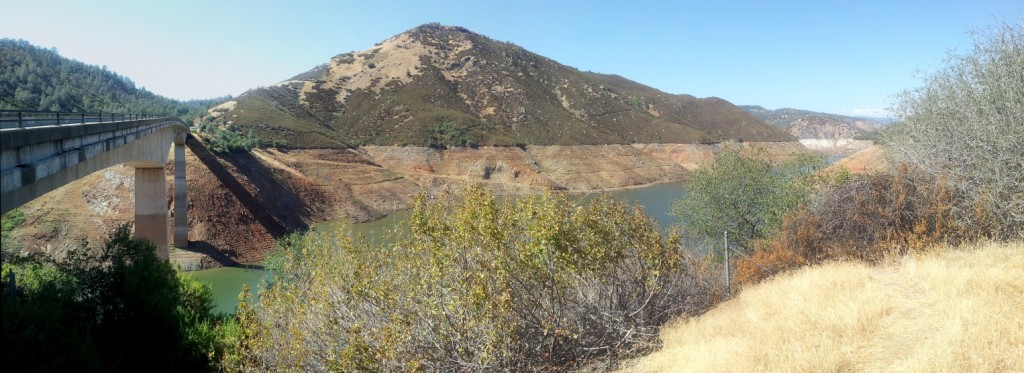
A few days ago, I gave an update on the California drought, which is gone in the north, and going in the south. I promised pictures of New Melones Lake (near where my Father and brother Ted live). Ted was kind enough to send me theses pictures:

August 2015
February 2017

Monday, February 13, 2017

California Drought Update

Going, going, . .

You all know that California, up until recently, had been in the throws of a historic (although not geologically unprecedented) drought. However, a few weeks ago, the weather patterns shifted to a "Pineapple Express" pattern which tends to sweep moisture laden air from the Hawaii area up to the Pacific Northwest, causing repeated strong rainstorms, as well as the much more badly needed snow in the Sierras, which act as long term water storage.

By way of Watts Up With That, this convenient diagram showing the recent changes in drought conditions:

Which show how the drought is essentially gone from the north of the state, and much relieved in most of the remainder, with reservoirs being refilled, in many cases above their historical average storage:


Now we here that the spillway at the nation's tallest damn at 770 ft, Oroville, is in the process being eroded away, threatening the integrity of the damn itself, and causing 188,000 people to be evacuated, and 23,000 National Guard to be put on stand by (I figure they can plug 184,000 holes in the damn).

The spillway was been all but destroyed, and the emergency spillway has been opened, and is itself being eroded:


And it's not just the dams that are being threatened. There is widespread flooding in the Sacramento River Delta (I hope the smelt are enjoying it). Ted sent me this link to a series of pictures from a fly over:


Hopefully Ted will send a picture of New Melones Lake, which he crosses daily on his way to work, and has been recording occasionally to show the drought.

After they get through this rough patch, California might want to seriously consider upgrading it's water resources, before boring a hole through earthquake prone mountains for the "train to nowhere".

Friday, September 30, 2016

The Gore Effect Strikes Australia

The Gore Effect is an informal and satirical term which alleges a causal relationship between unseasonable cold weather phenomena and global warming activism:

A study led by ANU Professor Neville Abram, which claims climate is driving clouds south, resulting in less rain reaching Australia’s Southern Coast, has been published in the midst of massive flooding in South Australia. Greens of course blame climate change for the deluge.

The press release;
Australia’s west, south losing vital rain as climate change shifts winds, study finds
Rising greenhouse gases and ozone depletion over the Antarctic are increasingly pushing rain-bearing storm fronts away from Australia’s west and south, according to a new international study.
The research, which involved the Australian National University and 16 other institutions from around the world, has just been published in the Nature Climate Change journal.
It found Southern Ocean westerly winds and associated storms were shifting south, down towards Antarctica, and robbing southern parts of Australia of rain.
ANU Associate Professor Nerilie Abram, the lead Australian researcher, said this had contributed to a decline of more than 20 per cent in winter rainfall in southwestern Australia since the 1970s.
“That band of rainfall that comes in those westerly winds is shifting further south, so closer towards Antarctica,” Dr Abram, from the ANU’s Research School of Earth Sciences and ARC Centre of Excellence for Climate System Science, said.
But:
So what about that flooding? As WUWT recently reported, South Australia is currently experiencing severe flooding and rainfall, and a statewide power blackout, thanks to their dependency on unreliable renewables backed by high voltage interconnectors from other states – above ground interconnector lines which are vulnerable to extreme weather. Greens of course are blaming climate for the intense storm.
Climate change is driving storms like South Australia’s
The storm which has ravaged South Australia is a disturbing preview of what’s likely to come if Australia fails to act on climate change.
Storms like the one which knocked out the entire South Australian electricity network yesterday are occurring in a warmer and wetter atmosphere, the Climate Council’s Professor Will Steffen said.
“These conditions, driven by climate change, are likely increasing the intensity of storms like the one in South Australia,” he said. …
We model, and God laughs.

Tuesday, January 5, 2016

Drought Busting Storms Hitting California?

I must say, it looks pretty good:


These were predicted at Watts Up With That a few days ago, and has been hanging in my open browser tabs: Drought buster? Up to 10 feet of snow this week for California’s Sierra Nevada.

Here is some good news for drought-stricken California; the latest forecast model output from WeatherBell suggests that the Sierra Nevada snow-pack will get a fresh dump of up to 10 feet of snow. The Sierra snow-pack has already been reported as above normal (at 136 percent of normal) in the most recent snow survey conducted by the California Department of Water Resources.
DWR Director Mark Cowin said the heavy snowfall so far during Water Year 2016 “has been a reasonable start, but another three or four months of surveys will indicate whether the snowpack’s runoff will be sufficient to replenish California’s reservoirs by this summer.”
Each water year begins on October 1 and ends on the following September 30. DWR conducts five media-oriented snow surveys in the Sierra Nevada each winter – near the first of January, February, March, April and May – at the Phillips Station plot (elevation 6,800 feet) just off Highway 50 near Sierra-at-Tahoe Road 90 miles east of Sacramento. Frank Gehrke, chief of the California Cooperative Snow Surveys Program, said more than four years of drought have left a water deficit around the state that may be difficult to overcome in just one winter season.
“Clearly, this is much better that it was last year at this time, but we haven’t had the full effect of the El Niño yet,” Gehrke said. “If we believe the forecasts, then El Niño is supposed to kick in as we move through the rest of the winter. That will be critical when it comes to looking at reservoir storage.” The state’s largest six reservoirs currently hold between 22 percent (New Melones) and 53 percent (Don Pedro) of their historical averages in late December. Storage in Lake Shasta, California’s largest surface reservoir, is 51 percent of its December 30 average. [The December 30th] manual survey found a snow depth of 54.7 inches – 16 inches more than the average depth measured there since 1965 – and 16.3 inches of water content, 136 percent of the January 1 average for that site.
This forecast is to be expected, thanks to an El Niño pattern this winter which has already brought much needed precipitation to California. Storms are already stacked up in an west-to-east line as indicated by this satellite image:

It will take more than a few storms to break the drought. Water in California depends on the snow pack in the Sierras, and the storage in numerous reservoirs. At this point, many of the reservoirs are still quite depleted, and will months to fill.  One of those reservoirs is New Melones, which is near where my parents and brother Ted lives. You can see his picture essay on New Melones from July at Down to the old bridge and back:


And I can't pass by a reference to the California drought without this essay from Victor David Hanson, The Scorching of California: How Green extremists made a bad drought worse.
. . .Just as California’s freeways were designed to grow to meet increased traffic, the state’s vast water projects were engineered to expand with the population. Many assumed that the state would finish planned additions to the California State Water Project and its ancillaries. But in the 1960s and early 1970s, no one anticipated that the then-nascent environmental movement would one day go to court to stop most new dam construction, including the 14,000-acre Sites Reservoir on the Sacramento River near Maxwell; the Los Banos Grandes facility, along a section of the California Aqueduct in Merced County; and the Temperance Flat Reservoir, above Millerton Lake north of Fresno. Had the gigantic Klamath River diversion project not likewise been canceled in the 1970s, the resulting Aw Paw reservoir would have been the state’s largest man-made reservoir. At two-thirds the size of Lake Mead, it might have stored 15 million acre-feet of water, enough to supply San Francisco for 30 years.

California’s water-storage capacity would be nearly double what it is today had these plans come to fruition. It was just as difficult to imagine that environmentalists would try to divert contracted irrigation and municipal water from already-established reservoirs. Yet they did just that, and subsequently moved to freeze California’s water-storage resources at 1970s capacities.

All the while, the Green activists remained blissfully unconcerned about the vast immigration into California from Latin America and Mexico that would help double the state’s population in just four decades, to 40 million. Had population growth remained static, perhaps California could have lived with partially finished water projects. The state might also have been able to restore the flow of scenic rivers from the mountains to the sea, maintained a robust agribusiness sector, and even survived a four- or five-year drought. But if California continues to block new construction of the State Water Project as well as additions to local and federal water-storage infrastructure, officials must halve California’s population, or shut down the 5 million acres of irrigated crops on the Central Valley’s west side, or cut back municipal water usage in a way never before done in the United States.

When the drought began in autumn 2011, the average Californian barely noticed. Mountain reservoirs remained full throughout 2011 and much of 2012, thanks to ample rainfall in previous years. Though rain and snowfall plunged to as much as 40 percent below average in most inland counties, shortages affected only large agribusiness conglomerates on the west side of the San Joaquin Valley—a small group of corporate grandees with plenty of land and little public sympathy.

During that first year of drought, quarrels over water were mostly confined to farmers and environmentalists. Confident that stored surface water in mountain reservoirs would remain plentiful, the Greens insisted that the state continue to divert reservoir water away from agricultural usage—at roughly the same rate as during pre-drought years—in order to replenish rivers. In practical terms, however, the diversions meant that substantial amounts of stored snowmelt were released from mountain dams and allowed to flow freely to the Pacific Ocean. Farmers called that wasted water; environmentalists called it a return to a natural, preindustrial California. The Green dream was not simply river restoration and beautification, however. Bay Area environmentalists also believed that vastly increased freshwater inflows would help oxygenate the San Francisco Delta, thereby enabling the survival of the Delta smelt, a three-inch baitfish, while ensuring that salmon could be reintroduced into the San Joaquin River watershed. . . .
Read the whole thing.

So while we may see a little relief for California's water woes, real infrastructure investment is the only long term solution. California is a land where drought has come and gone through history, and the history would suggest that a mega-drought is not out of the question:


California lost it's way years ago in a silly reversion to childhood. Will they ever recover?

Friday, June 26, 2015

Stuff Ted Sends

Brother Ted has these drought updates from California:
If however you do, and you look close in the upper reaches of the canyon you can see the OLD Bridge just starting to show. This photo was taken 11 days ago and the bridge is almost completely out from end to end now.

That's New Melone's Lake, from Highway 49 (the new bridge) Parrot's Ferry Road (also called E18, shown, but not labeled on the map at this scale). It connects Vallecito with Springfield). Thanks for the correction, bro.


Tuesday, April 14, 2015

Not All Fish are Created Equal: California's Green Drought and Virginia's Hot Ditch

Another article on California's drought, blaming it at least partially on the measures taken to protect that "charismatic megafauna", the Delta Smelt. I mostly post it for one interesting statistic:

Delta Smelt
Liberals blamed for California drought
. . . Environmentalists have long blamed agriculture for absorbing more than its share of water, but figures from the California Department of Water Resources show that farming accounts for about 41 percent of applied water usage. Fully 48 percent is reserved for environmental purposes, which includes improving the health of the Sacramento-San Joaquin Delta and its most famous inhabitant, the delta smelt.
. . .
The order calls for urban water agencies to achieve a 25 percent reduction through methods such as increased rates, reductions in kitchen and bathroom faucet flow rates and converting 50 million square feet of lawn into “drought-tolerant landscaping.”

Environmentalists laud the stricter conservation order. . .
So, basically, half of California's water is untouchable for ecological reasons. Now, I understand that water flows in rivers needs to be maintained to the extent possible, but 48% seems like quite a healthy chunk, something that you could work with during a period of extreme drought.

But environmentalists interest in saving fish is selective at best. Here in the Chesapeake we have a situation where an economically important fishery is being killed off (along with most of the fish) at the behest of environmentalists:

Speckled Trout - at a different hot spot
Closure of coal-fired plant spells end for trout hot spot
In this industrialized stretch of the Elizabeth River - among shipyards, chemical storage tanks, a junk yard and coal-fired power plant - swam an unrivaled population of huge speckled trout.

Even stranger, the power plant was a major reason why the fish were there. Since 1953, a skinny hot-water-discharge canal from Dominion's Chesapeake Energy Center has pumped a steady stream of warm water into the river.

The warm water gushed through what anglers call The Hot Ditch and spread into the river near Deep Creek, creating a plume of habitat that during winter allowed trout to survive and flourish.  Come January, February and March, when not much was biting in the bay or the cold wind was blowing so hard few ventured out, anglers could always count on the specks drawn to the warmth of The Hot Ditch.

"It was probably the premier trout fishing location, honestly, in the U.S.," said David Hester, who used to lead guided trips in the river. "I was told by many people who fished all over the country that this was the best trout fishing they'd ever experienced, and it was."

But that time might be over. The hot water is no longer flowing. On Sept. 23, Dominion closed the power plant for good as part the company's plan to meet clean air standards.

Then came the harsh winter. It's too early to know exactly what will happen to the speckled trout. But the signs aren't promising. Thousands have died, and nobody knows how many, if any, are left.
So why are the trials and tribulations of the Delta Smelt grounds for restricting agriculture and residential consumption in California, while the prospect of killing thousands of Speckled Trout in Virginia along with the coal-fired power plant brings a warm and fuzzy feeling to enviro-weenies hearts?

To be sure, part of it has to do with the respective fishes range. Delta Smelt are restricted to the Sacramento/San Joaquin River Delta in California, while Speckled Trout are a wide ranging species, from Cape Cod in the north, to Mexico in the south, along with Island in the Caribbean. Killing all the specks in the Hot Ditch would barely make a dent in the species while an event that caused the delta to become totally inhabitable to the smelt could make it extinct. But still, it's a smelt. They basically exist to be eaten by other fish, and sometimes people.

But I can't help but thinking that one reason is that the main reason is that the typical environmentalist would rather restrict human endeavor than save a fish.

Thursday, April 2, 2015

The "Big One" Hits California

The big drought that is: California governor orders mandatory water restrictions
California Gov. Jerry Brown ordered officials Wednesday to impose statewide mandatory water restrictions for the first time in history as surveyors found the lowest snow level in the Sierra Nevada snowpack in 65 years of record-keeping.

Standing in dry, brown grass at a site that normally would be snow-covered this time of year, Brown announced he had signed an executive order requiring the State Water Resources Control Board to implement measures in cities and towns to cut the state's overall water usage by 25 percent compared with 2013 levels.

The move will affect residents, businesses, farmers and other users.
. . .
The order issued Wednesday will require campuses, golf courses, cemeteries and other large landscapes to significantly cut water use; direct local governments to replace 50 million square feet of lawns with drought-tolerant landscaping; and create a temporary rebate program for consumers who replace old water-sucking appliances with more efficient ones.
. . .
The order also prohibits new homes and developments from using drinkable water for irrigation if the structures lack water-efficient drip systems. In addition, the watering of decorative grasses on public street medians is banned.

The snow survey on Wednesday showed the statewide snowpack is equivalent to just 5 percent of the historical average for April 1 and the lowest for that date since the state began record-keeping in 1950.

Snow supplies about a third of the state's water, and a lower snowpack means less water in California reservoirs to meet demand in summer and fall.
Urban environmentalists, seemingly unaware that food is grown on farms, and that one of California's biggest business is agriculture were concerned that farmers were not hit hard enough:
"In the midst of a severe drought, the governor continues to allow corporate farms and oil interests to deplete and pollute our precious groundwater resources that are crucial for saving water," Adam Scow, California director of the group Food & Water Watch, said in a written statement.

The order contains no water reduction target for farmers, who have let thousands of acres go fallow as the state and federal government slashed water deliveries from reservoirs. Instead, it requires many agricultural water suppliers to submit detailed drought management plans that include how much water they have and what they're doing to scale back.
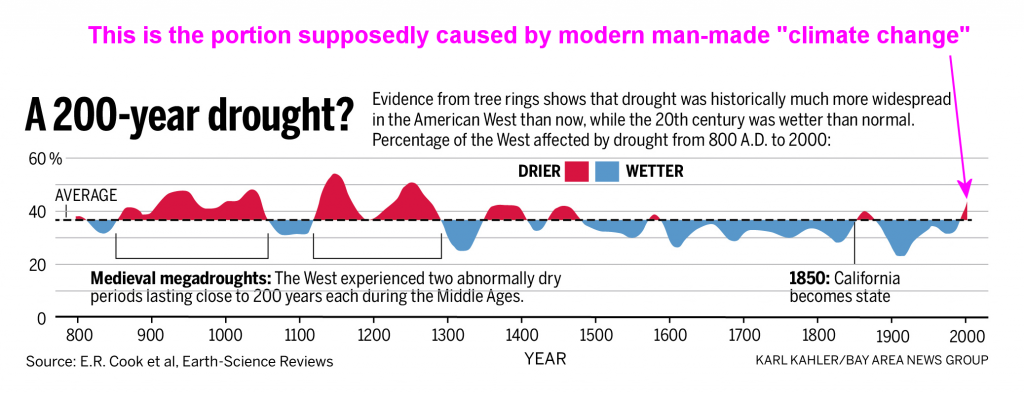
As bad as it is, this drought is just a hint of the mega-droughts that have plagued California and the American Southwest in recent geological past. Just because we haven't seen them since the European colonization doesn't mean they can't happen again:


Monday, September 29, 2014

Day After Day, the Whole Place Flakin' Away

California's Drought continues:

First, some news via Drudge: Daily water allocation could be the next California drought strategy
You probably know your Social Security number, your driver’s license number and perhaps the latest wrinkle in mattress marketing, your sleep number.

But do you know your drought number?

The latter represents the amount of water you are allowed to use per day. If you don’t know it, you probably should. Not knowing could cost you money. As California’s severe drought moves into a fourth year, state and local water agencies are working on something called “allocation-based rate structures,” a kind of precursor to water rationing that’s all the rage in Sacramento and in some areas such as Santa Cruz, Irvine and Santa Monica.

Here’s how it works: Your local water company, special district or city assigns you and your household a number in gallons — a daily water allocation. Usually, one number applies to maximum indoor water use, i.e. showers, kitchen and bathroom faucets, dishwashers, clothes washers, etc., and an extra allocation is assigned for outdoor use such as lawn irrigation.
We normally call such allocations by that nasty word "rationing."
Using census records, aerial photography and satellite imagery, an agency can determine a property’s efficient water usage. At the Irvine Ranch Water District, number of residents, amount of landscaping and even medical needs are factored into a household’s water allocation or water budget.
As a member of our local water co-ops board of directors, I would like to avoid such intrusive measures. I don't want to be asking how many people are living in the house to be used to set a ration, above which people will be harshly penalized, but I could see it come to that. We already argue about how best to set rates, to provide the best deal for our customers while discouraging excessive water use.
While some call it a more equal way to meter out mandatory water conservation, others call it social engineering. Some say the idea simply will not work.

In July, the State Water Resources Control Board passed stage one emergency regulations, giving powers to all local water agencies to fine $500 per violation.
Our local water co-op doesn't even have meters (yet), although we have a plan in place to install them, and I can already see a disagreement shaping as how to charge for water. In our case, our water supply isn't really controlled by rainfall (except may 10-14,000 years ago when our aquifer was filled), but by our capacity to deliver water. Hot dry weather makes people water their lawns, to the point that we are sometime unable to keep up with demand, and deplete our storage tanks.  This has been very good year for us, with rain mostly in time to keep the lawn green, and water use is down accordingly.

So how much water do Americans use?  Approximately 80-100 gallons per person per day:
Typical water use at home
BathA full tub is about 36 gallons.
Shower2-2.5 gallons per minute. Old shower heads use as much as 4 gallons per minute.
Teeth brushing<1 gallon, especially if water is turned off while brushing. Newer bath faucets use about 1 gallon per minute, whereas older models use over 2 gallons.
Hands/face washing1 gallon
Face/leg shaving1 gallon
Dishwasher20 gallons/load, depending of efficiency of dishwasher
Dishwashing by hand:4 gallons/minute for old faucets.. Newer kitchen faucets use about 1-2 gallons per minutes.
Clothes washer25 gallons/load for newer washers. Older models use about 40 gallons per load.
Toilet flush3 gallons for older models. Most all new toilets use 1.2-1.6 gallons per flush.
Glasses of water drunk8 oz. per glass (did you remember to drink your 8 glasses of water today?)
Outdoor watering2 gallons per minute
I save that one gallon per day by not shaving.

And that works out to be about right for our community 800 house, times 3 people per house (probably slightly less due to many older residents, but we don't have records), and 4-5 million gallons of water pumped per month on average, for a guesstimate about 70 gallons per person per day.

A large number of people in California are facing water restrictions now as a result of the drought:
Growing List Of NorCal Communities Running Out Of Water In Just 60 Days

As you probably know, Georgia I hail from California many years back, and our families are still mostly there, scattered up and down the length of California, from Los Angeles to McKinleyville and are experiencing the drought. Brother Ted, from Murphys, California gives his view:

despite the “Unprecedented Drought” that we are currently having, New Melones Reservoir is at this time 150′ and change higher then it was back in 1992
In other words, as dry as it has been, it could still get worse:

From a long-term perspective, it looks like California may just be recovering from an unprecedented wet spell that happened to coincide with the introduction of Europeans to the region.

There had been some up that a brewing El Nino might bring some needed rain, but the recent forecasts suggest a weal El Nino that is unlikely to provide much relief: A 'fickle' El Niño may still appear this year - but it won't be strong enough to end droughts in parched California, claims Nasa
El Niño - a heating of sea-surface temperatures in the Pacific - affects wind patterns and can trigger both floods and drought in different parts of the globe.

The most recent waves increase the chances that parched California could be in for some relief - albeit small - if weather patterns take a turn later this year.

But Nasa has warned that 'fickle' El Niño will likely be weak if it does appear, providing only limited relief for a drought-ridden west coast.

Around 430,000 acres of land will be left fallow in California - because there hasn't been enough rain or snow coming from the nearby mountain ranges.
If I were king (or even governor) of California, I would immediately drop the bullet train from nowhere to nowhere (Bakersfield to Fresno) project and concentrate my efforts on building adequate water supplies, whether by new reservoirs, bigger water projects, or desalination. Without a good water supply, California as it exists now cannot continue. Instead, I'm sure the powers that be will write it off to climate change (just look at the chart above for an instant refutation of that notion), and demand further restriction on energy use and control of the economy.

Saturday, September 27, 2014

Butterflies in the News

A swarm of butterflies, winging its way south for the winter, was "spotted" as large blue blobs on weather radar last week over southern Illinois and central Missouri.

"We think these targets are Monarch butterflies," the National Weather Service in St. Louis noted on itsFacebook page, which also includes a technical explanation of how the weather service came to this conclusion.

The monarchs were flapping their way south toward their winter home in Mexico. As noted earlier this year, the colorful insects were under stress this spring because of ongoing drought, an unusually cold winter and a lack of milkweed, their primary food source.
The demise of the Monarchs this year appears to have been somewhat over stated. I blame the media-global warming cadre for trying to turn everything into a story about the negative effects of the non-existent global warming. Monarchs have been rather regular visitors to what remains of the blooms on our Butterfly Bush in the last couple of weeks, presumably on their way south to Mexico. It would be cool to see a flight like that, though.


Thursday, August 21, 2014

Pelosi Permits San Francisco to Waste Water

Pelosi’s home city exempted from water restrictions imposed on rural farmers
The Endangered Species Act has wreaked havoc for decades on rural communities, but a newly filed lawsuit could force San Francisco urbanites like House Minority Leader Nancy Pelosi to share their pain.

A federal complaint filed this week contends that the Hetch Hetchy Project, which supplies water to San Francisco and the Bay Area, has unfairly enjoyed an exemption from the “severe cutbacks” required in rural California in order to save endangered fish species.

Craig Manson, who heads the Center for Environmental Science, Accuracy and Reliability (CESAR) in Fresno, said the lawsuit is aimed at addressing the “double standard” that forces farmers to give up water in the name of species conservation — without requiring Bay Area residents to do the same.

Mr. Manson wants the National Park Service to press the U.S. Fish and Wildlife Service to end the special exemption from the Endangered Species Act (ESA), but “the Park Service just won’t do it.”

Why not? Jeffrey Olson, National Park Service spokesman, said the agency cannot comment on ongoing litigation, but critics point out that San Joaquin Valley farmers have nowhere near the political clout of San Francisco’s political leadership, which includes Mrs. Pelosi and a good chunk of the state’s dominant liberal power structure.

“I think the law is being subjectively applied,” said Aubrey Bettencourt, executive director of the California Water Alliance. “California is a tale of two cities. If you added all the agrarian counties of California together in terms of registered voters, that’s not even enough to offset either San Francisco or Los Angeles. There are not enough votes.”
Dry Lake in California Coast Range
As I flew up and down California from Los Angeles to San Francisco over the past week or so, I was truly impressed by the depth of the drought.  You expect the hills of California to be mostly brown this time of year, but the reservoirs I saw showed huge areas of exposed bottoms due to the low levels. And it's not improving.

Water, of course, is a basic requirement for life, but it is also a commodity, and the market helps to control the price. When water is easy to get, the price should be low, and when it is difficult, the market will drive up the price and make users choose more wisely how to spend their water.

You might think that cities water needs are fairly well fixed by the number of people, but that is far from true. The average family uses about 300 gallons per day in the US at their household (not counting external uses, like manufacturing and irrigation used to make their goods and food).  How much by contrast do you think they actually drink? Not all that much.  We water our lawns, bath, and flush our shit with water treated to drinking water standards, not to mention public uses for municipal spaces (fountains, gardens). In an emergency, lawns can go brown, fountains and pools drained, and recycled "gray water" used to flush toilets and irrigate.

However, no need to do that if your urban democratic machine politicians can take the water away from the farmers who grow much of the nations food to provide it for the cities to waste at will. Whether or not that will be sustainable in the long run is an open question

Tuesday, August 19, 2014

Ohio Researcher Discovers Fish Need Water

A study by a Ohio researcher finds that fish populations decline when their rivers dry up.
Fish species native to a major Arizona watershed may lose access to important segments of their habitat by 2050 as surface water flow is reduced by the effects of climate warming, new research suggests.

Most of these fish species, found in the Verde River Basin, are already threatened or endangered. Their survival relies on easy access to various resources throughout the river and its tributary streams. The species include the speckled dace (Rhinichthys osculus), roundtail chub (Gila robusta) and Sonora sucker (Catostomus insignis).

A key component of these streams is hydrologic connectivity – a steady flow of surface water throughout the system that enables fish to make use of the entire watershed as needed for eating, spawning and raising offspring.

Models that researchers produced to gauge the effects of climate change on the watershed suggest that by the mid 21st century, the network will experience a 17 percent increase in the frequency of stream drying events and a 27 percent increase in the frequency of zero-flow days.
The finding is, of course, presented in the light of "Climate Change" aka "Global Warming" aka CO2 induced global warming, which is a convenient way to sell the study to a federal government which is desperately seeking to gain control over the economy, using CO2 as the excuse.  But is there really any evidence that the droughts currently plaguing California and the Southwest really all that unusual, and caused by CO2?
This graph should effectively cast doubt on that proposition.  While not disproving the hypothesis that the current drought is caused by CO2 induced warming, it does suggest that well prior to the period of massive human CO2 production, severe droughts were common, and indeed, for vast periods, the rule in the region, and that the current drought is only a short blip in the record by comparison.

The graph should also be a dire warning to anyone living in California, particularly anyone in a position of authority over water supplies. It is clear that California grew into the breadbasket of America in an era of relatively abundant water, a regime not guaranteed by nature, and subject to revocation without advance warning.

California needs to get serious about water.  Stealing it from the Sierras will not work indefinitely as the population and agriculture continue to grow.  However, California has, right on it's left border, one of the largest sources of water on the planet, the Pacific Ocean. They need to invest in desalinization in a big way, and that means also investing in energy in a big way, since population sized desalinization is an energy intensive process.

This also implies that California needs to get over it's allergy to energy development.