|
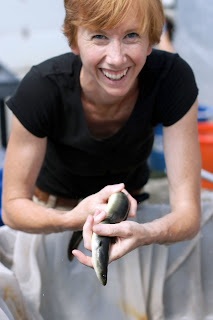
| ~1,000 eels in a bucket from the Daniels Dam eel ladder |
Four years after Maryland blew up Bloede Dam on the Patapsco River, biologists are still waiting for river herring and American shad to take advantage of new access to upstream reaches. Removal of the derelict hydroelectric facility had short-circuited their upriver spawning runs for more than a century.
American eels, though, haven’t wasted any time. Since Bloede was removed, there’s been a veritable explosion in the number of the snake-like fish showing up at Daniels Dam, the next barrier located about 8 miles upriver.
William Harbold, a biologist with the Maryland Department of Natural Resources, said he and colleagues have seen an exponential increase the past few years in traffic on the improvised eel ladder that DNR constructed at Daniels Dam. There, the juvenile eels slither to the top of the 27-foot-tall dam and drop into a mesh collection bag, where DNR biologists count them and then release them to continue their upstream journey.
In 2014, the year the ladder was installed, only 14 eels used it. By the time Bloede Dam was removed in 2019, the tally had grown to 53. Then word apparently got out. Eel numbers have jumped by an order of magnitude every year since. This year, the number of young eels retrieved from the ladder’s collection bag was approaching 37,000 by mid-November, Harbold reported.
Those numbers are a testimony to the resilience of eels, which spend most of their lives in fresh water after spawning in the Sargasso Sea in the Atlantic Ocean east of the Bahamas. They are also a validation of the low-tech eel passage structure that DNR installed at Daniels.
With a limited budget and lots of ingenuity, biologists fashioned the ladder from repurposed metal ductwork used in buildings to hold fiberoptic cable, Harbold explained. They carpeted the conduit floor with strips of fibrous erosion-control matting to give the eels some traction for their steep climb. Finally, they piped a stream of water into the river from the ladder’s base to attract eels milling around just below the dam.
“It’s worked more recently better than we thought it would,” Harbold said. The collection bag bulged with so many wriggling eels when checked in late May that DNR staff couldn’t count them individually. They had to estimate the number based on the average weight of an individual juvenile eel and the overall weight of the bag. About one fourth of all the eels tallied for the year showed up in one three-day span that month.
As a one time professional fish counter (in my high school days I counted fish for export at the fish store) I worked at, I call bullshit. Counting 9000 is time consuming and annoying, but not impossible, especially with enough cheap help. I don't blame them for making the choice to extrapolate from the weight of a small sample, but it was not necessary.
Sometimes other aquatic creatures have also made their way up the ladder. This year, biologists have found four northern water snakes and a couple of small snapping turtles in the bag with the eels.
Besides giving a boost to the upper Patapsco’s eel population, the new arrivals may help the river’s water quality. The larvae of Eastern elliptio mussels often hitch a ride in the gills of American eels. Once free of their hosts and grown to adulthood, each mussel can filter up to 10 gallons of water daily, removing nutrients and sediment.
The $17 million removal of Bloede Dam was chiefly intended to benefit river herring and American shad, two anadromous fish species that once thronged Bay watershed streams every spring during spawning season. They’ve been slow to respond, though.
William Harbold, a biologist with the Maryland Department of Natural Resources, points to the hoses pumping water into the eel ladder at Daniels Dam on the Patapsco River. The bulk of the ladder was fashioned from a metal tray designed to hold fiberoptic cable, which after nine years of exposure to the elements is rusting away. Timothy B. Wheeler
Since Bloede’s demolition, DNR biologists have conducted annual electrofishing surveys of the river to see what fish may be swimming up past the old dam site. In 2021, a little upriver, they recovered an alewife and a blueback herring, two members of the species collectively known as river herring. This year, they got two more alewife a little farther upriver in Ellicott City.
The DNR electrofishing surveys haven’t recovered any river herring or American shad all the way up at Daniels Dam. However, biologists with the Smithsonian Environmental Research Center in Edgewater, MD, have detected indirect evidence that at least some alewife and blueback herring are making it there. The fish have left behind traces of their environmental DNA, or eDNA — genetic material that fish shed into the water via blood, skin, mucus or feces.
“We never detected herring eDNA at these sites in four years of sampling before the dam removal,” said Matthew Ogburn, a SERC ecologist. “These results strongly suggest that the dam removal gives river herring access to the reach from Bloede Dam to Daniels Dam.”
Ogburn said the SERC team has detected eDNA of blueback herring even upstream of Daniels Dam, suggesting that some of the herring took advantage of a fish ladder there. Before the eel ladder, DNR had installed the concrete ramp for fish at Daniels in the early 1990s, but it never got much use by river herring while Bloede was still in place.
DNR has taken the Daniels Dam fish ladder offline for now because, since Bloede Dam’s removal, another less desirable fish has been surging upriver — invasive northern snakeheads. Harbold said DNR intends to keep the ladder closed until river herring or shad begin making it to the dam in greater numbers.
Bloede was the third dam on the Patapsco to be removed. Daniels, built in the early 1800s to provide hydropower for textile mills, is the last major barrier on the river. The relatively calm stretch of water just upriver of the dam is popular for kayaking and canoeing, so there may be some objections to removing it.
DNR has no plans yet to do so and no timetable for moving forward, spokesman Gregg Bortz said by email.
It's too bad the river herring haven't returned in greater numbers, but I'm not shocked. They haven't shown a lot of ability to recover in a lot of streams where they were formerly abundant. Somethings besides the dams have probably changed in the environment, making it less favorable. Until someone figures out what those are, it's likely to be a long slow process.
The use of DNA technology to show the presence of otherwise unsampled fish is really a remarkable step forward, and has only been available for a few years.
Time to blow Daniels Dam. How much does TNT cost, anyway? Maybe we could get the Marines to do it as a training exercise.
Some previous posts on the removal of Bloede Dam:
Herring Return to Undammed RiverChesapeake Bay News
Patapsco Dam Removal Proceeds
Drowning Death Revives Patapsco Dam Removal Project
Dam Removal on Patapsco River Being Planned