Showing posts with label bottles. Show all posts

Monday, January 5, 2026

A Bottle Bill for Maryland?

Balmer Sun, After 3 tries in Maryland, bottle bill backers hope to pass plastic refund program

Ten states across the country have already implemented bottle bills, with Oregon becoming the first in 1971. But Maryland is not one of them.

Democratic lawmakers, backed by Sierra Club members from Central Maryland, have tried to get the bill passed in Maryland three times already, only to see it get stuck in committee and not face a vote. This year, local activists are hoping that a renewed push — and growing attention on the dangers of microplastics — will help the bill finally succeed. Del. Jen Terrasa from Howard County and Sen. Ben Brooks from Baltimore County are slated as sponsors of the bottle bill for the 2026 legislative session.


“The counties and states have limited budgets for picking up litter, and they are actually quite dependent on volunteers, but there are only so many of us,” said Kerri Hesley, chair of the Catoctin Group. “We feel like this is the better way to make this a valuable resource. So people have an incentive not to litter, and if someone does litter, another person has an incentive to pick it up.”

According to the version of the bill introduced in the General Assembly last year, Maryland sells 5.5 billion single-use plastic beverage containers each year. In a recent letter sent in support of a proposed state law that would allow Prince George’s County residents to report others for littering or illegal dumping, the State Highway Administration noted that Maryland spent $15 million in fiscal year 2023 on litter cleanup.

 How much of that was plastic bottles?

Bottle bills in the U.S. and similar deposit return systems in Europe and Australia have cut litter by 50% on average, according to a study by the nonprofit Reloop. And a recent survey commissioned by the Sierra Club found that over 90% of respondents supported the bottle bill.

Still, the initiative has struggled to get off the ground in Annapolis. Rubenstein, who lives in Carroll County, said she spoke with Carroll Del. April Rose, a Republican who serves on the Economic Matters Committee that oversaw the bottle bill the past few years. The bill got a hearing in the Environment and Transportation Committee last year, but not in Economic Matters, and failed to advance out of either, replicating a yearslong pattern.

According to the fiscal note that accompanied last year’s bottle bill, the program would essentially pay for itself, since revenue would offset any operating costs over the next five fiscal years. But the analysis determined that the Bottle Bill could impact small businesses and small container manufacturers, which might incur costs from joining the program and would have to front the cost of the beverage deposit.

We lived under a bottle bill in Oregon, and while it was  a hassle, you got used to it. But IIRC, that was only glass bottles, beer and soda mostly. Will the bottles really be recycled, or will they just end up being shipped to China or India for disposal.

The Wombat has Rule 5 Sunday: Hello, Nurse! up and garnering clicks at The Other McCain.

Thursday, December 11, 2025

Beach Report 12/11/25 - Who Pulled the Plug?

It was sunny and breezy from the NW, although it let up some as I walked, and barely 40 F.  A blow-out tide, almost a foot below the astronomical low tide prediction.


Like most blow out tides, tooth hunting was awful, I walked the whole way up and back without finding a single tooth. 


However, I did not come home empty handed. I found this bottle partially buried in the sand. 
In case you can't read the label: A quick search on the internet shows that poison bottles were a thing in the late 1800s - early 1900s. The ribs were to make sure you could identify them in the dark. The examples I found showed they contained mercuric chloride. I haven't figured out who the bottle maker was, but they clearly sold them to pharmacies to get paper labels (2 sides are flat), and were stoppered with corks. Prices on line varied from over $100 to about $50. 

Sunday, December 8, 2024

Beach Report 12/8/24

We have shockingly warm weather for Dec. After days of chill and blowing, today was 60 F, with a light southwest wind that leaves the beach almost entirely untouched.
The tide was low, but fossil hunting hard, I had 11 teeth, and some miscellaneous stuff. None of it was really worthy of posting on the internet.

A Bald Eagle sitting on the green marker of Flag Harbor. Excuse the colors, it's a lousy cell phone picture, but I discovered by accident that one of the filters made the white head stand out. 
I did find something notable. A broken bottle, only slightly wore, with HI on one edge and NE on the other, and labeled 9 fluid ounces. I guessed immediately it was a NEHI soda bottle, and a quick search on the net shows they made bottles in this style in 7 and 9 ounces from the late 20's through the early 50s.  If it had been an intact bottle it might have been worth a few bucks.


Monday, March 11, 2024

Maryland, My Maryland

Chesapeake Bay Mag, Could MD Bottle Trade-In Bill Help Solve Plastic Pollution Problem?

Readers of a certain age might remember something called “deposit bottles,” those soft drink bottles you could take back to the store after you’ve emptied them and get a few cents back. They could be coming back thanks to a pair of bills working their way through the Maryland General Assembly.

Known as the Maryland Bottle Bill, it would lead to deposit fees of 10 cents on bottles of 24 ounces or less and 15 cents on larger bottles. The idea is to sharply reduce the amount of pollution from plastic bottles, reduce litter and at the same time encourage recycling in the state.

More than half the trash in the Anacostia River and Baltimore Harbor, two Chesapeake Bay tributaries that have been declared impaired by the Environmental Protection Agency, comes from discarded bottles, said state Sen. Benjamin Brooks, a Baltimore County Democrat and lead sponsor of the Senate version of the bill.

“Litter floating down our waterways is contributing to a plastic pollution crisis,” he told the Senate Education, Energy and Environment Committee during a hearing last Wednesday (March 5). Meg: Do you want to say last week? Not sure how you want to do the time element.

Most of the bottles that wash up seem to come of the streets from stormwater runoff. If the cities would control their stormwater this would also be significantly reduced.  

“Maryland,” he said, “has a beverage container and plastic pollution crisis and a bottle bill is proven to solve that problem. It has the potential to transform our state and reduce cost to local government.”

Christopher Williams, of the Anacostia Watershed Society, said the plastic “pollutes public spaces and fouls wildlife habitat, interfering with foraging, feeding and other behaviors.” And studies have found that microplastics, created when plastic bottles decompose, damage reproductive systems in sea life and harm humans.

My goodness, what a hassle that would be for both consumers and retailers. Theoretically, but not really practically, all these plastic bottles are recyclable, and hardly anybody recycles them. And a dime isn't worth what it used to be in the good old days before Bidenflation, and it's dubious that it would produce a significant rate of return. 

The Wombat has Rule 5 Sunday: Sleeping In ready as usual at The one and only Other McCain.

Tuesday, January 9, 2024

The Latest Water Bottle Threat - Nanoplastics!

WaPoo, A new study finds that ‘nanoplastics’ are even more common than microplastics in bottled water

People are swallowing hundreds of thousands of microscopic pieces of plastic each time they drink a liter of bottled water, scientists have shown — a revelation that could have profound implications for human health.

A new paper released Monday in the Proceedings of the National Academy of Sciences found about 240,000 particles in the average liter of bottled water, most of which were “nanoplastics” — particles measuring less than one micrometer (less than one-seventieth the width of a human hair).

For the past several years, scientists have been looking for “microplastics,” or pieces of plastic that range from one micrometer to half a centimeter in length, and found them almost everywhere. The tiny shards of plastic have been uncovered in the deepest depths of the ocean, in the frigid recesses of Antarctic sea ice and in the human placenta. They spill out of laundry machines and hide in soils and wildlife. Microplastics are also in the food we eat and the water we drink: In 2018, scientists discovered that a single bottle of water contained, on average, 325 pieces of microplastics.

But researchers at Columbia University have now identified the extent to which nanoplastics also pose a threat.

“Whatever microplastic is doing to human health, I will say nanoplastics are going to be more dangerous,” said Wei Min, a chemistry professor at Columbia and one of the authors of the new paper.

Scientists have also found microplastics in tap water, but in smaller amounts.

Sherri Mason, a professor and director of sustainability at Penn State Behrend in Erie, Pa., says plastic materials are a bit like skin — they slough off pieces into water or food or whatever substance they are touching.

“We know at this point that our skin is constantly shedding,” she said. “And this is what these plastic items are doing — they’re just constantly shedding.”

The typical methods for finding microplastics can’t be easily applied to finding even smaller particles, but Min co-invented a method that involves aiming two lasers at a sample and observing the resonance of different molecules. Using machine learning, the group was able to identify seven types of plastic molecules in a sample of three types of bottled water.

“There are some other techniques that have identified nanoplastics before,” said Naixin Qian, a PhD student in chemistry at Columbia and the first author of the new paper. “But before our study, people didn’t have a precise number of how many.”  

“It’s really groundbreaking,” said Mason, who was not involved in the research but was one of the first researchers to identify plastics in bottled water. The new study, she says, shows how extensive nanoplastics are and provides a starting point to assess their health effects.

“Normal humans looking at a sample of water — if there’s visible plastic in it, they’ll be turned off,” she said. “But they don’t realize that it’s actually the invisible plastics present that are the biggest concern.”

The new study found pieces of PET (polyethylene terephthalate), which is what most plastic water bottles are made of, and polyamide, a type of plastic that is present in water filters. The researchers hypothesized that this means plastic is getting into the water both from the bottle and from the filtration process.

Researchers don’t yet know how dangerous tiny plastics are for human health. In a large review published in 2019, the World Health Organization said there wasn’t enough firm evidence linking microplastics in water to human health, but described an urgent need for further research.

In theory, nanoplastics are small enough to make it into a person’s blood, liver and brain. And nanoplastics are likely to appear in much larger quantities than microplastics — in the new research, 90 percent of the plastic particles found in the sample were nanoplastics, and only 10 percent were larger microplastics.

Jill Culora, a spokeswoman for the International Bottled Water Association, said in an email that there “is both a lack of standardized methods and no scientific consensus on the potential health impacts of nano- and microplastic particles. Therefore, media reports about these particles in drinking water do nothing more than unnecessarily scare consumers.”
 
Finding a connection between microplastics and health problems in humans is complicated — there are thousands of types of plastics, and over 10,000 chemicals used to manufacture them. But at a certain point, Mason said, policymakers and the public need to prepare for the possibility that the tiny plastics in the air we breathe, the water we drink and the clothes we wear have serious and dangerous effects.

“You still have a lot of people that, because of marketing, are convinced that bottled water is better,” Mason said. “But this is what you’re drinking in addition to that H2O.”

So, to summarize, we finally found a way to measure very tiny plastic nanoparticles in water from plastic bottles, and found a lot of them (remember, they're very small). We have no evidence that they are dangerous at all, but they might be thousands of times more dangerous than microparticles!

Next worry, picoplastics! Which are probably a thousand times more numerous than nanoplastics, and may be a thousand times more dangerous! Be very afraid!

The Wombat has Rule 5 Monday: Happy Lee-Jackson Day! up and at 'em at The Other McCain.

Sunday, March 19, 2023

Beach Report 3/19/23

Clear and cold, just over freezing, blowing like mad from the NW, and a pretty high tide made for a tough walk (except for Skye, there's no weather here that bothers her. But, in addition to a solitary small tooth, Georgia found something that must be rarer than a Megalodon tooth:

A bit of Googling found Turlington's Balsam of Life

Turlington's Balsam of Life was a patent medicine developed by English merchant Robert Turlington.

He succeeded in obtaining a royal patent from King George II in 1744, which gave him the right to pursue anyone attempting to pass off their own product as his, one of the earliest medicinal patents. In his patent application Turlington claimed that the balsam contained 27 ingredients, and was effective in the treatment of "kidney and bladder stones, cholic, and inward weakness", a list of ailments he greatly expanded upon in a 46-page brochure printed shortly afterwards. Turlington's Balsam quickly became popular in England and in the American colonies. 

And how old is this bottle? We haven't found an exact match, but  

During the 17th and 18th centuries, the manufacturers of patent medicines began to use packaging as a tool to differentiate their products from those of their competitors, as there was often little to visually distinguish between the medications themselves. In Turlington's case that resulted in his changing the shape of the bottle containing his balsam at least four times in the ten years following the granting of his patent, culminating in an elaborately embossed tablet-shaped bottle introduced in 1754.

So it's clearly later than 1754, and it was sold up into the 1920s. The "patent lip" suggest a later, rather than an earlier year.


Tuesday, November 8, 2022

Message in a Bottle Goes from Maryland to Ireland

 Chesapeake Bay Mag, Md. Boy Follows Message In A Bottle To Ireland

When an Ocean City teen tossed a message in a bottle into the Atlantic Ocean, he never dreamed he’d be forever connected to a couple in Ireland, who found the bottle washed up on the beach 3,000 miles from where it started, against all odds.

But this fall the young man got to travel all the way to Ireland, tracing the bottle’s journey and uniting with those who discovered it. Cheryl Costello has the moving update to this improbable story. Watch below:

Wednesday, July 29, 2020

Wednesday, June 24, 2020

To Be Fair, Arsenic Costs a Little More

"High" levels of arsenic found in US Whole Foods’ bottled water brand
Bottled water manufactured by Whole Foods and sold in most of its US stores and on Amazon contains potentially harmful levels of arsenic, according to new tests by Consumer Reports (CR).

CR recently tested dozens of bottled water brands and found that Starkey Spring Water, introduced by Whole Foods in 2015, had concerning levels of arsenic, ranging from 9.49 to 9.56 parts per billion (PPB), at least three times the level of every other brand tested. Federal regulations require manufacturers to limit the amount of arsenic, a potentially dangerous heavy metal, in bottled water to 10 PPB. CR experts believe that level does not adequately protect public health.
Maybe it's the arsenic that makes it "refreshing and pure, with a silky smooth taste."
CR also tested samples of Starkey Spring Water in 2019, finding levels of arsenic that approached or exceeded the federal limit: three samples ranged from 9.48 to 9.86 PPB of arsenic; a fourth registered 10.1 PPB. Those results are cited in two pending consumer lawsuits over Starkey’s arsenic content.

Drinking a single bottle of Starkey probably will not harm you, says Dr James Dickerson, CR’s chief scientific officer. “But regular consumption of even small amounts of the heavy metal over extended periods increases the risk of cardiovascular disease, certain cancers, and lower IQ scores in children, and poses other health issues as well,” he says.
As I've noted before, I'm on the bored of directors of the local water coop. We're well aware of the arsenic issues of certain waters. All of our wells show traces of arsenic, and one well in particular has, on rare occasions, tested just above the 10 ppb MCL. We have solved that problem to the states's satisfaction by making sure that's the last well to come on during periods of high demand.
Aresenic not absorbed through skin.

The results of the testing come as the Guardian and Consumer Reports launch a major project this week on the challenges of getting access to safe, clean, affordable water in the US. That includes how the bottled water consumers sometimes resort to as an alternative is not only expensive, but may also not always be safer.

“I think the average consumer would be stunned to learn that they’re paying a lot of extra money for bottled water, thinking that it’s significantly safer than tap, and unknowingly getting potentially dangerous levels of arsenic,” says Erik Olson, senior strategic director of health and food at the Natural Resources Defense Council, an environmental advocacy organization that has researched bottled water quality.
FWIW, I spent most of my youth in Los Angeles, drinking their water, that for many years had approximately 50 ppb arsenic in it, mostly from a creek called Hot Creek in the Owens Valley, a thermal spring with incredibly high levels of arsenic. I'm OK, so far. . .

The Wombat has Rule 5 Sunday: Erin Gray up and running on time and within budget.

Wednesday, March 4, 2020

It's Wednesday

Water bottles or wet shirts? Embrace the healing power of "and."


How far would you go to save your favorite water bottle? About 1 mile. Actually, I don't have a favorite water bottle, although the one above looks pretty nice.

Friday, January 24, 2020

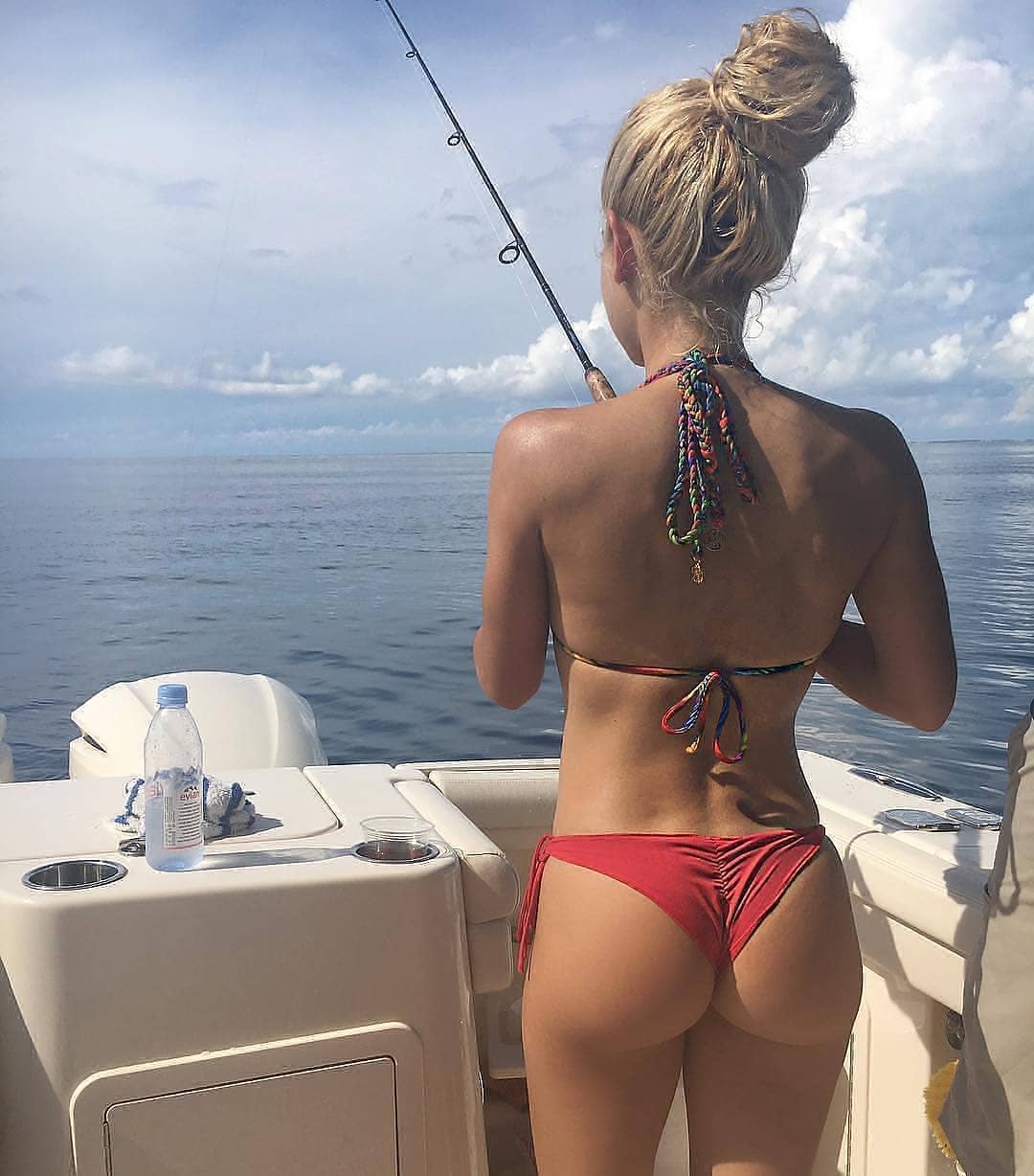
Fish Pic Friday - Marissa Everhart

What does a former Playboy model do after Playboy? Well, as we know, some go into acting, some go into modelling, and well, at least one, Merissa Everhart goes into fishing:
Growing up on the West coast of Florida, Marissa Everhart's fascination with fishing and the outdoors began at an early age. Fishing regularly with her family, that fascination turned to passion quickly as she learned about the big game possibilities available. As Marissa puts it, “I have a big heart, and I’m never scared to try something new. I’m only 5’2", but it doesn’t matter if it’s a giant 15-ft. sawfish from the Florida Everglades, a huge black marlin in the Pacific, or a massive 400-lb. goliath grouper from the Gulf of Mexico, I’m not going to back down from the challenge!”

International swimsuit and glamour model who rose to fame after being featured on the cover of Playboy Mexico. She has garnered a strong social media presence with over 700,000 followers and counting.


She's also done a gig for 138 water.

Some NSFW from the Mexico gig.

On the mend, the Wombat has Rule 5 Sunday: Ayako Kawasumi out by its nominal due date.