Showing posts with label Winter. Show all posts

Wednesday, March 4, 2026

Winter Kill on Calvert Cliffs Beach?

At the Slower Maryland Chronic, Lusby Resident Reports Mass Rockfish Die-Off at Calvert Cliffs Beach

A longtime Lusby resident and candidate for Calvert County Commissioner has reported observing multiple mass mortality events along the shoreline of Calvert Cliffs State Park in February 2026, documenting large numbers of dead mature rockfish, blue crabs, double-crested cormorants, seagulls, and other marine life between the Calvert Cliffs Nuclear Power Plant and the Cove Point LNG facility.

Patrick E. Flaherty, who has hiked the park nearly daily for 15 years, including through severe winter conditions, first noted the incidents in February. On February 23 alone, he captured 118 photographs of the affected area. The die-offs involved rockfish measuring 25–30 inches or larger, along with substantial numbers of crabs and birds, including approximately 8–10 double-crested cormorants and various seagulls.

Flaherty forwarded details to the Maryland Department of the Environment (MDE), which responded promptly and initiated an investigation. He plans to follow up this week with the assigned field investigator for any updates on findings or potential causes. He emphasized the significance of these events given rockfish—Maryland’s state fish—already experiencing serious population declines due to factors like habitat challenges and fishing pressures. The incidents raise concerns for commercial watermen, recreational anglers, and broader Chesapeake Bay ecosystem health.

The affected shoreline lies near the Calvert Cliffs Nuclear Power Plant and the Dominion Energy Cove Point LNG export terminal, a stretch now under consideration for a proposed major Amazon data center development. Flaherty provided a press release outlining his observations and offered to share high-resolution photos for review. He included sample images showing dead rockfish and crabs next to a dog collar radio controller measuring 7.5 inches for scale.

No public statements from MDE or other agencies have confirmed the cause of the reported die-offs as of March 3, 2026. Maryland’s Fish Kill Investigation Program, managed by MDE, handles reports of dead or distressed aquatic life, attributing such events to factors like natural water chemistry changes, low oxygen levels, biological shifts, pollution, or other human-related activities. Reports can be directed to MDE at 800-285-8195 during business hours.

Right after the ice left the beach, Georgia and I walked the beach, and saw a large number of sea ducks, Surf Scoters and Bluebills dead on the beach.  Georgia counted 16 dead birds between the harbor, and the boat ramp at Calvert Beach. Curiously, none that I saw were the two species of sea ducks we commonly see offshore, the Buffleheads and Old Squaw (yes, I'm that old and stubborn). I did see a single large dead striper, but that doesn't strike me as that unusual.

Initially, I was concerned that it might be bird flu hitting the ducks, but the fact that it encompasses so many different and unrelated animals makes me suspect it was a consequence of the extreme cold that we had in late Feb.  Why so many more other animals washed up on Calvert Cliffs beach a few miles south I'll leave open for speculation; I don't understand.

Sunday, December 21, 2025

Happy Solstice!

 I just found this, and rather than wait a year: Welcome to winter


So totally AI... 

The Wombat has Rule 5 Sunday: Probably Not Mrs. Santa up and garnering clicks at The Other McCain.

Monday, January 6, 2025

Snow Day

It looks like about 6 inches so far, and it seems like we're in a lull, expected to pick up again later.


A couple of photos from recent days at the beach. Say, what's that over on the south jetty?
A Bald Eagle perched on a south jetty rock, eating something that is probably a fish
He/she looked up at me an decided I wasn't about to fly across the channel and steal his fish. Too bad I didn't have my camera with the long lens, but the zoom on my new Pixel 6a camera isn't bad if you don't push too hard.

Wind swept beach with a blow out low tide. All sand, terrible for finding fossils. 
A few Buffies hanging around the harbor mouth.
Remnants of our first slight snow clinging in the shadows of the cliff.


Wednesday, December 21, 2022

A Hazy Shade of Winter

 Winter officially arrived today at 4:47 EST with the Winter or Hibernian Solstice


Actually, it's clear and bright here today, but cold.

The Wombat has Rule 5 Monday: St. Stephen’s Day Edition up and running at The Other McCain.

Tuesday, November 29, 2022

Winter is Coming!

Snow extent in the Northern Hemisphere at the end of November represents an important parameter for the early winter forecast. This year snow extent is running much higher than average and according to existing global estimates, it is now beyond the highest ever observed so far. Winter forecast, especially in its early phase and in Europe, might be strongly influenced by such a large snow extent, although many other factors need attention.

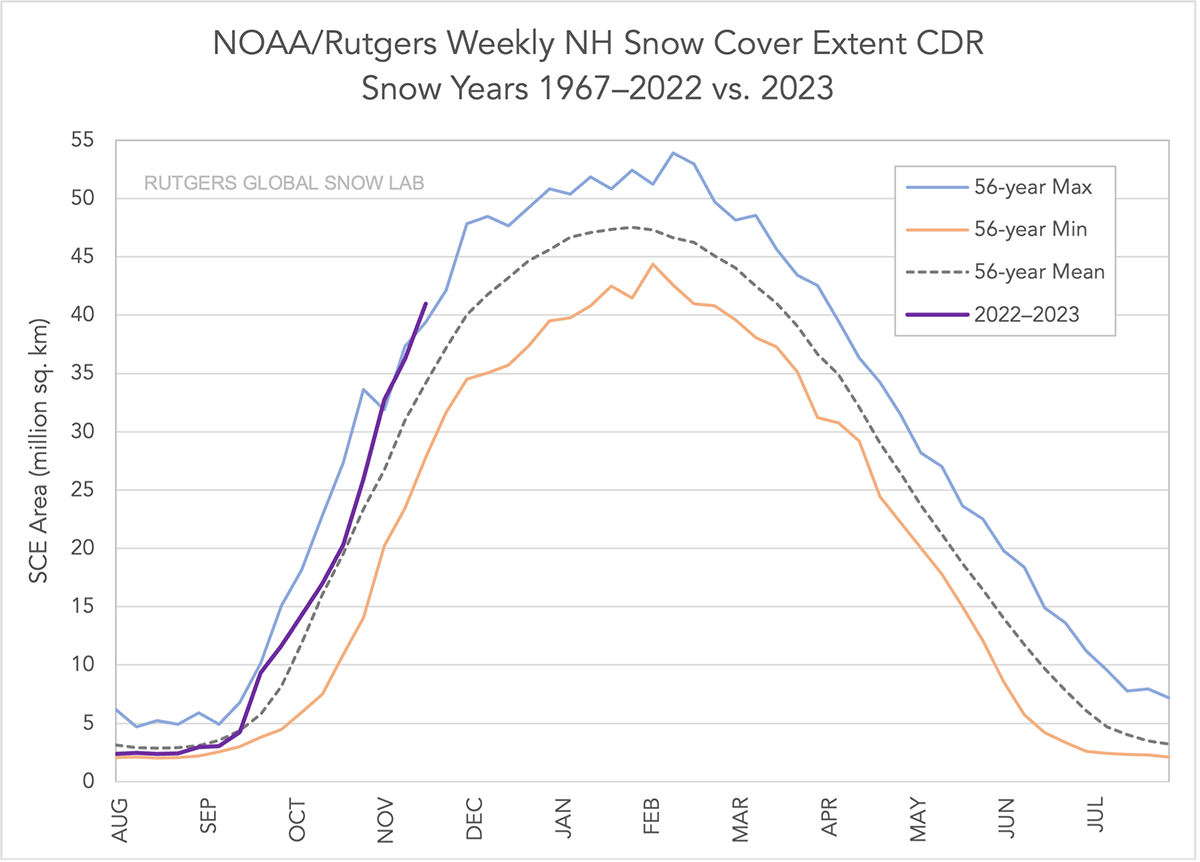
Northern Hemisphere snow extent is currently indeed very high, now at about 41 million square kilometers, according to the NOAA/Rutgers Global Snow Lab. The most recent snow cover information is given in the image below.


The Weekly Northern Hemisphere snow cover extent for the winter season 2022-2023 in purple is plotted together with the mean (grey dashed line), maximum (blue), and minimum (orange) snow cover extent for each week. Mean weekly snow cover extent and extremes were calculated using the 56-year period from October 1966 to July 2022.


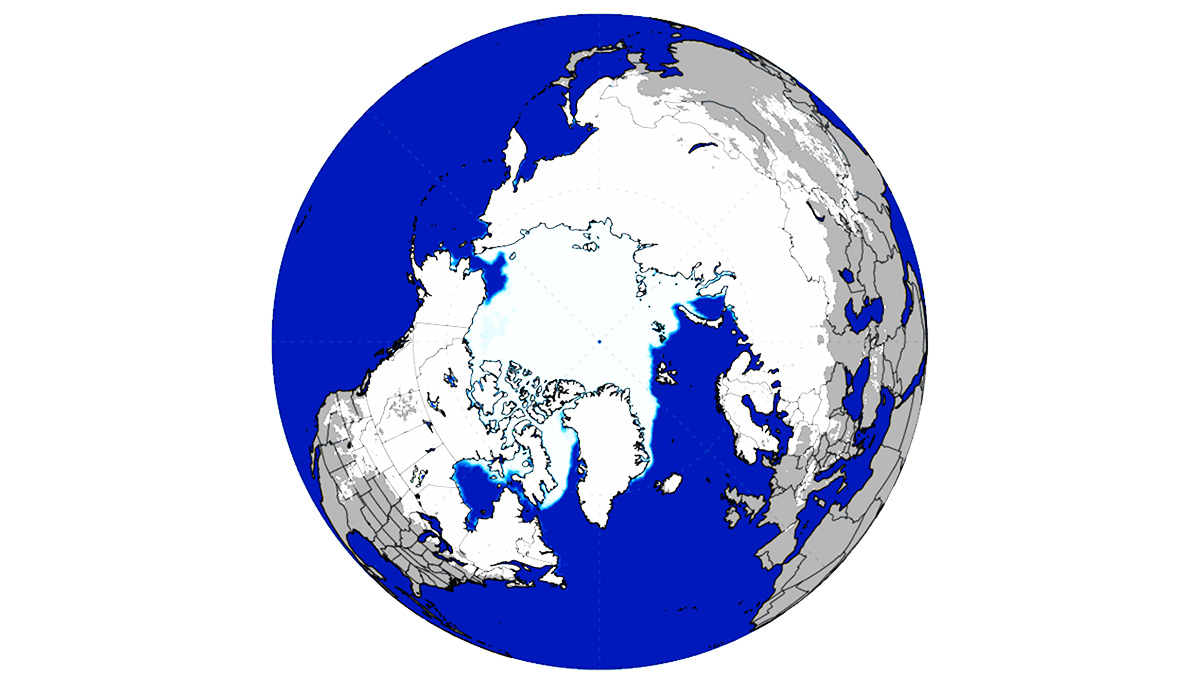
Looking at the below Rutgers Daily Snow Extent map, it is clearly noticeable how Russia is completely covered in snow now. Snow is also seen overwhelming all of Canada, and Alaska, as well as a good portion of the Lower 48. This is an important parameter for the early winter forecast.


You could probably forecast a colder-than-normal winter based on Autumnal Northern Hemisphere snow cover extent alone. It’s the largest snow extent in decades. Having so much snow on the ground means any arctic outbreak is going to be a little bit colder. . . .

A long detailed explanation follows.  From WUWT, Ace Forecaster Bastardi: “Something We Used to See In 1970s”, Warns Of “Spectacular Cold”

In his most recent Weatherbell Saturday Summary, veteran meteorologist Joe Bastardi looks ahead at the winter weather over the coming weeks across the globe.

What definitely distinguishes Joe from forecasters I follow here in Germany is that he doesn’t rely solely on the so-called ensemble models to make his longer term forecasts, but goes way back into the archives and searches for similar patterns that took place even decades ago (analogues) in order to better discern which way the weather is likely to turn in the weeks ahead.

German forecasters like here , here and here like to put out videos once or even twice daily to report on what the many model ensembles are showing, which is something no one really needs a meteorological license to do. Too often you hear these weather pundits suddenly change their 7+ day forecast, in lockstep with whatever the latest ensemble run crunches out. Yet, most of us know that such forecasts are only valid until the next ensemble run because 7 days out the models can and often make U-turns. 


In Joe’s latest forecast, he again makes use of analogue years to forecast weeks ahead. I recall a forecast he made some 2 weeks ago warning that early December likely will turn cold in Europe – long before anyone else – basing it on weather patterns seen over past decades. Lo and behold, now the models are finally seeing wintry weather for next weekend.

In his latest forecast, Joe has become “very concerned” about the coming cold, which is going to be a real problem for not only people in the US, but around the globe.


“Mark my word, if this kind of cold shows up, that we’ve been setting up since the end of summer, and it looks like it at least has merit to consider, there’s going to be a blaming on climate change because of the blocking that caused it.”

Joe worries that many countries aren’t going to have sufficient energy to meet the forecast cold challenges, something politically inexcusable in 2022 with all our modern technology. . . .

So far, our fall has been relatively mild.  I hope a turn for the worse is not in store. But being a La Nina year, it seems possible. 

The Wombat has Rule 5 Monday: HMS Foxhound/HMCS Qu’Appelle out on time and under budget at The Other McCain.


Sunday, December 22, 2019

Solstice Sunday Beach Report

Here on the second shortest day of the year (by one second), the night was cold, 26 F, and we had some skim ice in the back of the harbor. However, the sun came out and warmed the early afternoon air to nearly 50, and without wind, it was pretty nice when Skye and I headed out to the beach.
The tide was high, so fossiling wasn't so great, and I gave my best, a small, but nice Snaggletooth, to some nice fossil hunters who came down from Matoaka, and clearly had no clue what they were looking for. Besides, the girls were cute, and they gave Skye plenty of pets. Still, I came home with 8 teeth.

Sunday, October 21, 2018

Driving From Fall to Winter

Crossing the Appalachian mountains from Canonsburg to Slower Maryland, the seasons changed from  early fall to winter:


Thursday, December 21, 2017

Welcome to Winter

Now, get done with as quickly and as painlessly as possible. The First Day of Winter: Winter Solstice 2017
Winter officially begins with the Winter Solstice on Thursday, December 21, 2017. This is the astronomical first day of winter in the Northern Hemisphere. Enjoy our winter solstice facts, folklore, FAQs, and more!

The winter solstice is the day with the fewest hours of sunlight in the whole year. In the Northern Hemisphere, it always occurs around December 21 or 22. (In the Southern Hemisphere, the winter solstice occurs around June 20 or 21.)

In 2017, the Winter Solstice arrives at:
  • Thursday, December 21, 2017 at 4:28 pm UTC
  • Thursday, December 21, 2017 at 11:28 am EST
  • Thursday, December 21, 2017 at 10:28 am CST
  • Thursday, December 21, 2017 at 9:28 am MST
  • Thursday, December 21, 2017 at 8:28 am PST
  • Thursday, December 21, 2017 at 7:28 am AKST
  • Thursday, December 21, 2017 at 6:28 am HAST

The word solstice comes from Latin sol “sun” and sistere “to stand still.” In the Northern Hemisphere, as summer advances to winter, the points on the horizon where the Sun rises and sets advance southward each day; the high point in the Sun’s daily path across the sky, which occurs at local noon, also moves southward each day.

At the winter solstice, the Sun’s path has reached its southernmost position. The next day, the path will advance northward. However, a few days before and after the winter solstice, the change is so slight that the Sun’s path seems to stay the same, or stand still. The Sun is directly overhead at “high-noon” on Winter Solstice at the latitude called the Tropic of Capricorn.

Question: Is the solstice the start of winter or the mid-point of winter?

Answer: There is not a black-and-white answer—it depends. We follow what the astronomical calendar tells us. The solstice is the beginning of astronomical winter. (An almanac is defined as a “calendar of the heavens,” so we use the astronomical definition as well.) Astronomical seasons are based on the position of the Earth in relation to the Sun. However, meteorological seasons are based on the annual temperature cycle.

It is important for meteorologists to be able to compare climatological statistics for a particular season from one year to the next for agriculture, commerce, and a variety of other purposes. Thus, meteorologists break the seasons down into groupings of three months. Winter includes December, January, and February.

Linked by EBL in "Winter Solstice 2017." Wombat-socho has "Rule 5 Sunday: Merry Christmas!" up and running.

Saturday, November 11, 2017

First Frost!

The blast of polar vortex, or Alberta Clipper or whatever the heck it is arrived last night on schedule, and temperatures here plunged from 51 to 26 F overnight.

144 year earliest cold record for New York City to be broken – new 103 year record low already set

Usually, our first frosts kind of sneak up on us, a few cold days where the roof tops and surfaces freeze, but the overall temperature stays somewhat above freezing. Not this year.

Skye, of course, is pleased as punch, and her winter coat is growing in just in time.

The bad news is that this will dramatically accelerate the leaf fall, leading to huge amounts of time mowing, blowing and raking leaves. But it was going to happen sometime.

Sunday, December 25, 2016

It's Not Exactly Hell Freezing Over . . .

We know the northern hemisphere has been getting colder, for example we reported earlier this week that the USA was colder than any time last year with an average temperature of 16 degrees F. It isn’t just the USA, in northern Africa, reports suggest that it is only the second time in living memory that snow has fallen on the Sahara desert. The last record is for February 18, 1979, when the snow storm lasted just half an hour.

Snow falling on the Saharan mountain ranges is very rare, let alone on the sandy dunes of the continent’s largest desert.
Photo by Karim Bouchetata of Meteo Algerie
No, weather is not climate, but climate is the long term average of weather.

Wednesday, December 21, 2016

Winter is Coming!

Well, actually, it's here, as the Winter Solstice occurred at 5:44 EST. Best known as the shortest day of the year in the Northern Hemisphere and the start of "astronomical winter" (as opposed to meteorological winter), the solstice marks the moment the north pole of the earth points directly away from the sun.

The start of winter finds us cold (31.1 F now), but on a warming trend. The next few days, maybe even to the end of the year are projected to be above freezing.

We clicked on an offer for a free month of HBO through Amazon Prime, and started a watching "Game of Thrones". That should keep up busy, trying to see them all before it runs out.


Monday, February 1, 2016

It's Bikini Season in Poland!


Even the dog thinks they're nuts.

"Rule 5 Sunday: Super Bowl L"  is ready at The Other McCain, courtesy of Wombat-socho.

Monday, December 21, 2015

Happy Solstice

Today, around 11:49 PM is the Winter Solstice, the  shortest day of the year here in Southern Maryland. It is also the start of astronomical winter (meteorological winter began Dec. 1):