Showing posts with label sediment. Show all posts

Saturday, August 15, 2026

Maryland Counties Come Together to Demand Conowingo Danegeld

The Conowingo Dam (Photo by Christine
 Condon/Maryland Matters)
At Maryland Matters, New collaboration unveiled on Conowingo Dam, as Maryland awaits federal OK on settlement

When it comes to the Conowingo Dam, tensions have cooled between leaders in rural Maryland counties and state officials, as well as dam owner Constellation Energy.

That fact was on display Thursday at the Maryland Association of Counties summer conference in Ocean City, when leaders from all three camps convened — this time to discuss a settlement agreement through which Constellation will pay $340 million for various environmental projects over the next several decades, in exchange for a crucial water quality certification from the state.

Initially, Republican officials in several rural Maryland jurisdictions, under the banner of the Clean Chesapeake Coalition, challenged that deal, as they were long aggrieved by sediment overflow events from the at-capacity dam, which is located in Cecil County. But state environmental officials persuaded them to drop their challenge.

Now, the Clean Chesapeake Coalition is no more, replaced by an advisory group with a far more collaborative tone, Cecil County Administrator Dan Schneckenburger said Thursday.
“We pivoted to: Let’s try to work together,” Schneckenburger said. “We’ve always been on different sides of this issue — maybe not addressing it the way we wanted to see it addressed. So we ultimately said, ‘Let’s put together an advisory group, and we can work on implementation of the settlement.’”

But there’s still a possibility that a wrench could be thrown into Maryland’s plans.

The Federal Energy Regulatory Commission still must decide whether to sign off on Maryland’s certification, and whether to issue a new 50-year license for the dam to continue operating.

And in January, President Donald Trump’s (R) Environmental Protection Agency proposed a rule change, setting new limits on state water quality certifications, known as Clean Water Act Section 401 certifications.

State officials believe that their water quality certification —and the millions of dollars worth of accompanying environmental projects — is not in jeopardy, since they filed the license application with FERC last fall, well before the new draft rule was issued, said Adam Ortiz, deputy secretary at the Maryland Department of the Environment, which negotiated the settlement with Constellation and local riverkeepers. The state is expecting FERC approval next year, Ortiz told the audience.

“We’ve been checking in: ‘How’s it going over there? Are we ready to proceed?’ And there’s no indication that there’s going to be a problem,” Ortiz said during Thursday’s meeting. “That doesn’t mean that there’s not a possibility that is a problem.”

The new rule, if it moves forward, would limit states’ abilities to object to “non-point” pollution sources, focusing instead on “point sources” such as industrial sites that discharge wastewater directly into the environment, Ortiz said.

The dam is considered a non-point pollution source, since it does not generate pollution of its own but instead acts as a pass-through for contaminants flowing down the Susquehanna River, including farm fertilizers from upstream, and into the Chesapeake Bay.

Federal officials believe that the new rule would protect “water quality while eliminating regulatory overreach that has imposed unnecessary burden on critical infrastructure projects,” according to documents released about the alteration.

Conowingo Dam, by intercepting  sediments that would otherwise end up in the Chesapeake Bay has been protecting the Bay from excess mud for nearly a century, mud that, except for Conowingo Dams existence, would have ended up in the Bay. But it's sediment holding capacity is now exhausted, as was inevitable.  Forcing Constellation to pony up for poorly defined "environmental projects" as the price for continued licensing is simple extortion, and will only result in higher electricity prices in the mid-Atlantic region, already some of the nations highest.

"Once you have paid him the Danegeld/ You never get rid of the Dane."

Wednesday, January 7, 2026

Counties Drop Conowingo Sediment Settlement Suit

 Maryland Matters, Conowingo Dam appeal dropped, allowing $340M settlement to go forward

Maryland’s $340 million settlement with the owner of the Conowingo Dam can now move forward, after a group of Eastern Shore counties dropped their challenge of the deal.

The withdrawal came less than a month after the administrative appeal was originally filed. Officials at the Maryland Department of the Environment, which brokered the key settlement deal, had lobbied hard for the handful of counties to back down.

That’s because the appeal had the potential to derail or delay the funds from dam owner Constellation, which are designated for various environmental projects. The state negotiated to receive the funds in exchange for issuing the hydroelectric dam a crucial water quality certification, which it needs in order to obtain a 50-year license from the Federal Energy Regulatory Commission.

“We are very excited to move out of the courtroom and into action. After nearly a decade of legal challenges we can now put this $340M to work to accelerate progress on the Bay,” wrote Maryland Department of the Environment spokesperson Dave Abrams in a statement. “Thank you to the local governments who worked closely with us to reach this resolution. We are all on the same team and will work closely with them and other stakeholders as we move forward.”

After Maryland officials promised counties they could have input on the rollout of the environmental projects in the settlement, several counties pulled out in late December. Cecil County — which hosts the dam and has complained about the impacts of sediment build-up — was the final hold-out, but dropped out on Friday.

It's always been my opinion the Marylanders should have been more grateful for the role of Conowingo in keeping sediment out of the Bay, and less demanding of those companies willing to help keep the dam serving that purpose. I'm glad the work will be going forward now.

Wednesday, December 31, 2025

Another Dam Controversy

At the Balmer Banner, Eastern Shore opposition to Maryland’s $340M Conowingo Dam deal splinters

Barely a month after several Eastern Shore counties challenged Maryland and Constellation Energy’s $340 million deal to relicense the Conowingo Dam, three out of four objecting jurisdictions have backed out of the appeal. Dorchester County voted last week to withdraw its challenge to a state environmental certification for the dam, while the attorney leading the coalition spearheading the challenge said two other counties, Queen Anne’s and Kent, also backed out. That leaves only Cecil County, the northern Maryland county at the mouth of the Susquehanna River and Conowingo Dam, holding the line.

Asked about the withdrawals, Charles D. “Chip” MacLeod, the attorney for the Clean Chesapeake Coalition that filed the appeal, pointed to a campaign by Maryland environmental officials to dissuade counties from their challenge. “Lots of pressure being applied to local officials who dared to slow the process and bring attention to a bad deal for the Bay and Marylanders,” MacLeod said in an email Friday. Cecil County officials remain committed to the challenge “at this stage,” MacLeod said.

Maryland Department of the Environment officials have toured the Eastern Shore in recent weeks in an effort to convince the Republican-led four counties to reconsider. State officials met with county leaders at a recent Maryland Association of Counties summit and have presented at county council meetings in both Cecil and Dorchester counties to make their case for the downstream benefits of the settlement deal. The effort appears to have paid off. Officials on the Dorchester County Council announced last week that they voted to withdraw from the appeal following conversations with state regulators.

A not so brief recap of the situation. When completed in 1928 on the Susquehanna River just above the head of Chesapeake Bay, Conowingo Dam was the second largest hydroelectric powerplant in the US. Immediately, sediments, natural erosion as well as agriculture enhanced silt, started to fill the "pool" behind the damn, protecting the Bay from them. When I arrived in the Chesapeake Bay region in 1985, the head of the EPA Bay Program said the filling of the pool with sediment was the single greatest threat to the Bay.  Years later, that threat has become reality. The pool behind the damn has no room for more sediment, and in freshets, mud simple pours over the dam. Rather than plan ahead, the authorities decided to wait, and then blame whoever owned the dam at the time for the situation reverting back how it would be in the dams absence, tying restoring the pool (at least somewhat) to relicensing the dam. If it were me, I might just offer to hand them the keys for a buck or two, and find out how they deal with it.

Saturday, June 15, 2024

No Progress on "Sneaker Index"

Bernie (in overalls) and others at a
"Wade-In" at Rhode River, 2009
 The BayNet, 37th Annual Patuxent River Wade-In

On Sunday, June 9, 2024, the 37th Annual Patuxent River Wade-In took place to raise awareness about the health of the Patuxent River. This year’s official index was 25 inches.

The annual wade-in invites community members to walk into the Patuxent River and measure the “Sneaker Index.” The index was developed by the late Senator Bernie Fowler, who measured how many inches he could wade into the water and still see his white sneakers.

The tradition has since been passed to his grandson Cody Fowler, who dons his Grandfather’s classic wade-in uniform: denim overalls, a straw hat, and the required white sneakers.

The goal for the index is approximately 57″, so there’s still some work to be done. However, the event isn’t as much about the index’s recording, but about bringing attention to the health of our environment, specifically the Patuxent River.

To learn more about Fowler and the origins of this tradition, click here.

The "Sneaker Index" is simply scientific nonsense, based on the questionable sentimental memory of an aging politician (sound familiar?). Maybe there was a day back in the 1940's when the wind didn't blow, and a teenage Bernie Fowler could see his feet, but, without a picture, I don't believe it. Any kind of wind kicks up sufficient mud to significantly reduce the visibility, and that can change for day to day, hour to hour, and minute to minute. I've been around the Bay long enough to see it in action.

Wednesday, December 21, 2022

Court Cans Conowingo Contract

Bay Journal, Appeals court vacates Conowingo Dam license

The long-running debate over how to deal with Conowingo Dam’s impact on the Chesapeake Bay is on again. A federal appeals court on Tuesday vacated the license granted in 2021 to operate the hydropower facility on the Susquehanna River.

Siding with environmental groups, a three-judge panel of the U.S. Court of Appeals for the District of Columbia found that the Federal Energy Regulatory Commission exceeded its authority by accepting a privately negotiated deal between Maryland and the utility that owns the dam as part of the license agreement. Under that deal, the state had greatly scaled back what it had originally required of the dam’s operator to reduce pollution coming downriver to the Bay.

Spokespeople for groups that had challenged the license hailed the court’s ruling, saying it clears the way for making the dam’s operator, Constellation Energy, to play a bigger part in dealing with the water-fouling nutrients and sediment building up behind Conowingo and flowing downriver.

“This decision will not only protect the Susquehanna River and the Chesapeake Bay for the next 50 years of this license term but will also ensure that all water quality certifications for large projects can’t just be thrown out when it is politically expedient or when the state is pressured to do so,” said Betsy Nicholas, executive director of Waterkeepers Chesapeake. “This is a big win for the Chesapeake Bay, watermen, downstream residents and the entire Chesapeake Bay cleanup plan.”

The Waterkeepers group, along with two of its member organizations — the Lower Susquehanna Riverkeeper and Sassafras Riverkeeper — and the Chesapeake Bay Foundation filed suit in June 2021. They asked the court to overturn FERC’s acceptance of what some called a “sweetheart deal” between Maryland and Constellation’s corporate predecessor, Exelon Corp., over what the company would do to address the dam’s impacts on water quality and aquatic habitat.

The 94-foot-high dam straddles the Susquehanna in Maryland, about 10 miles upstream from the Bay. Its turbines generate enough emission-free electricity to power 165,000 homes, according to Constellation. After the dam’s completion in 1928, it captured a portion of the nutrients and sediments washing down the river. But now its 14-mile reservoir is mostly filled, and more nutrients and sediment from farm runoff, municipal wastewater and stormwater flow through the dam and into the Chesapeake, where they contribute to algae blooms and other water quality woes.

Incidental to its original function to produce electricity, Conowingo collected sediment and pollution from its completion in 1928 until recently, when the reservoir behind it essentially filled with mud washed down from Pennsylvania. Without the dam, that sediment would have continually entered the Bay. Now that the reservoir is full, environmentalists and court are saying that the company that now owns the dam (which is not the company that built it), owes them for no longer being able to do that. If I were Constellation, and had fuck you money, I'd just abandon the dam.

Thursday, December 16, 2021

RIP: Bernie Fowler

Bay Journal, Bernie Fowler, tireless Maryland advocate for clean water, dies

Those sneakers are going to be hard to fill.

Clyde Bernard Fowler, tireless champion and agitator for cleaning up his beloved Patuxent River and the rest of the Chesapeake Bay, died Sunday at the age of 97.

Over five decades of public and private life, the former Maryland state senator known to everyone simply as “Bernie” never gave up trying to curb the pollution he saw threatening the region’s once-vibrant waterways. He pressed for legislative remedies and even joined in bringing a pair of lawsuits when nothing else seemed to be working. He also took his case directly to the public in a way that proved contagious.

Starting in 1988, Fowler led an annual “wade in” from the banks of the Patuxent, where he had netted for soft crabs as a young man in the 1940s and ‘50s, to dramatize the need to restore its clarity and vitality. He frequently recalled that in those days he could wade out into the river and still see his sneaker-clad toes when the water was chest deep on his lanky 6-foot frame.


The wade-ins drew media coverage and politicians, and the “sneaker index” — the water depth at which point Fowler lost sight of his feet — became an informal but important yardstick for judging progress or its lack in restoring the Patuxent.

“We’ve lost a real titan of the Bay community,” said Ann Swanson, executive director of the Chesapeake Bay Commission. Fowler sat on that tri-state legislative advisory body for 37 years, she said, first as a state senator, then as a citizen member and finally as an emeritus.

“The wade-in was just a beautiful example where Bernie combined science with community involvement,” Swanson said. “He made his sneakers a scientific tool, a Secchi disk. And then he combined it with politicians and music and floats and picnics. Because he knew if you’re going to accomplish environmental protection it has to be fun.”

Bernie has been a fixture in the Bay community from the day I arrived in 1985.  Shockingly, to many, this environmentalist/politician was also a marina owner (in nearby Broomes Island) and a local land developer.

His "index" was, of course, largely BS. The transparency of the water in a place like Broomes Island, where his "official" wade ins were carried out, varies daily, indeed, hourly, depending on wind and currents. Any trend would take years to emerge from the noise in the data. But it attracted attention, and that was what mattered;

A photo of Bernie et al at a supplemental wade in at SERC in 2009.

Tuesday, June 15, 2021

Patuxent River Flunks "Sneaker Test" for 2021

Chesapeake Bay Magazine: Annual Patuxent Wade-in Yields Disappointing Water Clarity Results

An important tradition returned to the Patuxent River this weekend. At 97 years old, Bernie Fowler measured the 2021 “Sneaker Index” in his annual Patuxent Wade In at Jefferson Patterson Park. 100 “Fowler Followers”—regular attendees, old friends, and children of all ages—waded into the river Sunday afternoon, arm-in-arm.

97! He's holding up OK.  One of the little known facts was that in addition to being a well known and well beloved politician in Calvert County, Bernie was a land developer (makes sign of the cross).

For 34 years, the former Maryland state senator has walked into the Patuxent to informally test its water quality. He walks until he can no longer see his white sneakers on the river bottom. From a low of 10 inches of sneaker visibility in 1988, the inaugural Wade In on the Patuxent, to a half-century high of 47 inches in 2019, Fowler’s “dear generous river” is recovering slowly.

What? Annual (let alone daily) variability? Whoda thunk! 

This year’s Sneaker Index was a disappointing 34 inches, but Greg Bowen, emcee of the event and executive director of American Chestnut Land Trust (ACLT), attributes this decline to recent events—6.5 inches of rainfall in the last fifteen days.

All it takes to create poor visibility is an hour or two of wind beating against the shoreline to stir up a bit of sediment. I learned this from Walleye Pete, chasing clear water around the islands.  

Although the Sneaker Index is an informal measure, in 2017 the Goddard Space Flight Center was able to confirm the accuracy of the wade-in yardstick by comparing it to images from two satellites. Science and common sense make a wonderful match: A former EPA administrator once called the Sneaker Index “magnificent in its simplicity: a good indicator of water quality.”

It is essentially a Secchi Disk, without the Secchi Disk.  On the water, we use a light colored fishing lure. 

Wednesday, February 10, 2021

Baltimore Harbor Sediments Used to Rebuild Park

 Dredged sediment from Port of Baltimore helping to restore city parkland

Sediment dredged from shipping channels leading to the Helen Delich Bentley Port of Baltimore is helping restore the underutilized Ridgley’s Cove park property in Baltimore City into a multi-use recreation area with walking trails. Restoration of Ridgley’s Cove, located behind Horseshoe Casino and adjacent to the Middle Branch of the Patapsco River, makes use of sediment from the Maryland Department of Transportation Maryland Port Administration’s (MDOT MPA) Cox Creek Dredged Material Containment Facility. The project is the largest example of innovative reuse of dredged sediment from Baltimore Harbor channels.

“Baltimore is world renowned for its beneficial use of dredge material, and the Ridgley’s Cove reconstruction is further proof of Maryland’s ingenuity,” said MDOT MPA Executive Director William P. Doyle. “Continuous dredging is critical to accommodate the ships that enter the Port of Baltimore to deliver high volumes of cargo and support tens of thousands of jobs. We can use this dredged material to restore, reclaim and rebuild property in surrounding communities.”

MDOT MPA is working on the project with the Maryland Department of the Environment, Maryland Environmental Service, Baltimore City, Baltimore Development Corporation and the company, TopGolf, in a unique partnership of local and state government, a nonprofit and private industry. CBY, a Dundalk-based hauling company, is handling the dredged material transport from Cox Creek to Ridgley’s Cove, with 150 to 180 trucks a day transporting sediment to the site.

150 dirt trucks a day? That' serious traffic. I wouldn't want that on my street.  

Approximately 22,000 cubic yards of blended sediment from the Cox Creek facility will be used as capping material in the upland restoration of Ridgley’s Cove. Historical research of the site indicates environmental impacts stemming from land use activities dating back to the late 1800s. Restoration of the upland and nearshore environment is part of a mitigation package associated with the future TopGolf facility. Plans involve remediation of existing environmental impacts and reestablishing the site as a recreational asset.

So they're not worried enough about the pollutants in the sediment to prevent them from using it in a golf course (Baltimore harbor sediment is notoriously contaminated with heavy metals, including lead, copper, chromium and cadmium, as well as a wide variety of organic pollutants, DDTs, PCBs and more). Does that mean it's safe enough to put on farm fields in small amounts? That would be a good thing, to restore soil that has been lost to erosion. 

Friday, January 29, 2021

Can the Bay Be Turned into Bricks and Mortar?

Chesapeake Bay Mag, Port Of Baltimore Could Recycle Sediments into Bricks and Concrete

The Port of Baltimore has already repurposed tons of dredged materials from its shipping channels to restore Poplar and Hart-Miller islands in the Chesapeake Bay.

Now, two companies will study the possibility of reusing dredged sediment to create concrete road barriers. Governor Larry Hogan and Maryland’s Board of Public Works approved the contracts Wednesday. Three other contracts have already been approved to test the use of dredged materials to make bricks and pavers, shoreline protection barriers, and even soil for growing sod.

“These innovative uses could turn sediment that builds up in the Chesapeake Bay into a valuable resource for making bricks, concrete and even structural support for shorelines,” says Gov. Hogan.

The shipping channels that lead to the Port of Baltimore must be routinely dredged to keep lanes open for the deep-water ships that call on Baltimore, so there is no shortage of mud, sand and sediment from the bottom. The port says an average of 4.7 million cubic yards of material must be dredged every year, from the 150 nautical miles of channels in the Bay, Patapsco River, and Baltimore Harbor.

The Hart-Miller (Baltimore County) and Poplar (Talbot County) island restoration projects have made good use of the dredged material, and James and Barren islands in Dorchester County are next to be rebuilt. But the new sediment-recycling study contracts could allow for more innovative use of dredged materials.

New productive solutions for dredged materials will allow the port to continue dredging without fear of where to put the surplus muck.

“This allows us to continue removing dredged sediment from our channels to maintain the 50-foot depth needed to accommodate the supersized vessels that bring cargo and jobs to the Port of Baltimore while recycling that sediment to use again in other ways—a real win-win,” says Maryland Port Administration Director William P. Doyle.

In each of the newest studies, contractors will use sediment from the port administration’s Cox Creek Dredged Material Containment Facility outside Baltimore. Harford Industrial Minerals Inc. will study use of dredged sediment in structural concrete and fill. And Susquehanna Concrete Products Inc. will study use of the sediment for general-use concrete products like retainer walls and blocks.

I don't really see that there's that much to study. People have been making mud and sand into bricks and mortar for millennia; it ain't exactly rocket science. What I question is whether there's enough demand for bricks and concrete made with river mud to come anywhere closed to solving the problem of where to dispose of all the sediments that accumulate in the harbor.

On the other hand, we have a proven solution; using the sediments to restore eroded islands. News on that front, Poplar Island Ecosystem Restoration Expansion Complete, Open to accept Dredge Material

The U.S. Army Corps of Engineers, Baltimore District, completed construction of the Poplar Island Ecosystem Restoration Project lateral expansion Jan. 20, 2021, providing 575 additional acres, including four new wetland cells and one large upland cell. The project is now able to accept dredged material associated with the approach channels to the Port of Baltimore until around 2032.
And once Poplar Island is finished, they already have plans to move on and restore Barren Island and James Island. If they can used the sediment to make bricks and concrete, great, but I don't see pressing need.

Tuesday, December 22, 2020

Virginia to Spend $2.3 Million to Keep Cows Dry

Winchester Star: More funding coming for livestock fencing

Fencing perennial streams can reduce nutrients and feces from entering waterways when livestock pass through, which would help to achieve the water quality goals in Virginia’s final Chesapeake Bay Total Maximum Daily Load Phase III Watershed Implementation Plan.

On the other hand, streamline fencing is costly.

But a light has shined at the end of the tunnel.

Following an increase in livestock fencing program participation, the Virginia Soil and Water Conservation Board recently voted in favor of supporting a new fencing reimbursement program called the Small Herd Initiative.


The program, which was allocated $2.26 million in state funding and starts on July 1, would put more money into the hands of small cattle operators.

“What we are attempting to do through the Small Herd funding is offer extra incentives,” said Darryl Glover, director of the Soil and Water Conservation division of the Department of Conservation and Recreation.

Extra incentives would help to achieve Phase III’s goal for the amount of phosphorus and nitrogen entering the Chesapeake Bay by 2025 and avoid making fencing mandatory.

During the 2020 General Assembly session, Gov. Ralph Northam’s administration proposed legislation that would make fencing mandatory for any operator with 20 or more bovines in the Chesapeake Bay watershed by July 1, 2026.

I'm glad to see this. Large numbers of cows using streams is a significant pollution problem, for both sediment, and nutrients. At the same time, I'm gratified that the state is stepping up and handling it with their own money, and not relying of the feds (at least that I can see). 

Monday, October 19, 2020

Put In Your Two Cents on Conowingo Dam

 Chesapeake Bay Magazine, Feedback Wanted on Conowingo Dam Action Plan

For the first time, a coalition of environmental groups have drafted a plan to clean up pollution from the Conowingo Dam that flows into the Chesapeake Bay. And they’re opening it up for public input.

The Conowingo Watershed Implementation Plan is meant to be a road map toward achieving a “pollution diet” similar to the one in place for the entire Chesapeake watershed. The goal is to reduce the nitrogen, phosphorous and sediment loads that wash downstream and harm marine life.

For decades, the Conowingo Dam functioned to trap nutrients, sediment, and pollution so that less of it traveled from the Susquehanna River and reached the Bay. But over time, sediment built up behind the dam, rendering it unable to trap any more pollutants. While the watershed states struggle to meet their cleanup goals for the Bay, it’s even more important to address the pollution at Conowingo Dam. This dam-specific Watershed Implementation Plan (WIP) zeros in on the specific problems it presents.
Conowingo Dam
“It has one focus: nitrogen,” explains The Center for Watershed Protection’s Bryan Seipp. The goal of the plan is to find the lowest cost solutions to eliminate six million pounds of nitrogen pollution entering waterways. The Conowingo WIP is a much-needed solution to a challenging problem that will build on, but not duplicate, the WIPs that states are already using to meet their existing goals.”

The WIP is a partnership between the Chesapeake Bay Program, Chesapeake Bay Trust, the Center for Watershed Protection, Chesapeake Conservancy, and a steering committee that includes all of the Bay states. Joel Dunn, President and CEO of Chesapeake Conservancy, promises the coalition will “track implementation and reward performance” to advance conservation and restoration goals. “We can do hard things,” he puts it simply.

The plan, more than a year in the making and funded by a $600,000 EPA grant, is open for public comment from individual residents, businesses, watershed groups and local governments, from now until December 21, 2020. You can submit comments and questions related to the draft WIP to CWIP@chesapeakebay.net. To read more on the plan, visit the Chesapeake Bay Program website.
My view is that the sediments behind the dam should be used to rebuild Chesapeake Bay islands lost to erosion in part due to the lack of sediment coming down the Susquehanna as a result of the dam (admittedly, only a small part). I don't worry too much about the nutrients and toxics in the sediments. In properly reconstructed islands, only a small amount of the sediment will interact with the water, and a rational plan would use clean sediments for that portion.

The other problem would be the technical one, the problem of moving the dredge spoils over (or around) the dam.  I'm sure it can be done, but it might be expensive. How about a slurry pipeline to carry the sediments to the needed areas. Slurry pipelines work for coal.

Tuesday, January 21, 2020

Good Luck!

District unveils first steps to clean up Anacostia’s toxic sediment
The District of Columbia has released the first steps of a plan to clean up a legacy of toxic contaminants on the bottom of the Anacostia River.

The “early action” plan calls for capping, dredging and monitoring contaminated sediment at nearly a dozen “hot spots” along a highly urban and historically industrial nine-mile stretch of the river, which flows from suburban Maryland through the nation’s capital.

The District Department of Energy and Environment will hold the first of several public meetings to explain the proposed plan on Thursday, Jan. 23, from 6:30 to 8:30 p.m. The public comment period for the plan was extended to March 2, with additional meetings to be held on Jan. 27 and Feb. 3.


After the comment period, DOEE says it will issue an interim record of decision by September. The agency plans to hire contractors to begin the work sometime this year. The cleanup is expected to take several years.

The department’s proposed plan maps out 11 “early action areas” located in the river’s main stem, plus Kingman Lake and Washington Channel, where sediments containing toxic contaminants will be removed, capped or treated with activated carbon. These areas contain the highest concentration levels of polychlorinated biphenyls (PCBs), now-banned chemicals once widely used as coolants or insulators in electrical equipment that are now associated with cancer and other health effects.

The main ways people would be exposed to these contaminants is by wading or swimming in the river or by fishing and eating contaminated fish tissue. It is currently illegal to swim in District waters, and anglers are advised to limit their consumption of locally caught fish, especially bottom-feeders from some portions of the river. But a 2013 report found that many residents consume significant amounts of fish caught in the Anacostia anyway. Fish, aquatic insects and other wildlife also are impacted by the chemicals in the river’s sediment, which can become resuspended in the water when the bottom is stirred up.

The proposed plan predicts the work will yield a 90% reduction in people’s risk of exposure to PCBs from eating contaminated fish. “The idea here is that if we clean up the most contaminated areas, the presumption is you’re reducing the risk,” said Dev Murali, remedial project manager with the District. Follow-up monitoring is planned to gauge the cleanup’s effectiveness.

The project is estimated to cost about $30 million. The District government is funding the first steps of the sediment cleanup, though the city will likely seek to recover remediation costs from companies and federal agencies that contributed to the pollution.
I was involved in measuring the heavy metals and toxic organics in the sediments of the Anacostia back in 2003. It was apparent then that the fine sediments of the river were heavily contaminated at different points of time in the past, depending on the pollutant, and that, while inputs had been reduced, and new sediments being deposited, while cleaner, were still contaminated. Certainly removing the contaminated sediments, or capping highly contaminated areas (which may depend on how much depth you have) will be an improvement, but it will be an expensive fix.

I wish them good luck

Tuesday, January 7, 2020

Pennsylvania Riverkeeper Wants to Punish Exelon Over Conowingo Dam

Ted Evgeniadis,  Lower Susquehanna Riverkeeper: Maryland must demand more of Exelon to address Conowingo sediment problems
On January 31, 2014, Exelon submitted to MDE an application for a water quality certification. That application included copies of the resource studies that had been completed as part of the FERC relicensing process. However, the studies were insufficient for MDE to make conclusions and impose conditions for the protection of water quality. MDE requested for more studies specifically on Sediment Transport in the Lower River and Upper Chesapeake Bay. At this point, Exelon withdrew and resubmitted its application multiple times due to their inability to produce the required studies the state of Maryland needed to issue the certification.

Furthermore, recent case law states that one year means one year for a state to issue a 401 water quality certification, in that a withdrawal and resubmission does not constitute a new application request. Unfortunately, Exelon used this court decision and petitioned FERC pleading that MDE waived their right to the 401 certification issued in May 2018. By petitioning FERC, Exelon instilled fear through the ranks at MDE and coerced them behind closed doors, without public input, to enter into a grossly insufficient relicensing settlement agreement which falls short of protecting Maryland’s waterways.

It is not acceptable to have a state waive its enforcement authority based on a payment of money that provides no assurance of water quality improvement. Additionally, the public and interested parties like our organization and Waterkeepers Chesapeake must have input into what will happen to the Susquehanna River and the Chesapeake Bay over the next 50 years. As it is now, virtually all of the substantive portions of the settlement will not be incorporated into the 50 year federal license agreement – which means there is no public input, scrutiny and, more importantly, no ability to enforce these provisions.

The settlement agreement provides insufficient funds to deal with the risks that Conowingo operations pose to the Susquehanna River and Chesapeake Bay, specifically sediment and nutrients. It includes statements of intent without assurances that the initiatives and actions under the agreement will actually be fulfilled by Exelon. There is no enforcement power for the public to make sure the terms of the settlement are fulfilled in a sufficient manner. It requires payments made by Exelon to go to the State’s Clean Water Fund, which can be reallocated or raided by the Governor at any time over the next 50 years. Also, it does not mention any appropriation of funding for upstream water quality improvements to combat sediment and nutrient load to the dam’s reservoir

The Susquehanna River is a public resource and should not be sold off to a private company for exclusive use without ensuring that the impacts to the public have been properly mitigated. Therefore, MDE and Governor Hogan should increase their funding ask from Exelon before fully signing off on the agreement, or nix the agreement entirely and continue pursuing the more protective Water Quality Certification. The settlement should specifically include more funding for the Sediment Disposal Study and Resiliency Initiatives mentioned. The State should also build realistic assurances into the agreement that the terms will be fulfilled, not just statements of intent.

A large storm like Hurricane Agnes has a 40% chance of happening over the license term with that probability increasing with climate change. A storm of that magnitude will scour out millions of tons of harmful sediment that the dam has collected, and then deliver it downstream where it will smother submerged aquatic vegetation, fish habitat, oyster beds and inevitably create large "deadzones" in the Bay. This is the single largest threat to the Chesapeake Bay and Exelon is choosing to ignore the facts and claim their dam does not implicate water quality. It may be another state’s silt coming downstream but that dam has blocked it and its reservoir is now full.

It's understood we all need power and the dam will continue to stand upright, so let's make sure this proposed settlement gets revised to reflect true and accurate measures Exelon must take in order to protect aquatic species, fish migration, water quality now and for the future, while producing and selling power at a fair rate of return that does not monopolize this public resource’s intrinsic value. We urge the congressional delegation of PA and MD to contact the Hogan Administration and MDE and demand more for the Susquehanna River and Chesapeake Bay. We ask the public and other environmental groups to participate in our action alert and sign our petition found here https://bit.ly/2FpBUK4 . This settlement agreement will set national precedence in hydropower relicensing so it’s critical that Exelon is held accountable over the license term and pays its fair share to protect the river and Bay for the next 50 years.
The Conowingo Dam, which protected the Chesapeake Bay from sediments running down the Susquehanna River for most of a century, was purchased by Exelon long after it was built. I still fail to see why that is Exelon's fault that the dam is no longer protecting the Bay.

If I were Exelon, I'd threaten to give it back to the state.

Saturday, July 13, 2019

Wrong, Just Wrong

By the AP, as published by NYPo, Chesapeake Bay ‘dead zone’ has 200 million tons of pollutants
When the Conowingo Dam opened to fanfare nearly a century ago, the massive wall of concrete and steel began its job of harnessing water power in northern Maryland. It also quietly provided a side benefit: trapping sediment and silt before it could flow miles downstream and pollute the Chesapeake Bay, the nation’s largest estuary.

The old hydroelectric dam spanning the lower Susquehanna River is still producing power, but its days of effectively trapping sediment in a 14-mile (22.5-kilometer) long reservoir behind its walls are over. Behind the 94-foot (29-meter) high barrier lies a massive inventory of coal-black muck — some 200 million tons (181 million metric tons) of pollutants picked up over decades from farmlands, industrial zones and towns.

How big a threat this sediment stockpile poses to the Chesapeake Bay or whether anything can even be done about it depends on who one talks to. With Maryland pushing to curb pollution in dam discharges, the issue has become a political football as Conowingo’s operator seeks to renew its federal license to operate the dam for 46 more years after its old license expired.

And as negotiations drag on, the lack of agreement about curbing runoff pollutants following the wettest year on record imperils hard-won gains in restoring the Chesapeake Bay. . . 
Do you see the problem here?

The so called "Dead Zone" in the Chesapeake Bay is the bottom water in the deep channel that runs out of oxygen in summer, forming a hypoxic (with less than 2 ppm oxygen), or in some cases anoxic (without oxygen) zone in the water that is deadly to organism. I reported on that last night; good news that it wasn't, at time they checked, as bad as they feared it would be based on the amount of rain we have had.

The 200 million tons that AP reports in the "Dead Zone" are the sediments safely, for now, captured behind Conowingo Dam. A pain, but not a current problem. The problem is that Conowingo pool is full, and is no longer catching new sediment that comes down. Those are a problem, but not 200 million tons worth.

We have no idea how many pounds of "pollutants" there are in the Bay; that rather depends on the definition. Certainly nutrients, mainly fixed nitrogen and phosphorus, are regarded as the primary problem. But they do not constitute 200 million tons. The annualized TMDL for nitrogen in the Bay is only 186 million pounds, phosphorus 12.6 million lbs. Even the TMDL for sediment is only 3.2 million tons.

They have part of the story right, and part dead wrong: Behold the Gell-Mann Amnesia Effect:
Briefly stated, the Gell-Mann Amnesia effect is as follows. You open the newspaper to an article on some subject you know well. In Murray's case, physics. In mine, show business. You read the article and see the journalist has absolutely no understanding of either the facts or the issues. Often, the article is so wrong it actually presents the story backward — reversing cause and effect. I call these the "wet streets cause rain" stories. Paper's full of them.

In any case, you read with exasperation or amusement the multiple errors in a story, and then turn the page to national or international affairs, and read as if the rest of the newspaper was somehow more accurate about Palestine than the baloney you just read. You turn the page, and forget what you know.

Tuesday, February 26, 2019

Maryland to Begin Conowingo Dredging

Gov. Larry Hogan’s administration says it expects a pilot program to test removing dredge materials from the Conowingo Dam to be “substantially complete” this year.

The administration announced Monday that Northgate Dutra JV will carry out a $3 million pilot project to test the quality of sediment throughout the dam reservoir. It also will dredge and reuse a small portion of it to create a market for cost-effective recovery of material that has greater value on the land than as a threat to water quality in the river or Chesapeake Bay.

The pilot project will be funded by the Maryland Department of the Environment.
When I first arrived in Maryland in 1983, I went to a conference being held on the state of the Bay. The head of the EPA Bay Program at the time (whose name I have forgotten) said that the greatest threat to the Bay was the filling of the pool behind the Conowingo Dam, because when it filled (in 30 years IIRC), the sediment washing down from upstream, along with the nutrients, would no longer be trapped behind the dam. And the world ignored it. And it came to pass, that in the last few years, the dam has been unable to retain sediment in big floods.

And now, it finally looks like they're going to do something about it. $3 million is barely a start, but its a start. There are some 200 million tons of sediment behind the dam. I hope they find something useful to do with it. I suggest rebuilding some islands.

Wednesday, January 9, 2019

Rain Causes Chesapeake Bay Downgrade

From WaPoo: Chesapeake Bay’s health receives D-plus on foundation’s report card
Scientists rated the health of the Chesapeake Bay a D-plus in a report released Monday, the first time in a decade that the health of the bay has decreased.

Officials at the Chesapeake Bay Foundation, which issues a report card every two years, cited record regional rainfall as the cause of increased pollution and poor ­water clarity in the bay, which had seen substantial improvementsto its health in recent years.

“Simply put, the bay suffered a massive assault in 2018,” William Baker, president of the Chesapeake Bay Foundation, said in a news conference Monday. “The bay’s sustained improvement was reversed in 2018, exposing just how fragile recovery is.”
 Baker, and WaPoo's mandatory, and largely irrelevant Trup bashing cut.
Marks for nitrogen and phosphorous pollution declined in this year’s report, compared with 2016, when the last report was released. The bay received a ­C-minus rating then.

Baker said severe pollution in Pennsylvania’s portion of the Susquehanna River, which supplies 50 percent of the bay’s fresh water, contributed to its declining health. He said there are 19,000 miles of streams and rivers in Pennsylvania that are polluted and suggested that the state must find the “political will” to fully fund efforts to bring them back to health.
Wow. A full grade point lower? I haven't seen that much degradation here in the middle of the Maryland portion of the Bay, but certainly the upper was more impacted by the stormwater, sediments, and just plain dilution by freshwater, which can impact the more salt loving animals (like oysters) and plants (SAV).

Pennsylvania, which has no shoreline on the Bay, but is the source of much of the freshwater discharge is a reluctant player here. Somehow, Maryland and Virginia need to find a way to sweeten the pot, and encourage Pennsylvania to do better.

Maryland also needs for bite the bullet on Conowingo Dam, and find the money to dredge the pool behind it to make more room for new sediment to settle out. I'd rather have my money spent on that than purchasing or condemning more private land for the state to sequester away from the people.

Wednesday, October 3, 2018

Baltimore Harbor, Still Polluted

Oh look! Contaminated sediment!
Baltimore poised to approve study of toxic chemicals in Back River, helping scientists figure out how to get rid of them
Traces of toxic chemicals have persisted in waterways and animals for decades since the U.S. government banned their use. And they continue to flow into waterways such as the Back River in Baltimore County. A study there could soon could help explain why that is happening — and maybe provide insights into how to get rid of them. Baltimore’s Board of Estimates is expected to approve city funding Wednesday morning for the research.

Industrial chemicals known as polychlorinated biphenyls, or PCBs, were long used in electrical and hydraulic equipment and plastics. They were outlawed in 1979 but continue to be found throughout the environment, including in humans.

As Baltimore City, Baltimore County and other jurisdictions around the state struggle with how to tackle the toxic pollution in the Chesapeake Bay, researchers at the U.S. Geological Survey and University of Maryland, Baltimore County, are focusing on the Back River to better understand the contamination. They plan to collect and analyze samples of PCBs that are embedded in muddy creek bottoms, flowing out of wastewater treatment plants and floating around in the water — and into fish gills.

PCB pollution is often thought of as a contaminant found only in soils and sediments, a remnant of old factories and dirty industry. But the research aims to address a different reality regarding PCBs, said Upal Ghosh, a professor of chemical, biochemical and environmental engineering at UMBC.

“What we are finding for our area, especially, and many other urban areas, is there are ongoing sources still,” he said. “We’re starting to figure out what these sources are.”

PCBs are known to cause cancer and impair reproductive and immune systems in animals, building up the most in those at the top of the food chain. Research published last week found the chemicals are threatening the future survival of killer whales.
Because Killer Whales are such an important part of Chesapeake Bay's fauna.

I spent a lot of time and the governments money measuring and studying the movement of toxics in Baltimore Harbor. The sediments are loaded, and, by and large, the toxics aren't going anywhere fast. While PCB do degrade slowly, and not rapidly enough to help much, while heavy metal are eternal. The best hope for cleaning the Harbor (and most similar areas), is either to dredge the shit out, and sequester it somewhere (I have some ideas), or cover it with clean sediment, and then make sure that new sources are kept to a minimum. Unfortunately, in a place like Baltimore, a huge part of the city itself was grossly contaminated from carelessness up until the Clean Water Act, and inputs from the city itself, while declining, are still very high.

Wednesday, August 29, 2018

Mussels Bringing Clarity to Maryland Rivers

Residents along the Severn River are used to muddy, murky water with little visibility below the surface. “You don't have to go out very far before you can't see the very bottom,” said Severna Park resident Nancy Somers.
“Typically this time of the summer, boat traffic keeps it stirred up and very murky looking,” added her neighbor Mel Merritt. “And I've noticed how much clearer it is and how much easier it is to see the bottom of shallow areas.”

What's causing this new, clearer view? Scientists point to Dark False Mussels. They are filter feeders that have blossomed in underwater colonies, covering rocks, docks, pilings and the underside of boats.
False Dark Mussels coat an oyster cage in the Severn River
False Dark Mussels are an invasive species, originally native to the Gulf Coast, and related to the dreaded Zebra Mussel. Should we fear them as well?

Chesapeake Bay Foundation Senior Naturalist John Page Williams said, “They're here when conditions are right for them. I mean they're still here all the time but the population drops way down.” Williams said this shellfish population can be found exploding in the Severn and Magothy Rivers because of our very wet spring. “It's been outrageously wet,” he said.

Dark False Mussels are very small; they’re only about the size of a fingernail. But all together, by the millions, they can make a big impact.
. . .
The clarity the mussels create helps underwater grasses grow which in turn helps fish and the entire ecosystem thrive. But unlike oysters, which are larger, important players in the bay's recovery, Dark False Mussels are much less reliable. They explode in population every several years. For now, locals are loving the view, even if it's not quite the Bahamas.

“It's not a clear blue or Caribbean color but it's much closer to the river I remember from when I was growing up,” Merritt said.
I've seen similar "blooms" of filter feeding organisms that provide, for a while anyway, much clearer water, several times during my time of life in the Bay region. In particular, ten years ago or more, I recall a bloom of the sea grape, Mogula Manhattanensis, that had the visibility in our area as great as 10 ft (1 ft or less is more typical). Such respites are welcome, but don't really represent a long term improvements. The blooms inevitably fail again, and the organisms either die, or are eaten by predators, and the nutrients they have sequestered in their tissues recycled back to the water. For long term improvement we really need large areas covered with relatively stable populations of something long lived, something, like say, oysters.

Thursday, July 26, 2018

Here It Comes

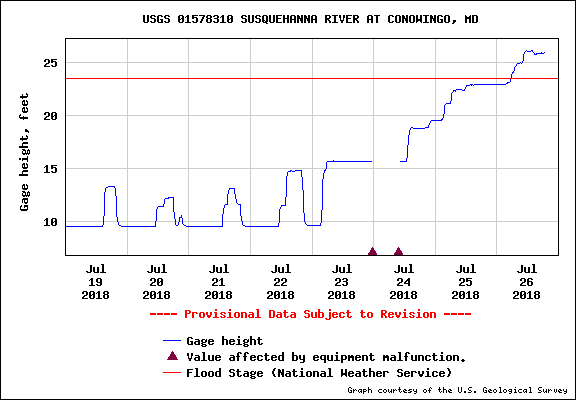
As the result of recent rains (we had 4.75 inches a few days ago) , the Susquehanna River is flooding, and the Conowingo Dam has opened as many as 20 floodgates to deal with the flow, threating Port Deposit, a small Maryland town immediately downstream: Conowingo Dam officials open 20 gates

Officials with the town of Port Deposit said Conowingo Dam opened 20 gates Thursday.

Bainbridge Elementary has been opened for flood evacuees, Cecil County officials said.

Peak river flow should crest at 2 a.m and no more than 25 gates are expected to open, Conowingo officials said.

Officials ask anyone who needs to move their vehicle to park along Center Street on Route 276. They remind residents not to leave any valuables in their vehicle and to lock the doors.

Due to high river flows along the Susquehanna River and flooding in the town of Port Deposit, Delmarva Power may be required to shut off electric service to some homes and businesses to maintain a safe environment for customers and the local community.

Electric service will not be restored until Delmarva Power can assure the safety of the electric service and all required safety inspections are completed.

Artesian Water is urging Port Deposit customers to limit water use during the flood emergency.

If 26 gates open, there would be a voluntary evacuation, officials said. The emergency evacuation center will open at that time, officials said. Anyone without transportation is asked to report to Town Hall for a shuttle to the evacuation center or call Town Hall at 410-378-2121. Staff members are available at Town Hall to provide updated information.
Needless to say, the floodwaters are not exactly clean, and now that the pool behind the dam is essentially full of sediment, the Bay will receive a full shot of Pennsylvania (and New York) mud. It will probably take a few more days for the trash washed over the dam, and the mud to reach our area.

And more rain is in the pipeline.

Tuesday, March 27, 2018

EPA's Plan for Conowingo Dam

The Chesapeake Bay Program has published its "plan" for what to do about Conowingo Dam, the fact that it is full of sediment, and not retaining any more pollution laden sediment. After detailing the history of the problem, a useful effort, but one we've heard before, they finally get around to what they intend to do about it. Study it:
Recently, the Chesapeake Bay Program decided that the best way to address the increased pollution from the Conowingo Dam would be to create a separate Watershed Implementation Plan (WIP) for the dam. WIPs detail the steps that each watershed jurisdiction (Delaware, the District of Columbia, Maryland, New York, Pennsylvania, Virginia and West Virginia) will take to meet their pollution-reduction targets.

A separate steering committee will be tasked with writing this new WIP for the Conowingo Dam and developing a financing strategy. The committee will have representatives from each jurisdiction and the assistance of a third party. The Environmental Protection Agency will provide oversight in the development and implementation of the Conowingo WIP, evaluate and track the progress being made to reduce the additional pollution from the dam and provide technical and contractual support.

This approach will give all the jurisdictions in the Chesapeake Bay watershed the chance to participate in this massive undertaking and contribute in putting conservation practices in place to help offset the nutrient and sediment pollution loads from the Conowingo Dam.
Of course, this is no plan at all, except a plan to get a group of like minded people together and decide what's best for the jurisdictions. Of course, the answer will be onerous actions on the current owner of the dam, Exelon, which made the mistake of buying an asset which has saved the Bay for 80 years or so.