Showing posts with label apples. Show all posts

Sunday, October 17, 2021

When Life Gives You Apples . . .

Make apple crisp, apple pie, baked apples etc, etc, etc.

Many years ago, a few years after we had this house built, we started a small orchard in the front yard, planting a pie cherry (Montmorency, I think), and a Granny Smith apple tree. The pie cherry suffered from rot from the start, as well as birds, but we managed one decent crop of cherries, IIRC, before it gave up the battle. The apple tree muddled along forever in the partial shade from a large holly tree, flowering nicely in spring, setting a large crop of apples, dropping most of them before they matured, and the squirrels claiming almost all the rest. Over the years, we must have collected a total of about 5 edible apples. Every year I pruned it, swearing that if it didn't produced this year, I'd cut it down (like we did with one in the back yard). Of course, we never pre-treated it for any diseases.

This year, I just let the pruning go, and maybe as a result, we had what appeared to be a bumper crop which attained ripeness.  Yesterday, in advance of a storm, I went out and harvested the remaining apples on the tree, using a rake to pick the apples, and trying to catch them as they fell. I was usually successful, but next year, if we have a good crop, I should get an apple picker. Corwin and Gabi assisted by throwing the badly rotten apples (of which there were quite a few) into the woods. Apples that looked like we could salvage at least half were kept for immediate use. After those were peeled cored and set aside for baking (yielding a gallon of cut apple pieces), this was what was left for storage.
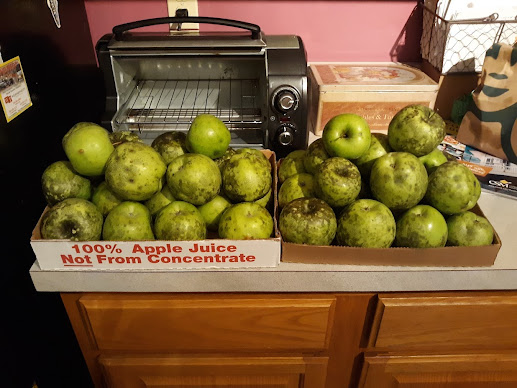
I know, they look pretty nasty, covered with mildew, and some even more resistant apple-cedar rust, but with a little scrubbing, that comes off, leaving just a few spots. As Joni said sang, give me spots on my apples, but leave me the birds and the bees, please. Georgia took some of the cut apples went to make an apple crisp:
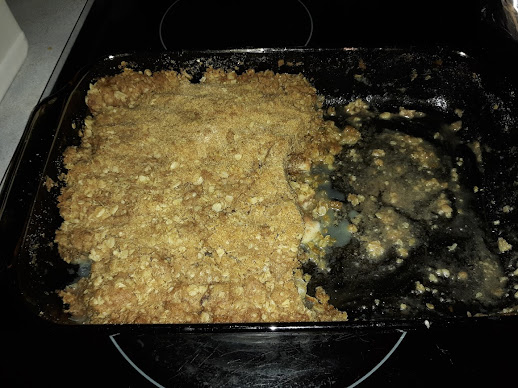
It's delicious. 

Thursday, November 21, 2019

What, No More Red Apples?

A little help from Pirate's Cove this morning: ‘Climate Change’ Could Kill Off Red Apples Or Something
It’s always some prognostication of doom from the Cult of Climastrology. They never seem to offer any sort of positive message like Pat Michaels, former president of the American Association of State Climatologists, says, “It’s warmed up around one degree Celsius since 1900, and life expectancy DOUBLED … yet [if] that temperature ticks up another half a degree … the entire system crashes? That’s the most absurd belief.”

They also like to duck having discussions and debates. But, anyhow, on to Maybe Future Doom

The archetypal apple is – no two ways about it – red. There may be yellow apples or green apples in the grocery store too. In some places, you might even find varieties that are striped or mottled with a profusion of hues, like the gorgeous Cox’s Orange Pippin.
But red – or occasionally, pure, sharp Granny Smith green – is the colour of apples in most alphabet books. It’s an interesting detail, because apples were not always so resolutely monochrome. (snip)
Intriguingly, colour also depends on temperature. To get an apple that’s fully red, temperatures must stay cool, Chagne says, because if they climb to above about 40C (104F), MYB10 and anthocyanin levels crash. In the Pyrenees region of Spain, he and his colleagues found normally vividly red striped apples were completely pale after a particularly hot July. As temperatures warm, he suggests, it could become more difficult for apples to turn red. (snip)
 Some apples are both red and green
Perhaps the threat that climate change poses to the red apple will be counterbalanced by our sheer determination to breed them, even if it takes expensive breeding programmes. Even before we understood the genetics, colourful apples exerted a strong pull on humans. John Bunker, an apple collector based in Palermo, Maine, has rescued numerous forgotten breeds from extinction. These include apples that used to be grown a century or more ago before orcharding became so Delicious-focused, including the magnificent Black Oxford, an apple whose red is so dark you might mistake it for an enormous plum before seeing its brilliant white flesh. “The colours are phenomenal. And I think that for some people including myself that was the original attraction,” he says.
 Nothing wrong with a green apple, either
In fact, the majority of the article has zero to do with red apples, or any color of apples. It’s really about the history of apples and their colors, what growers might do that has nothing to do with climate, just attracting consumers. The word “climate” appears twice: once in the headline and the other in bold above. But, this is climate cultism, having to interject this into every story.

Apples will be fine. Climate cultists? They need an intervention.
This is an observation I make everyday; journalists try to force climate change into every story the same way I try to find excuses for Rule 5.

Due to a bout of the flu, the Wombat was a little late with Rule 5 Wednesday: Busy In The Kitchen.